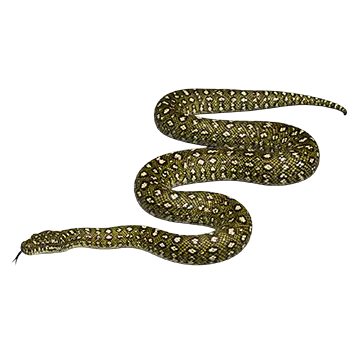

A Diamond Python is generally considered adult from around three to four years in males and four to five years in females, though the animal continues to gain length and mass at a slowing rate well beyond that point. Most captive adults settle between six and eight feet in total length, with exceptional females occasionally approaching or slightly exceeding nine feet. Mass at maturity typically falls between two and four kilograms, with large, well-conditioned females reaching five to six kilograms. These are substantial snakes, but they are considerably more slender and more muscular than a boa or a ball python of comparable length, reflecting a body plan built for climbing rather than for bulk.
Sexual dimorphism is pronounced and becomes obvious in adulthood. Females are longer, heavier, and noticeably thicker through the body, while males remain more slender with proportionally longer tails and more prominent cloacal spurs, the vestigial pelvic limbs visible as small curved claws either side of the vent. Males typically top out around six feet where a female of the same clutch may reach eight. Neither sex is inherently more suitable as a captive, though large females require correspondingly larger enclosures and heavier furniture.
By full maturity the adult pattern is finally complete. The ground colour has darkened to a deep glossy black or blue-black, the pale juvenile blotching has resolved into the distinctive cream to bright yellow rosettes and diamond clusters across the dorsum, and individual yellow scales are scattered through the black in a speckled arrangement. Ventral scales are typically cream to yellow, sometimes with dark marbling. The head is broad and clearly distinct from the neck, with deep labial heat pits along the upper and lower jaws that allow the snake to detect endothermic prey in complete darkness.
Growth does not truly stop, but it becomes slow enough to be imperceptible from year to year. This means that weight in an adult Diamond Python is a stable and therefore highly informative parameter. Once an animal reaches maturity, establish its healthy baseline mass and monitor deviations from it. A mature Diamond Python that gains fifteen percent over a year is being overfed; one that loses ten percent outside a cooling cycle or a breeding season has a problem that needs investigating. In an animal that may live thirty years, this single number, tracked patiently, is the most useful diagnostic tool a keeper has.