
Emergence and the First 48 Hours

Diamond Pythons are oviparous, and a hatchling's first task is cutting its way out of a leathery, parchment-shelled egg using the egg tooth, a temporary keratinous projection on the tip of the snout. This process, called pipping, produces a single slit through which the neonate will often sit motionless for twelve to thirty-six hours with only its snout exposed. That apparent inactivity is not distress. The hatchling is completing absorption of the residual yolk sac through the umbilical scar, and forcing it out of the egg during this window can rupture the yolk stalk, cause an umbilical hernia, or introduce infection into an unsealed body wall.

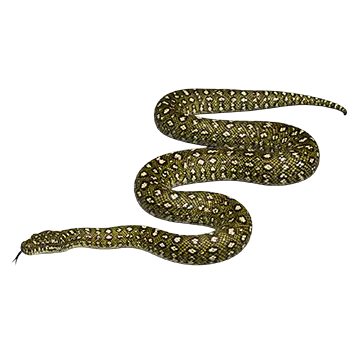
A typical Diamond Python clutch contains ten to twenty-five eggs, and the whole clutch generally pips within a twenty-four to forty-eight hour window once the first egg is cut. Neonates measure roughly twelve to eighteen inches from snout to vent tip and weigh between fifteen and twenty-five grams. They emerge patterned quite differently from the animal they will become: most are olive, chocolate, or reddish brown with irregular pale cream blotching and dark banding, showing none of the black ground colour and cream diamond clusters that give the subspecies its name. That transformation belongs to the years ahead, not the first weeks.

Once a hatchling has fully abandoned its shell and is moving with purpose, it can be lifted into an individual container. Housing neonates separately is standard practice for this subspecies. Communal tubs invite competition at feeding time, make it impossible to attribute a refused meal or an abnormal stool to a specific animal, and create a real risk of accidental cannibalistic strikes when two hatchlings seize the same prey item. Each container should hold a small water dish, a snug hide, and at minimum one low horizontal branch or cork piece, because the arboreal instinct in this python is present from day one.

Sanitation during this period matters more than at almost any other point in the animal's life. Remove shell fragments, spilled albumen, and any eggs that fail to pip within seventy-two hours of their clutchmates, since decomposing contents cultivate bacteria and fungi in a warm, humid box shared with immunologically naive animals. Keep the emergence area near 86 to 88 degrees Fahrenheit with humidity around 75 to 85 percent, then begin easing conditions toward the cooler, drier gradient a growing Diamond Python needs over the following week.

The First Shed and Establishing Feeding

No Diamond Python hatchling should be offered food before it completes its post-natal shed, which occurs seven to fourteen days after emergence. Until that shed is finished the neonate is still metabolising internalised yolk, and the digestive tract has not switched over to processing exogenous protein. Offering prey earlier wastes the item, teaches the hatchling to associate the keeper's approach with an unrewarding disturbance, and adds stress at a moment when the animal has no energy reserves to spare. Watch for the dulling of the ground colour and the blue-grey opacity of the spectacles, then wait a further three to five days after the eyes clear before the first meal.

The appropriate first prey item is a single day-old pink mouse, offered thawed from frozen and warmed to slightly above room temperature. Diamond Pythons are ambush foragers with heat-sensing labial pits, so a prey item that reads as thermally alive is far more likely to trigger a strike than one presented cold. Use long feeding tongs, hold the pinky at or slightly above head height to exploit the neonate's upward-oriented arboreal hunting posture, and give it small twitching movements rather than sweeping motion. Many hatchlings strike, coil, and constrict a pre-killed item exactly as they would live prey, which is normal and desirable behaviour.

A proportion of Diamond Python neonates are stubborn starters. In the wild, small individuals of this subspecies take a substantial number of skinks and other lizards before graduating to endothermic prey, and that dietary preference can persist in captivity. Where a hatchling refuses three consecutive rodent offerings spaced a week apart, scenting is the standard remedy: rub the pinky briefly against a shed lizard skin or a frozen and thawed day-old chick, or braining the prey item by nicking the skull to release scent. Offering in a small dark deli container overnight, undisturbed, resolves a further share of refusals.

Feed once every seven days through the first six months, with one correctly sized item per feeding. The prey should leave only a modest bulge that disappears within forty-eight to seventy-two hours. Resist any temptation to accelerate growth with larger or more frequent meals, because Diamond Pythons are naturally slow-growing and long-lived, and power feeding this subspecies produces regurgitation, hepatic lipidosis, and a shortened life. Provide a heavy, tip-resistant water bowl at all times, changed daily, and expect the hatchling to soak in it occasionally, particularly in the days before a shed.

Growth Rates and Early Development

Growth in a hatchling Diamond Python is deliberate rather than explosive, and keepers arriving from experience with ball pythons or boas frequently misread normal progress as a failure to thrive. A neonate that hatches at sixteen inches and twenty grams should reach roughly twenty-four to thirty inches and eighty to one hundred and twenty grams by twelve months on a sensible feeding schedule. This unhurried trajectory is a function of the subspecies' temperate-zone metabolism, which evolved under a cool, strongly seasonal climate in coastal New South Wales rather than under tropical conditions.

Weigh each hatchling weekly on a digital kitchen scale accurate to one gram and log the results. Weight is the single most informative early indicator of health in a neonate python, and a written record turns a vague impression into an actionable trend. Expect a modest dip in the days immediately after a shed and after defecation, and expect steady gains between meals. What should never appear is a plateau lasting more than three weeks or any net loss across a month, either of which warrants a review of temperatures, feeding response, and hydration before it becomes a clinical problem.

Shedding is frequent at this stage, occurring roughly every four to six weeks while growth is fastest. A complete shed that comes off in a single inverted tube, spectacles included, confirms that humidity, hydration, and nutrition are all adequate. Retained eye caps or fragmented shed on the tail tip are the earliest warning that the enclosure has drifted too dry. Never peel retained shed from a hatchling by hand; instead raise humidity, provide a damp sphagnum moss hide, and allow the animal to work it free against its branches and hide entrance.

Behavioural development is just as measurable as physical growth. Within the first month a hatchling Diamond Python should be climbing confidently, anchoring its prehensile tail on branch junctions, and selecting an elevated resting spot rather than remaining permanently on the substrate. Nocturnal activity increases from around week three as the animal establishes a hunting rhythm. By four to six months the neonate's movements have shifted from the jerky, poorly coordinated crawl of the first days to the controlled, deliberate bridging gait characteristic of a semi-arboreal python, and body condition should show a gently rounded triangular cross-section with no visible vertebral ridge.

Thermal Gradient and Neonatal Enclosure Design

The most consequential mistake a keeper can make with a Diamond Python begins in the hatchling enclosure: keeping the animal too warm. This is the southernmost python in the world, native to a temperate coastal climate with genuinely cold winters, and it is the subspecies associated with Diamond Python Syndrome, a progressive wasting and neurological condition strongly linked to chronic overheating and to the absence of seasonal thermal variation. Correct thermal habits established in the first year are preventive medicine, not preference. Target a basking surface of 86 to 90 degrees Fahrenheit, an ambient warm end near 80 degrees, a cool end of 72 to 75 degrees, and a night-time drop to 65 to 70 degrees.

That night drop is not optional and should never be engineered away with a thermostat set to hold a flat temperature around the clock. Wild Diamond Pythons experience substantial diel swings, and captive animals denied them show reduced appetite regulation, poor long-term muscle tone, and elevated risk of the neurological presentation described above. Deliver heat from above using a low-wattage ceramic heat emitter or a small radiant heat panel governed by a pulse-proportional or dimming thermostat with a separate high-limit backup, and verify the actual basking surface temperature with an infrared thermometer rather than trusting the controller's set point alone.

Hatchling enclosures should be small enough to feel secure but tall enough to climb. A tub or terrarium of roughly eighteen by twelve by twelve inches suits the first several months, with the vertical dimension used properly: two or three cork rounds, manzanita limbs, or PVC branches arranged as a climbing lattice from substrate to the upper third of the box. Provide a minimum of two hides, one on the warm side and one on the cool side, plus an elevated hide or a cork tube fixed high in the enclosure, since a Diamond Python that cannot retreat upward is a Diamond Python under low-grade chronic stress. Every lid must lock; neonates are strong, persistent, and remarkably good at exploiting a gap.

Humidity for this subspecies sits lower than most keepers expect, between 45 and 60 percent, rising only during shed cycles. Diamond Pythons come from dry sclerophyll forest and woodland, not rainforest, and sustained high humidity combined with poor ventilation produces blister disease and respiratory infection with unpleasant speed. Paper towel or unprinted kraft paper is the ideal neonatal substrate because it makes urates, stool, and mite dirt immediately visible and eliminates ingestion risk during feeding. Spot clean after every defecation, strip and disinfect the enclosure monthly with a reptile-safe disinfectant, and ensure cross-ventilation so that air is exchanged rather than left to stagnate.

Handling the Hatchling Diamond Python

Hatchling Diamond Pythons are, almost without exception, defensive. They hiss, strike repeatedly, wrap tightly around fingers, and readily discharge musk from the cloacal glands. None of this indicates a bad-tempered animal or a husbandry failure. A twenty-gram arboreal snake in a landscape full of birds, goannas, and kookaburras survives by treating every large approaching object as a predator, and that response is hardwired. The adult Diamond Python is one of the more placid pythons commonly kept, and nearly all hatchlings grow into that temperament given consistent, unhurried handling.

Leave a new hatchling completely alone for its first two weeks, and thereafter observe the feeding rule strictly: no handling for forty-eight hours before an offered meal and seventy-two hours after one has been taken. Handling a recently fed neonate is the most common cause of regurgitation, and a regurgitation at this size sets an animal back weeks and can permanently disrupt gut flora. Once the hatchling has taken three or four consecutive meals reliably, begin sessions of three to five minutes, two or three times per week.

Technique matters more than duration. Approach from the side rather than from directly above, which mimics an aerial predator, and lift the snake with a small hook or by scooping under the mid-body rather than reaching for the head. Support the animal across both hands and let it move through them, since a climbing species feels secure when it has something to grip and panics when it feels suspended. Never restrain the head, never grip tightly in response to a strike, and never drop or jerk away when bitten, because a hatchling Diamond Python bite is startling but medically trivial, amounting to a few pinprick abrasions.

End each session while the snake is still calm rather than waiting for it to become agitated, because the last thirty seconds of an interaction are what the animal generalises from. Wash hands with unscented soap before and after handling, both to remove prey scent that could trigger a feeding response and to observe basic hygiene around a reptile capable of shedding Salmonella. Keepers who handle briefly, frequently, and predictably through the first six months almost always end up with a three-year-old Diamond Python that tolerates handling calmly, whereas those who handle rarely and then for long stretches tend to preserve the defensive reflexes indefinitely.

Early Health Screening and Veterinary Care

Every Diamond Python hatchling should be examined by a veterinarian experienced with reptiles within the first four to six weeks in your care, and this is non-negotiable for any animal acquired from an outside source rather than produced in your own collection. The initial examination should cover body condition scoring, hydration assessment, oral cavity inspection for early stomatitis, palpation for retained yolk or umbilical abnormalities, and a direct and flotation faecal examination for cryptosporidia, coccidia, nematodes, and pentastomids. Establishing this relationship before an emergency arises is far easier than trying to find qualified reptile care at short notice.

Quarantine every incoming hatchling for a minimum of ninety days in a separate room from any established collection, served last during daily rounds and with dedicated tools and water bowls. Snake mites, Ophionyssus natricis, are the most frequent parasite introduced with new stock and appear as tiny dark specks in the water bowl, white dust-like debris on the skin, and excessive soaking. Left untreated in an animal this small they cause anaemia and act as vectors for more serious pathogens. Inspect around the eyes, under the chin, and in the heat pits, where mites congregate.

Respiratory infection is the second common presentation in young Diamond Pythons and almost always traces to an environmental cause: excessive humidity, poor ventilation, a cool end that is genuinely too cold rather than pleasantly cool, or the absence of a proper basking option. Open-mouth breathing, audible clicking, bubbling from the nostrils, and a hatchling that rests with its head elevated at an unusual angle all warrant same-week veterinary attention. Correct the husbandry immediately and in parallel with treatment, because antibiotics alone will not resolve an infection sustained by a defective environment.

Be alert from the outset for the earliest indicators of Diamond Python Syndrome, even though the full condition typically presents in older animals. Head tremors, star-gazing, difficulty righting itself, progressive weight loss despite normal feeding, and repeated unexplained regurgitation all justify an urgent husbandry audit alongside veterinary work-up. In young animals caught early, the condition frequently improves substantially once temperatures are lowered, a night drop is introduced, and a seasonal cycle is implemented. Keep a written log of weights, feedings, sheds, defecations, and enclosure temperatures from the first week, because the trend data in that log is often what allows a veterinarian to distinguish a manageable husbandry problem from an emerging clinical disease.

Always consult a qualified professional before making any health-related decisions. This content is provided for informational reference only and should not replace professional guidance specific to your animal.