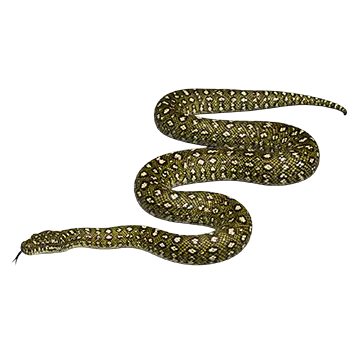

The juvenile phase in a Diamond Python spans roughly six months to three years of age, bridging the fragile hatchling and the sexually mature adult. It is the longest and least dramatic stage in the animal's development, and precisely because it lacks the urgency of hatchling care or the visible milestones of breeding, it is the stage most often mismanaged. Nearly every chronic problem seen in adult Diamond Pythons, from obesity to Diamond Python Syndrome to intractable defensiveness, traces back to decisions made or neglected during these years.
Size progression is unhurried by python standards. A well-managed juvenile typically measures two to two and a half feet at twelve months, three to four feet at two years, and four to five feet approaching three years, with females generally outpacing males from the second year onward. Mass climbs from roughly one hundred grams at a year to somewhere between eight hundred grams and one and a half kilograms by the end of the third year. These ranges are broad because the subspecies is genuinely variable and because individual feeding response differs, but a juvenile substantially ahead of these figures is almost certainly being overfed rather than growing exceptionally well.
Metabolically, the juvenile Diamond Python is still governed by its temperate-zone ancestry. Appetite is not constant across the year; it climbs through spring, peaks in late spring and early summer, and tapers markedly as autumn approaches, even in an animal held at stable indoor temperatures. Keepers unfamiliar with the subspecies frequently panic at an autumn appetite decline in a two-year-old and respond by raising temperatures, which is exactly the wrong intervention. Recognising this rhythm as normal, and working with it rather than against it, is the central skill of juvenile Diamond Python husbandry.
This is also the stage at which an individual animal's personality becomes legible. Some juveniles settle into placid tolerance by eighteen months. Others remain flighty and quick to strike well into their third year and only relax as they approach adult size. Both trajectories are within the normal range for the subspecies, and the difference is more often genetic and individual than a reflection of handling technique, provided handling has been consistent and appropriate.