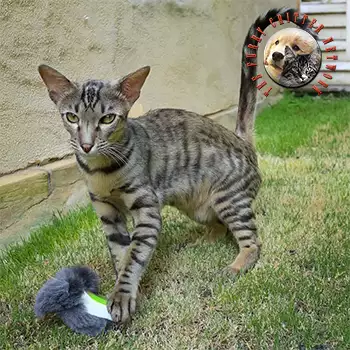

The juvenile period for an Oriental Longhair spans roughly from three months to around twelve months of age, though this breed often continues filling out in muscle tone and coat density well into its second year. During this stage, the kitten's signature elongated body becomes increasingly apparent. The legs lengthen, the wedge-shaped head becomes more defined, and the large ears that characterize the breed grow to their full, striking proportions, sometimes appearing almost comically oversized relative to the face before the rest of the body catches up.
Weight gain should be steady and consistent throughout this period. A healthy Oriental Longhair juvenile will typically gain around a quarter to half a pound per month, though individual variation is normal. Males tend to be somewhat larger than females, reaching an adult weight of roughly eight to twelve pounds, while females usually settle between six and ten pounds. Regular weigh-ins help you track growth and catch any plateaus or sudden changes that might indicate a health concern.
The semi-long coat begins to develop its adult texture during this stage. Kittens may go through an awkward phase where the coat appears uneven or patchy as the longer guard hairs come in at different rates. This is temporary and does not indicate a health problem. By the time the cat approaches its first birthday, the coat should be developing the fine, silky quality that distinguishes the breed, lying close to the body with a graceful plume forming on the tail.
Bone development is largely complete by around ten to twelve months, but muscle tone and overall physical maturity continue to develop. Oriental Longhairs are naturally lean and athletic, so do not expect or encourage a stocky build. A healthy adolescent should have visible muscle definition along the shoulders and hindquarters without prominent ribs or hip bones. If you can feel the ribs easily with light pressure but cannot see them, the body condition is generally appropriate.