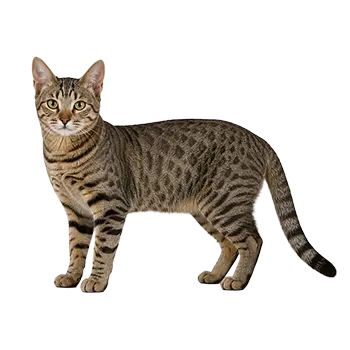

A Long Adolescence

Most domestic cats are structurally finished somewhere around twelve to eighteen months. The Dragon Li is not. This breed is widely described as slow maturing, with muscle mass, chest depth, head width, and coat texture continuing to develop until roughly three years of age. An eighteen-month-old Dragon Li that looks lanky, narrow through the shoulders, and slightly out of proportion is usually not underfed or unwell. It is simply not finished.

This has practical consequences. Owners who judge the cat against a two-year-old British Shorthair often conclude something is wrong and start adding calories, which produces a fat adolescent rather than an earlier adult. Show breeders face the mirror problem, since a Dragon Li presented at a year old may be dismissed as insubstantial when it is merely young. The correct response in both cases is patience and body condition scoring by hand rather than by eye.

Behaviorally, the long runway means the boisterous teenage phase lasts longer here than in many breeds. The window from about six to eighteen months brings peak activity, peak testing of boundaries, and peak destructiveness in an under-stimulated household. It also brings the greatest capacity to learn. A Dragon Li that gets structured outlets during adolescence typically settles into a composed, self-possessed adult; one that does not tends to keep the adolescent habits permanently.

Sexual maturity, importantly, arrives far ahead of physical maturity. A Dragon Li female can cycle and conceive at five to six months, while she is still visibly a kitten and years away from finished growth. Never treat physical immaturity as contraception.

Growth Tracking and Body Condition

From twelve weeks to about six months, a Dragon Li typically gains in the neighborhood of half a pound per month, hitting roughly six to eight pounds at six months. Growth then slows markedly, and the remaining two to four pounds of adult weight accumulate slowly over the next eighteen to thirty months, largely as muscle and bone rather than length. Weigh the cat monthly on the same scale and plot it; a curve is far more informative than any single number.

Assess body condition by touch rather than appearance, because the Dragon Li's dense, close-lying coat and mackerel pattern visually flatten the silhouette. Ribs should be palpable under a thin layer of covering with light pressure, as the knuckles of a loose fist feel. There should be a visible waist from above and a slight abdominal tuck from the side. A modest primordial pouch of loose skin along the belly is normal in this breed and is not fat.

Growth plates in the long bones close between roughly ten and eighteen months, and this is the window in which high-impact activity should be moderated slightly. That does not mean confining the cat, which would be both impossible and counterproductive, but it does mean avoiding forced repetitive jumping to great height and providing intermediate landing platforms on tall cat trees rather than a single long drop.

Watch for the classic adolescent plateau at around eight to ten months, when many owners panic because the scale stops moving. In a slow-maturing breed this is expected. As long as the cat is bright, muscled, eating well, and holding condition, the plateau is a pause rather than a stall. Genuine loss of weight or condition at any age warrants a veterinary workup.

Feeding the Growing Dragon Li

A growth-formulated diet, meaning food labeled for growth or for all life stages under AAFCO or the equivalent European FEDIAF profile, should continue until the cat is around twelve months old at minimum. Given this breed's extended development, many breeders keep Dragon Li kittens on kitten food until fifteen to eighteen months, particularly for males, who put on the most late-arriving muscle. The higher protein and higher energy density support that build without simply padding fat.

Feeding frequency matters at this age. Three to four meals a day through six months, dropping to two or three thereafter, suits a small stomach with a large energy demand. Free-feeding dry food is convenient and is the single most common route to an overweight adolescent, because a Dragon Li is an opportunistic eater with a landrace hunter's instinct to consume whatever is available. Portion measured meals instead.

Moisture deserves specific attention. Cats descend from desert-adapted ancestors and have a weak thirst drive, meaning a dry-only diet leaves most cats chronically at the low end of hydration. Including wet food in at least part of the daily ration supports urinary tract health and is easier to establish as a habit now than at five years old, when a Dragon Li's considerable stubbornness will be fully developed.

Use some of the daily ration as a training and enrichment currency rather than putting it all in a bowl. Puzzle feeders, food-dispensing balls, and scattered portions hidden around a room engage the hunting sequence and slow consumption. This is not a gimmick for this breed; the Dragon Li's working ancestry as a rodent-controlling farm and village cat means a food source that requires effort is closer to normal than a full dish is.

Energy, Play, and the Hunting Drive

The Dragon Li retains an unusually intact predatory sequence. Selected for centuries as a functional mouser rather than as a lap ornament, this cat needs to stalk, chase, pounce, catch, and kill something several times a day. Adolescence is when that drive peaks. An owner who does not choose the target will find that the cat chooses it, and the cat's choices are typically ankles, houseplants, and anything on a high shelf.

Structure at least two dedicated play sessions of ten to fifteen minutes daily, ideally at dawn and dusk when this breed's crepuscular activity naturally peaks. Use wand toys that let you make prey move like prey: away from the cat, into cover, with pauses. Let the sequence finish. A hunt that never ends in a capture leaves the cat frustrated, so allow a real catch at the end and follow it with a small food reward, which mimics the natural hunt-eat-groom-sleep cycle and is the most reliable way to get a Dragon Li to settle.

Vertical territory is not optional for this breed. Dragon Li cats are athletic climbers with strong hind-leg drive and a documented fondness for surveying from height. Tall cat trees, wall shelves, and window perches give the cat somewhere to put that energy and also serve as the retreat this reserved breed wants when visitors arrive. A home with generous vertical routing has measurably fewer adolescent behavior complaints.

Hands are never toys. Play aggression is the single most common adolescent complaint in energetic breeds, and it is almost always created by well-meaning humans wrestling with an eight-week-old kitten. If a Dragon Li grabs a hand, stop moving, disengage without drama, and end the session for sixty seconds. Redirect onto a wand or a kickeroo toy. Physical punishment does not work on this breed and reliably converts a playful cat into a defensive one.

Training, Litter Habits, and House Manners

Dragon Li cats are intelligent and highly trainable by feline standards, and they are frequently described in Chinese sources as being unusually responsive to their people, with anecdotal reports of retrieving and of learning to come reliably when called. Adolescence is the ideal training window. Clicker or marker training with a food reward works well; a Dragon Li will work happily for a target it understands and will disengage entirely from one it finds pointless.

Start with practical behaviors: coming to a specific sound, entering a carrier voluntarily, standing on a scale, and tolerating nail trims and toothbrushing. Carrier training in particular pays for itself many times over across a fifteen-year lifespan. Break each behavior into small steps, keep sessions to three or four minutes, and finish while the cat is still interested rather than when it walks away.

Litter box habits are usually established easily in this breed, but the standard rules still apply and are worth enforcing now. Provide one box per cat plus one, sited in quiet, low-traffic locations with two exit routes; use an unscented clumping litter at a depth of about two inches; scoop daily. A Dragon Li's reserve means it dislikes eliminating where it feels cornered, and a covered box in a closet is a common trigger for a cat that starts going elsewhere. House soiling always warrants a veterinary examination first, since urinary disease presents identically to a behavior problem.

Scratching is a normal marking and stretching behavior, not misbehavior. Offer both vertical sisal posts tall enough for a full stretch, which for a large adolescent Dragon Li means at least thirty inches, and horizontal cardboard scratchers. Place them next to the furniture the cat has already chosen rather than in the corner you would prefer, then move them gradually. Declawing is an amputation and is banned or condemned in most of the veterinary world; regular nail trimming and nail caps address the same concern without it.

Adolescent Health, Vaccination, and Neutering

The core vaccination series finishes with a booster at sixteen weeks or later, followed by a further booster at around one year, after which most cats move to a three-year interval for panleukopenia, herpesvirus, and calicivirus. Rabies is scheduled according to local law. Feline leukemia vaccination is recommended for all kittens and is continued in adulthood for any cat with outdoor access, which is worth considering carefully in a breed with this much hunting motivation.

Neutering timing is a live discussion, and the current mainstream veterinary position, endorsed by a broad North American consensus and by many European bodies, favors sterilization by around five months of age to precede the first estrus and to prevent unwanted litters. Some breeders of slow-maturing breeds argue for waiting until nine to twelve months so that gonadal hormones can contribute to the final build. Both positions are defensible; discuss the tradeoff with your veterinarian in light of your household, and understand that a female left intact past five months may well cycle, and that an intact male will spray.

Adolescence is also when the first parasites, upper respiratory infections, and dietary indiscretions tend to show up. Establish a year-round flea, tick, and heartworm preventive appropriate to your region, and keep a fecal check on the annual schedule. Ringworm spreads readily among young cats in multi-cat homes and presents as circular scaly patches rather than as visible worms.

The teething period from roughly three to six months, during which thirty deciduous teeth are replaced by thirty permanent ones, drives an increase in chewing on everything available. Provide safe chew targets, and check the mouth periodically for retained deciduous canines, which sit alongside the erupting adult tooth and cause crowding and tartar if not extracted. Start toothbrushing now; a cat trained to it in adolescence usually accepts it for life, and dental disease is the most common chronic problem this breed will face.

The Teenage Personality

Somewhere between six and twelve months, many Dragon Li owners report that the sweet, biddable kitten has been replaced by something with opinions. Increased independence, selective hearing, testing of previously accepted boundaries, and a sudden interest in doors and windows are all typical. This is a developmental phase rather than a personality change, and the cat that emerges at the far end usually resembles the kitten more than the adolescent did.

This breed's reserve with strangers tends to consolidate during this period. A Dragon Li that was an indiscriminate greeter at four months may begin retreating when the doorbell rings at nine months. Do not force social contact. Provide an escape route and a high perch, let visitors ignore the cat entirely, and allow the cat to make the approach. The Dragon Li's loyalty is real but is directed toward its own people; a distant politeness toward everyone else is the breed working as designed rather than a training failure.

Inter-cat tension often surfaces in adolescence in multi-cat homes, as a maturing Dragon Li begins to assert claims on resources it previously ignored. The remedy is almost always resource distribution rather than discipline: multiple feeding stations out of sight of one another, separated water sources, surplus litter boxes, and enough vertical real estate that two cats can occupy the same room without occupying the same plane. Reintroduce slowly with scent swapping and controlled sightlines if outright fighting has begun.

Night activity peaks in this window too. A crepuscular hunter with unspent energy will hold a rodeo at four in the morning. The solution is scheduling rather than scolding: a substantial interactive hunt in the late evening, followed immediately by the largest meal of the day, exploits the hunt-eat-groom-sleep sequence and moves the cat's deepest sleep into your night. Getting up to feed a yowling cat teaches it that yowling produces food, and a Dragon Li will learn that lesson in exactly one repetition.

Always consult a qualified professional before making any health-related decisions. This content is provided for informational reference only and should not replace professional guidance specific to your animal.