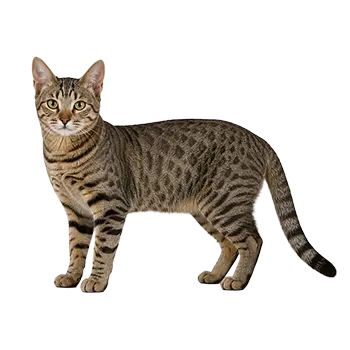

The Finished Dragon Li

By roughly three years of age the Dragon Li has completed a build that took twice as long as most cats need. The finished animal is a medium-to-large, rectangular, muscular cat, heavier in the hand than it looks, with a broad wedge-shaped head, well-developed cheeks in entire males, rounded muzzle, tall and slightly rounded-tip ears, and almond eyes in green to yellow-green. Adult weight generally falls between nine and twelve pounds, with the largest males occasionally exceeding that. The prime years run approximately from three to seven.

The coat is the breed's signature: short, dense, hard-textured, and lying close to the body, always in a brown mackerel tabby with agouti ticking on individual hairs. The ticked banding gives the pattern a distinctive broken, almost brindled quality that separates the Dragon Li from a Western mackerel tabby at a glance. Necklaces are usually broken, the tail carries dark rings and a dark tip, and the classic breed marking is the pair of dark lines running from the outer corners of the eyes.

Temperamentally, the adult is the calm settling of the adolescent's raw material. A well-raised Dragon Li in its prime is composed, watchful, and self-directed. It is not a demanding cat, and it does not tend toward the constant vocal narration of an Oriental breed. It bonds intensely with its household while remaining plainly indifferent to visitors. Owners routinely describe it as dog-like in loyalty, which is fair, and as easy, which is fair only if its exercise needs are honored.

This is also the stage at which owners are most likely to become complacent. A healthy adult cat that eats, sleeps, and causes no trouble generates no prompts to act, and the diseases that shorten feline lives are largely silent in the years when they begin. The prime years are the years to build monitoring habits, not the years to relax them.

Maintenance Nutrition and Weight Control

An adult Dragon Li transitions to a maintenance diet formulated for adult cats once growth is complete, which in this breed means later than the twelve-month default. Caloric needs vary widely, but a neutered indoor adult of ten pounds typically requires somewhere in the region of 180 to 250 kilocalories a day, and an active cat with outdoor access may need considerably more. Feed to body condition rather than to a chart, and reassess the portion every time the condition score moves.

Obesity is the most consequential preventable disease in domestic cats and is the biggest threat to a Dragon Li's prime years. Even modest excess weight materially raises the risk of type 2 diabetes mellitus, hepatic lipidosis, osteoarthritis, and lower urinary tract disease, and it shortens life expectancy. This breed's dense build and thick coat conceal weight gain well, so palpate the ribs monthly and weigh the cat quarterly. A one-pound gain on a ten-pound cat is a ten percent gain; the human equivalent is fifteen pounds.

Protein remains central. Cats are obligate carnivores with an inflexible requirement for taurine, arachidonic acid, preformed vitamin A, and a high dietary protein intake to support continuous gluconeogenesis. A high-protein, moderate-fat, low-carbohydrate diet suits the species and suits this breed's lean, working build particularly well. Vegetarian and vegan diets are not appropriate for cats without specialist formulation and supervision, and even then are best avoided.

Hydration remains the quiet long-term investment. Wet food as a meaningful part of the ration, multiple water stations sited away from food bowls, wide shallow dishes that do not press on the whiskers, and a circulating fountain for cats who prefer moving water all raise total intake. Chronic kidney disease is the leading cause of death in older cats, and the habits that support renal and urinary health are set down now, a decade before the disease becomes visible.

Exercise and Environmental Enrichment

A Dragon Li in its prime is an athlete with nowhere to work. The breed spent centuries as a functional village and farm mouser, and no amount of pedigree registration has removed that from the animal. In a modern apartment the drive still fires on schedule at dawn and dusk. Twenty to thirty minutes of genuine interactive play a day, in two or three sessions, is the baseline, and the operative word is interactive: a basket of toys the cat can access at will is furniture, not exercise.

Rotate the prey type. Wand toys with feather, fur, or fabric lures satisfy the aerial and ground hunt respectively; a laser pointer satisfies chase but should always be finished by landing the dot on a physical toy or a treat, since an unresolvable hunt is a source of real frustration. Kicker toys let the cat use the rabbit-kick disembowelling motion that a wand cannot provide. Puzzle feeders, treat balls, and scattered kibble hunts turn eating into working.

The home should be built upward. Cat trees with multiple tiers, wall-mounted shelving in a climbable route, cleared window sills, and a perch overlooking a bird feeder are all high-value real estate for a breed that likes to observe from altitude. Vertical space also resolves conflict in multi-cat homes and gives this reserved cat somewhere to be present but unavailable when the house fills with strangers.

Mental work matters as much as physical work in a breed this intelligent. Continue trick training into adulthood; teach a recall, a target touch, a carrier entry, a mat station. Consider harness and leash work, which many Dragon Li cats take to well if introduced patiently, as a safer alternative to free outdoor roaming. A cat that is asked to think for a few minutes a day is a cat that is not devising its own projects.

Coat, Nail, and Dental Care

The Dragon Li's grooming needs are among the lightest of any breed. The short, hard, close-lying double coat resists matting almost entirely and sheds moderately, with a heavier seasonal shed in spring and autumn. A weekly pass with a rubber curry brush or a fine-toothed comb removes dead undercoat, distributes skin oils, and, more usefully, gives you a weekly hands-on survey of the whole body. Bathing is rarely necessary and is generally unwelcome.

Use that weekly session as a physical examination. Run both hands over the ribs, spine, and abdomen; check for lumps, scabs, thinning, or areas the cat resents being touched. Look in the ears for dark waxy debris, which suggests mites or infection. Check the eyes for discharge and the third eyelid for prominence. Part the coat at the base of the tail and along the spine, where flea dirt shows first as black specks that smear red on damp cotton.

Trim nails every two to three weeks. Take only the sharp translucent tip, staying well clear of the pink quick, and do one or two paws per session if that is all the cat will tolerate. A Dragon Li handled as a kitten usually accepts this calmly. Continue to provide tall sisal posts for the stretching and marking function that trimming does not replace.

Dental disease is the most common chronic condition this breed will meet, and periodontal disease, tooth resorption, and gingivitis are all substantially preventable. Daily brushing with a feline enzymatic toothpaste is the gold standard; never use human toothpaste, which contains fluoride and often xylitol. Veterinary dental cleaning under general anesthesia, with full-mouth radiographs, is periodically necessary regardless of home care, since tooth resorption originates below the gumline and is invisible on examination. Anesthesia-free dental scaling is cosmetic and does not address subgingival disease.

Preventive Healthcare in the Prime Years

An annual veterinary examination is the minimum for an adult Dragon Li, and a twice-yearly visit is better once the cat passes seven. The examination itself carries most of the value: weight trend, body and muscle condition scoring, oral examination, abdominal palpation, thoracic auscultation, and a thyroid palpation take ten minutes and catch a great deal. Establishing baseline bloodwork and urinalysis while the cat is healthy makes later results interpretable, since a creatinine that is normal for the population may be abnormal for this individual.

Vaccination in adulthood typically means a three-year booster for the core panleukopenia, herpesvirus, and calicivirus vaccine, rabies on the schedule your jurisdiction requires, and feline leukemia for any cat with outdoor access or exposure to cats of unknown status. Discuss the risk profile honestly rather than defaulting to either extreme; an indoor-only Dragon Li in a single-cat home has a different requirement from one who patrols a smallholding.

Parasite prevention should run year-round in most climates. Fleas transmit tapeworm and cause flea allergy dermatitis; ticks transmit several pathogens; heartworm, though associated with dogs, causes a distinct and frequently fatal respiratory syndrome in cats for which there is no treatment, only prevention. A hunting cat also has a meaningful exposure to toxoplasma and to roundworm through prey, which is a public health consideration in households with immunocompromised people or a pregnant woman.

The Dragon Li's landrace breadth means it lacks the concentrated inherited disease burden of many closed-registry breeds, but hypertrophic cardiomyopathy is the most common feline heart disease across the species and is not excluded by a healthy pedigree. It is frequently silent until it presents as sudden congestive failure or as aortic thromboembolism. Ask your veterinarian about auscultation findings, and be aware that a murmur is neither sensitive nor specific; echocardiography is the only reliable screen.

Living With an Adult Dragon Li

The adult Dragon Li is a companion rather than a decoration. It follows its people between rooms, supervises tasks, and is often in the room without demanding to be in the lap. Many are notably tolerant of being handled by their own household and equally clear that the arrangement does not extend to guests. Owners should read the retreat to a high shelf when the door opens as a functioning coping strategy rather than as a problem to be corrected.

This breed generally does well with respectful children and with cat-savvy dogs, particularly when raised with them, and its athleticism gives it the escape options that make cohabitation workable. It is less reliably tolerant of small prey animals, and a household containing hamsters, birds, or fish should assume the Dragon Li's interest is predatory rather than social, and secure enclosures accordingly. That instinct is intact and is not trainable away.

Multi-cat households succeed on resource geometry. One litter box per cat plus one, distributed rather than clustered; separate feeding stations out of line of sight; multiple water sources; and enough perches, hides, and shelves that two cats can share a room on different levels. Most inter-cat aggression in adult homes is competition dressed as personality, and most of it resolves when the competition is removed.

A long absence is worth planning for. The Dragon Li's strong household attachment means boarding can be genuinely stressful, and an in-home sitter who maintains the routine is usually the better option. Synthetic feline facial pheromone diffusers, an unwashed item of your clothing, and consistent feeding times all reduce the disruption. Behavior changes on your return, particularly litter box lapses or overgrooming, are stress signals rather than retaliation, and are worth a veterinary check before they are read as spite.

Outdoor Access and Risk

Few questions divide cat owners as sharply as outdoor access, and few breeds make the question harder than a landrace mouser bred for centuries to work outside. The honest position is that the Dragon Li's drives are genuinely served by outdoor life and that outdoor life measurably shortens it. Free-roaming cats face vehicles, dogs, other cats, infectious disease including feline immunodeficiency virus and feline leukemia virus, antifreeze and rodenticide, and in many regions predation and theft.

The compromise most veterinary bodies now favor is contained outdoor access. A cat-proofed garden with an inward-angled fence topper, a purpose-built catio, or a secure enclosure with climbing structure delivers the sensory richness, sunlight, and hunting stimulation of the outdoors without the traffic and the pathogens. For a breed this athletic, a catio with real vertical structure is not a consolation prize; it is often more interesting than a suburban lawn.

Harness and leash walking is a realistic option for many Dragon Li cats, and the breed's trainability makes it a better candidate than most. Introduce the harness indoors over weeks, not days, pairing it with food, and never pull the cat by the lead; the walk is the cat's, and you are attached to it. Never leave a harnessed cat unattended outdoors, and never tether one.

If a cat does roam, minimize the harm. Microchip the cat and, critically, keep the registration details current; a chip registered to a dead phone number is a piece of glass. Use a quick-release collar with a tag. Keep feline leukemia vaccination current, sterilize, and maintain year-round parasite prevention. Bring the cat in overnight, when both traffic risk and conflict with other cats are highest. And recognize that predation on local wildlife is a real ecological cost, not an invention of cat-haters; a hunting breed with outdoor access will take birds and small mammals, and the responsibility for that sits with the owner rather than the cat.

Always consult a qualified professional before making any health-related decisions. This content is provided for informational reference only and should not replace professional guidance specific to your animal.