
The Fledgling Transition

The juvenile period for a Ring-Necked Dove begins when the young bird leaves the nest, typically between 14 and 18 days of age. This transition from nest-bound squab to active fledgling is one of the most dramatic shifts in the bird's life, marked by a rapid expansion of physical capability and environmental awareness. Fledging does not happen in a single moment but unfolds over several days as the young dove makes progressively longer and more confident forays away from the nest before eventually spending more time off the nest than on it.

The first flights of a fledgling Ring-Necked Dove are often clumsy and poorly controlled. The bird may flutter to the cage floor, crash-land on perches, or misjudge distances when attempting to return to the nest. This is entirely normal and reflects the fact that flight coordination requires practice. The pectoral muscles, while developed enough to generate lift, are not yet conditioned for sustained or precise flight. Caregivers should ensure the cage or flight enclosure is free of hazards during this period. Remove deep water dishes that a fluttering fledgling could fall into, cover any gaps where a young bird might wedge itself, and pad hard surfaces near likely landing zones if the bird is particularly uncoordinated.

Parent-raised fledglings continue to solicit feedings from the adults even after leaving the nest. The parents will continue to provide crop milk and regurgitated seed for a diminishing period, but they also begin encouraging the fledgling to explore food sources independently. This overlap period, where the young bird receives both parental feedings and begins self-feeding, is a natural and essential part of the weaning process. Removing the fledgling from its parents too abruptly during this stage can cause nutritional setbacks and significant stress.

Hand-raised fledglings require a thoughtful transition plan as well. At this stage the young dove is still receiving hand-feedings but should be offered access to shallow dishes of small seeds, finely chopped greens, and fresh water. The fledgling will initially play with food rather than consume meaningful quantities, but this exploratory behavior is the precursor to independent eating. Patience is essential. Forcing weaning by abruptly withdrawing hand-feedings before the bird is consistently eating on its own can lead to dangerous weight loss and developmental setbacks.

Diet & Weaning

Weaning is the process by which a juvenile Ring-Necked Dove transitions from dependence on crop milk or hand-feeding formula to self-sustaining consumption of solid foods. In Ring-Necked Doves, weaning typically occurs between three and five weeks of age, though individual birds vary in their readiness. The process should be driven by the bird's behavior and weight trends rather than by an arbitrary timeline. A dove that is weaning successfully will show declining interest in hand-feedings, increasing consumption of solid food, and stable or increasing body weight.

The weaning diet should consist primarily of a high-quality dove seed mix that includes small millets, canary seed, and other fine-grained seeds appropriate for columbid species. Avoid large seeds like sunflower and safflower during early weaning, as the juvenile's beak and crop are not yet equipped to handle them efficiently. Supplement the seed mix with finely chopped dark leafy greens, small amounts of grated carrot, and a mineral grit designed for doves. Grit is particularly important for columbid species because they swallow seeds whole rather than hulling them, and the grit aids in grinding food within the muscular gizzard.

During the active weaning period, continue offering hand-feedings on a declining schedule. Reduce feedings from four per day to three, then two, and finally one, while monitoring the bird's weight closely. If the bird loses more than five to seven percent of its body weight during any phase of the reduction, return to the previous feeding schedule for a few days before attempting to reduce again. The morning feeding is typically the last one to be dropped because the bird's crop has been empty overnight and the supplemental feeding helps maintain energy levels during the most active part of the day.

Fresh, clean water must be available at all times once the fledgling begins eating solid food. Doves drink by immersing their beak and sucking water continuously, unlike most birds that scoop and tilt. Provide water in a shallow dish that is deep enough for the bird to submerge its beak but not so deep that the young bird risks drowning. Change the water at least twice daily to prevent bacterial growth, especially in warm environments.

Calcium supplementation deserves attention during this growth phase. Juvenile doves are building bone density rapidly and require adequate calcium and vitamin D3 to support proper skeletal development. A cuttlebone or mineral block placed in the cage provides a self-regulating calcium source. If the bird does not show interest in the cuttlebone, calcium can be provided through a liquid supplement added to the drinking water at the veterinarian's recommended dosage.

Physical Development

The juvenile period brings a transformation in the Ring-Necked Dove's physical appearance as the bird acquires its adult plumage, reaches its full body size, and develops the musculature needed for sustained flight. At the start of this stage, the fledgling still carries remnants of its juvenile feathering, which is slightly duller and less defined than the adult plumage. Over the coming weeks, a gradual molt replaces these juvenile feathers with the definitive first adult plumage that will characterize the bird until its next full molt cycle.

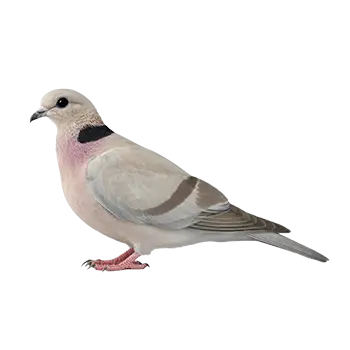
The hallmark feature of the species, the distinctive dark half-collar or ring across the nape of the neck, becomes progressively more defined during the juvenile period. In very young fledglings, this marking may be faint, incomplete, or partially obscured by downy feather remnants. As the adult feathers grow in, the collar sharpens into the clean, dark crescentic band that gives the species its common name. The body plumage settles into the characteristic soft grey-brown of the upperparts and the paler, pinkish-grey wash of the breast and underparts.

Body weight increases steadily through the juvenile phase as the bird builds muscle mass, particularly in the pectorals and leg muscles. A fully fledged juvenile Ring-Necked Dove typically weighs between 120 and 160 grams, with some variation depending on diet, genetics, and individual metabolism. Weekly weigh-ins remain useful during this period to confirm that the bird is maintaining healthy growth. Sudden weight fluctuations, either gains or losses that deviate from the established trend, can indicate health issues or dietary imbalances.

The beak and feet undergo subtle changes during adolescence as well. The beak hardens and assumes its final shape, developing the slightly curved upper mandible that characterizes adult columbids. The feet gain strength and dexterity, and the juvenile becomes increasingly confident in its ability to grip perches of varying diameters, navigate cage furniture, and land accurately after flight. Providing perches of different widths and textures during this stage promotes healthy foot development and helps prevent pressure sores that can develop when a bird stands on a single uniform surface.

Flight Training & Exercise

Flight is a fundamental behavior for Ring-Necked Doves, and the juvenile period is when the bird refines its flying ability from awkward fledgling fluttering into controlled, purposeful flight. Even doves kept as indoor companion birds need regular flight exercise to maintain cardiovascular health, muscle tone, and psychological well-being. Denying a dove the opportunity to fly can lead to obesity, muscle atrophy, and behavioral problems including chronic stress and feather condition issues.

Once the juvenile is confidently leaving the nest and making short flights within its enclosure, it is time to consider providing a larger flight space. A flight cage, ideally at least 36 inches long, allows the young dove to practice sustained horizontal flight. Doves are not acrobatic climbers like parrots and rely almost entirely on flight for locomotion, so horizontal cage length matters more than height. If space permits, a small aviary or a bird-safe room where the dove can fly freely under supervision offers the best flight training environment.

Supervised out-of-cage flight time in a bird-proofed room is an excellent supplement to cage-based exercise. Before releasing the juvenile, secure all windows and doors, cover mirrors and large glass surfaces that the bird might fly into, turn off ceiling fans, remove toxic houseplants, and ensure no other pets are present. The first few free-flight sessions should be brief, lasting ten to fifteen minutes, and the room should be kept calm and quiet to avoid startling the bird into panicked, uncontrolled flight. As the dove gains confidence, session duration can be gradually extended.

Flight conditioning also supports bone density and joint health during the juvenile's rapid growth phase. The impact of landings and the mechanical loading of wing beats stimulate bone remodeling and help ensure the skeleton develops the density it needs to support the bird through its full lifespan. A juvenile dove that is confined to a small cage with no opportunity for real flight may develop weaker bones and reduced flight muscle mass, deficits that can be difficult to fully correct later in life.

Behavioral Development

The juvenile Ring-Necked Dove undergoes significant behavioral maturation as it transitions from a dependent fledgling into a self-sufficient young bird. During this stage, the dove begins exhibiting species-typical behaviors that will define its social interactions and daily routines throughout adulthood. Understanding these emerging behaviors helps caregivers provide the right social and environmental support and distinguish normal developmental behavior from signs of stress or illness.

Vocalization patterns develop noticeably during the juvenile period. The soft begging calls of the nestling give way to the characteristic cooing that Ring-Necked Doves are known for. Males typically begin practicing their advertising coo, a rhythmic three-note phrase, as they approach sexual maturity, though the early attempts may sound uneven or incomplete compared to the polished vocalizations of an adult male. Females are generally quieter but produce a softer, less structured coo. Caregivers should welcome these vocalizations as a sign of healthy development and social confidence.

Preening behavior becomes more elaborate and purposeful during the juvenile stage. The young dove spends increasing amounts of time maintaining its plumage, working oil from the preen gland at the base of its tail through each feather to maintain waterproofing and structural integrity. Allopreening, where the bird gently preens a companion bird or solicits preening from a cagemate, may also emerge if the juvenile is housed with other doves. This behavior is a form of social bonding and a sign of comfort within the social group.

Exploratory behavior peaks during adolescence. The juvenile dove investigates its environment with increasing curiosity, examining new objects, testing different perching surfaces, and spending time watching activity outside its cage. This natural curiosity should be supported by providing a variety of enrichment items, including safe natural branches, shallow bathing dishes, and small mirrors. Ring-Necked Doves are not destructive chewers like parrots, so enrichment focuses more on tactile variety, visual interest, and bathing opportunities than on items designed to be demolished.

Some juvenile doves go through a brief period of flightiness or skittishness as they approach sexual maturity, even if they were well-socialized as chicks. This is a normal developmental phase driven by hormonal changes and heightened environmental awareness. Maintain a calm, consistent handling routine during this period and avoid forcing interactions. The phase typically passes within a few weeks as the bird's hormones stabilize and it settles into its adult temperament.

Housing & Environment

As the juvenile Ring-Necked Dove grows in size, strength, and flight ability, its housing needs evolve beyond the brooder or small rearing cage that served it during the newborn phase. The primary requirement for a juvenile dove's enclosure is horizontal space. Doves navigate their environment by flying rather than climbing, so a long, wide cage is far more useful than a tall, narrow one. A minimum cage size of 32 inches long by 18 inches wide by 18 inches high accommodates a single juvenile dove, but larger is always better, and a flight cage of 36 inches or more in length is preferred.

Perch placement within the cage should encourage flight by positioning perches at opposite ends of the enclosure so the bird must fly to move between them. Use natural wood perches of varying diameters, ranging from roughly half an inch to one inch, to promote healthy foot exercise and prevent pressure sores. Avoid placing perches directly above food or water dishes where droppings would contaminate them. At least one perch should be positioned high enough that the dove can roost at the highest point in the cage, which satisfies the species' natural preference for elevated sleeping positions.

Cage placement in the home matters for the juvenile's psychological development. Ring-Necked Doves are social animals that benefit from being in a room where family activity occurs, but the cage should be positioned against a wall or in a corner so the bird has a solid backdrop on at least one or two sides. This reduces the feeling of exposure that can cause chronic low-level stress in a prey species. Avoid placing the cage in direct sunlight, next to heating or cooling vents, or in the kitchen where fumes from cookware and cleaning products can endanger the bird's sensitive respiratory system.

Cleanliness is fundamental to the juvenile dove's health. The cage floor should be lined with paper or a smooth, easily replaced substrate and changed daily. Food and water dishes should be washed with hot water and mild soap every day, and the cage itself should receive a thorough cleaning and disinfection at least weekly. Ring-Necked Doves produce a fine feather dust as part of their normal plumage maintenance, and this dust can accumulate on cage surfaces, nearby furniture, and air filters. Regular cleaning manages this dust and helps maintain good air quality around the bird.

Health Monitoring

The juvenile period is generally a time of robust health for Ring-Necked Doves, but ongoing monitoring remains important because the young bird's immune system is still maturing and its transition to solid food introduces new potential for digestive issues. Establishing a consistent health monitoring routine during adolescence ensures that problems are caught early and builds a baseline of normal values against which future changes can be measured.

Continue weighing the juvenile dove on a weekly basis using a gram-accurate scale. After the rapid growth of the first few weeks, weight gain slows and eventually plateaus as the bird reaches its adult size, typically between 130 and 170 grams depending on the individual. Once the bird has stabilized at its adult weight, that number becomes a personal baseline. Any subsequent weight loss of more than ten percent should prompt a veterinary evaluation, as unexplained weight loss in a dove frequently signals an underlying illness such as gastrointestinal infection, parasites, or organ dysfunction.

Droppings remain the most accessible daily health indicator. Healthy dove droppings consist of a small, well-formed greenish-brown fecal portion, a white urate component, and a small amount of clear liquid urine. The number of droppings per day varies with food and water intake but should remain relatively consistent from day to day. Changes in color, consistency, volume, or odor can reflect dietary changes, stress, or disease. Particularly concerning are droppings that are entirely watery with no formed fecal component, droppings that contain undigested seeds, or droppings with a yellowish or reddish discoloration.

A veterinary checkup at the end of the juvenile period, around three to four months of age, provides a valuable wellness assessment before the bird enters adulthood. This visit allows the veterinarian to confirm that the molt into adult plumage is progressing normally, evaluate body condition and weight, and screen for any subclinical health issues. Discuss the dove's long-term diet, housing, and preventive care schedule with the veterinarian at this visit to establish a care plan that will serve the bird through its adult years.

Between veterinary visits, observe the bird daily for behavioral clues to its health status. A healthy juvenile Ring-Necked Dove is alert, active during daylight hours, eats and drinks with consistent enthusiasm, preens regularly, and vocalizes throughout the day. Lethargy, prolonged fluffing of the feathers, sitting on the cage floor rather than perching, loss of appetite, or cessation of vocalizations are all signs that something may be wrong. Doves, like most prey species, are skilled at masking illness until it becomes severe, so even subtle changes in behavior deserve attention and follow-up.

Always consult a qualified professional before making any health-related decisions. This content is provided for informational reference only and should not replace professional guidance specific to your animal.