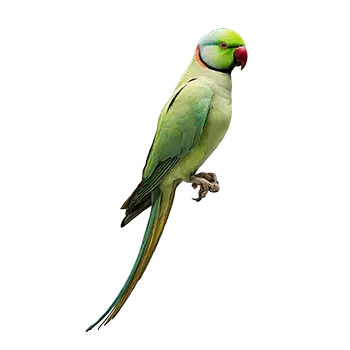

Growth & Physical Development

The juvenile stage of an Indian Ringneck Parakeet begins around six to eight weeks of age when the bird is substantially feathered and continues through roughly one year of age, though full physical maturity — including the development of the iconic neck ring in males — may not be complete until two to three years of age. During this period, the bird undergoes dramatic physical transformation, transitioning from a clumsy, downy fledgling into a sleek, agile flyer with the distinctive long tail and elegant proportions the species is known for.

Feather development is one of the most visible markers of juvenile growth. By the time the bird fledges, its body is largely covered in contour feathers, though these juvenile feathers are typically duller and less vibrant than the plumage it will eventually develop after its first full molt. The long central tail feathers, a hallmark of the species, grow in gradually and may not reach their full length until the bird is well past six months of age. During this growth period, the tail feathers are fragile and can be damaged easily by cages that are too small or by rough handling.

Weight should be monitored regularly throughout the juvenile period, though the intense daily weighing of the neonatal stage can be relaxed to weekly checks once the bird is fully weaned and eating independently. A healthy juvenile Indian Ringneck will typically weigh between 115 and 140 grams, depending on the individual and its subspecies. Significant weight fluctuations — either sudden drops or unexplained gains — should be investigated, as they can indicate illness, dietary problems, or stress.

The bird's beak and feet continue to develop and harden during this stage. The beak, which appears oversized relative to the head in very young birds, gradually becomes more proportional. Providing appropriate chewing materials such as untreated wood perches, mineral blocks, and safe foraging toys is important for beak health and development. Perches of varying diameters help the feet develop strength and dexterity, which are essential for a species that uses its feet extensively for climbing and manipulating food.

Nutrition & Diet Transition

The weaning process is one of the most critical transitions in a young Indian Ringneck's life, and it requires patience, observation, and a willingness to let the bird set its own pace. Weaning typically begins around seven to eight weeks of age when the bird starts to show interest in solid foods, but it can take several additional weeks before the bird is eating enough independently to sustain itself without supplemental hand-feeding. Forcing weaning by abruptly cutting off formula can lead to weight loss, malnutrition, stress, and behavioral problems.

Introduce a wide variety of foods during the weaning period to establish healthy eating habits that will last a lifetime. Offer a high-quality pellet formulated for parakeets or small parrots as the dietary foundation. Alongside pellets, provide a rotating selection of fresh vegetables — leafy greens, carrots, sweet peppers, broccoli, and squash are excellent choices. Fresh fruits can be offered in moderation as treats. Sprouted seeds and legumes are nutritionally dense and provide texture variety that appeals to curious young birds.

Seeds should not be the primary diet for a juvenile Indian Ringneck, despite the species' well-known fondness for them. An all-seed diet is deficient in essential vitamins, minerals, and amino acids, and can lead to chronic health problems including fatty liver disease, feather quality issues, and calcium deficiency. Seeds can be included as a small component of the diet or used as training rewards, but they should never constitute the majority of what the bird eats.

During the weaning transition, continue to offer hand-feeding formula once or twice a day, typically in the morning and evening, while encouraging independent eating throughout the day. Weigh the bird regularly and watch for any sustained weight loss. A small dip in weight during weaning is normal as the bird adjusts, but a consistent downward trend means the bird is not yet consuming enough solid food and still needs formula supplementation. Every bird weans at its own pace, and some Indian Ringnecks may take longer than others.

Behavioral Changes

The juvenile and adolescent period brings significant behavioral shifts that can be surprising and sometimes challenging for first-time Ringneck owners. Indian Ringnecks are well known for a developmental phase commonly referred to as the bluffing stage, which typically occurs between four months and one year of age. During this phase, a previously sweet and compliant bird may become nippy, moody, territorial, or resistant to handling. Understanding that this is a normal developmental phase — not a permanent personality change — is essential for maintaining a positive relationship with the bird.

Bluffing behavior can include lunging, biting, hissing, and retreating from hands that the bird previously stepped onto willingly. The intensity and duration of the bluffing phase varies significantly between individuals. Some birds pass through it in a few weeks with minimal behavioral disruption, while others may exhibit challenging behavior for several months. The key to navigating this period is consistency, patience, and avoiding punitive responses. Never hit, flick, or blow at a bird that bites, as these reactions damage trust and can create lasting fear-based aggression.

This is also the period when Indian Ringnecks begin to develop their impressive vocal abilities. Juvenile birds will start practicing sounds, often beginning with whistles, beeps, and garbled attempts at words they have heard frequently. Repeating words and phrases clearly and consistently in a calm, positive tone encourages speech development. Indian Ringnecks are among the most talented talking parrots, and the foundations laid during the juvenile period often determine the breadth of the bird's eventual vocabulary.

Expect increased independence and curiosity during this stage. The bird will want to explore its environment, test boundaries, and investigate anything within reach. This is a normal and healthy part of development, but it also means that bird-proofing the space becomes critical. Remove or secure any hazards, including toxic plants, open water sources, electrical cords, ceiling fans, and small objects that could be swallowed.

Training Priorities

Training during the juvenile period establishes the behavioral framework for the bird's entire life, and Indian Ringnecks are exceptionally responsive to positive reinforcement training when it is started early and conducted consistently. The most important behaviors to teach during this stage are the step-up command, target training, and voluntary return to the cage. These foundational skills make daily management safer and easier and build a communication bridge between bird and caregiver.

The step-up command — where the bird steps onto your hand or finger on cue — should be practiced daily in short, positive sessions. Use a calm verbal cue and present your hand steadily. Reward compliance immediately with a small treat and verbal praise. If the bird is in its bluffing phase and reluctant to step up, use a perch or dowel as an intermediate step rather than forcing hand contact, which can escalate biting and erode trust.

Target training, where the bird learns to touch its beak to the end of a stick or designated object on cue, is an incredibly versatile tool. Once the bird understands targeting, it can be guided to new locations, into carriers, onto scales for weighing, and through a wide range of other behaviors without the need for physical handling. Target training is especially useful during the bluffing phase when direct hand contact may be met with resistance.

Keep training sessions short — five to ten minutes is ideal for a juvenile Ringneck — and always end on a positive note. If the bird is becoming frustrated, distracted, or agitated, wrap up the session with a behavior it already knows well so that it ends with a success and a reward. Consistency is more important than duration. Multiple brief sessions spread throughout the day are far more effective than one long session that exhausts the bird's attention and patience.

Avoid inadvertently reinforcing unwanted behaviors. If the bird screams and you rush to its cage, it learns that screaming brings attention. If it bites and you react dramatically, the reaction itself can become reinforcing. Respond to unwanted behavior with calm, neutral redirection rather than emotional reactions.

Flight & Exercise

Flight is the defining physical activity of any parrot, and the juvenile period is when Indian Ringnecks develop the strength, coordination, and confidence they need to become competent flyers. Fledging — the first flight — typically occurs around seven to eight weeks of age, and the bird will be clumsy and crash-prone at first. This is entirely normal. Providing a safe, open space for flight practice is far more beneficial than clipping wings at this stage, as early flight experience contributes to physical development, cardiovascular health, bone density, and psychological well-being.

If you choose to allow your bird to be flighted indoors, the environment must be thoroughly bird-proofed. Windows and mirrors should be covered or marked so the bird can see them as barriers. Ceiling fans must be turned off whenever the bird is out of its cage. Doors and windows to the outside should be secured. Kitchens and bathrooms present particular hazards and are best kept off-limits during free flight time. Supervision is essential at all times — a flighted bird can get into dangerous situations in seconds.

For birds that are wing-clipped, either by breeder preference or for safety reasons in a particular living environment, exercise must be provided through other means. Encourage climbing, which Indian Ringnecks excel at and enjoy, by providing a large cage with horizontal bars and external play stands with ladders and ropes. Foraging activities that require physical effort — hanging toys, puzzle feeders, and items that must be manipulated — provide both mental and physical stimulation.

Regardless of flight status, every juvenile Indian Ringneck needs several hours of out-of-cage time each day to explore, interact, and exercise. A bird that spends all of its time in a cage, no matter how large, will not develop the physical fitness or psychological resilience it needs for a healthy life. Structured play time that includes interaction with the caregiver also strengthens the bond between bird and human, which is particularly important during the sometimes challenging adolescent period.

Spay/Neuter Considerations

Unlike dogs and cats, surgical sterilization is not a standard or commonly recommended procedure for pet parrots, including Indian Ringneck Parakeets. Avian reproductive anatomy differs significantly from mammalian anatomy, and the surgical risks associated with removing reproductive organs in birds are substantially higher. The procedure requires an experienced avian surgeon, carries risks of hemorrhage and infection, and is generally only performed when there is a medical necessity, such as chronic egg binding or reproductive tumors.

For most companion Indian Ringnecks, hormonal management through environmental and dietary adjustments is the preferred approach to managing reproductive behavior. Limiting daylight exposure to 10 to 12 hours per day by covering the cage or moving the bird to a dark, quiet room in the evening helps regulate the hormonal cycles that drive breeding behavior. Avoiding warm, dark, enclosed spaces that could be perceived as nesting sites — such as boxes, tents, or the space under furniture — also helps reduce hormonal triggers.

Dietary adjustments can also play a role in hormonal management. Reducing high-fat, high-calorie foods during periods of hormonal activity and ensuring the bird does not have unlimited access to soft, warm foods that mimic the regurgitated food exchanged between mates can help minimize breeding-related behaviors such as excessive regurgitation, territorial aggression, and chronic egg laying in females.

If your Indian Ringneck is exhibiting persistent or problematic reproductive behaviors despite environmental management — such as a female that lays eggs repeatedly despite no mate or nesting opportunities — consult your avian veterinarian. Hormonal implants or injections may be available as a medical intervention in severe cases, though these come with their own set of considerations and should be discussed thoroughly with a qualified avian specialist.

Socialization & Exposure

The juvenile period represents a critical socialization window for Indian Ringneck Parakeets, and the breadth of experiences introduced during this time has a lasting impact on the bird's temperament and adaptability as an adult. Ringnecks that are exposed to a variety of people, environments, sounds, and objects during their first year tend to be more confident, less phobic, and more resilient in the face of change than birds that are kept in limited, unchanging environments.

Introduce new people gradually and on the bird's terms. Allow visitors to sit near the cage or play area and speak calmly without attempting to handle the bird immediately. Once the bird appears relaxed in the person's presence, interactions can progress to offering treats and, eventually, step-up requests. Indian Ringnecks sometimes develop strong single-person bonds and can become aggressive toward others if socialization is too narrow. Regularly exposing the bird to different family members and trusted friends helps prevent this tendency.

Environmental enrichment should be rotated regularly to keep the bird mentally stimulated and accustomed to novelty. Change the arrangement of toys and perches inside the cage every week or two. Introduce new foraging opportunities, different types of safe wood and textures, and novel objects that the bird can investigate. A bird that learns to approach new things with curiosity rather than fear during the juvenile period will be much easier to manage and much more enjoyable to live with for the decades ahead.

Safe outdoor exposure, such as time on a screened porch or in a secure outdoor aviary, provides natural sunlight and fresh air that benefit both physical health and mental well-being. If taking the bird outside, always use a secure carrier or a well-fitted avian harness — even clipped birds can gain enough lift in an outdoor breeze to fly away, and outdoor hazards including predators, toxins, and extreme temperatures pose serious risks. Never leave an outdoor bird unsupervised.

Always consult a qualified professional before making any health-related decisions. This content is provided for informational reference only and should not replace professional guidance specific to your animal.