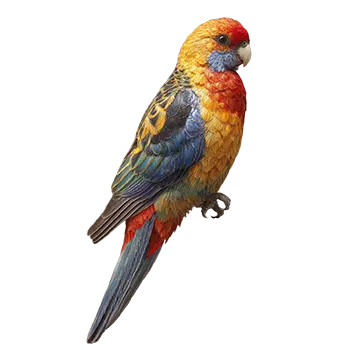

The transition from manageable senior decline to the final stage of a Golden-Mantled Rosella's life is not always marked by a single dramatic event. More often, it is a gradual accumulation of signs that, taken together, indicate the bird's body is approaching the limits of its capacity to sustain itself. For caregivers who have watched their rosella age through the senior years, the shift may be subtle at first, distinguishable from normal aging only through the lens of sustained, careful observation over weeks and months.
Decreased appetite is frequently among the earliest indicators that a rosella is entering its final phase. A bird that has always been an enthusiastic eater may begin picking at food without consuming meaningful quantities, or it may abandon favored foods entirely. Weight loss follows, and in a bird that may already be lighter than it was during its prime, even small losses represent a significant decline in body condition. The keel bone becomes sharply prominent, and the pectoral muscles that once felt firm and rounded begin to waste, giving the chest a sunken appearance when viewed from the front.
Mobility declines markedly as the body weakens. The bird may stop flying entirely, preferring to remain on a single perch or even on the cage floor. Gripping strength diminishes, and the bird may be observed resting with both feet flat rather than tucking one foot into its belly feathers, a posture of comfort in healthy birds. Falls from perches become more frequent, particularly during sleep, and the bird may appear unsteady or disoriented when attempting to move. These changes reflect a combination of muscle wasting, joint degeneration, and potential neurological decline.
Behavioral withdrawal is another hallmark of the end-of-life transition. A rosella that was once alert and responsive may become increasingly passive, showing little interest in enrichment, social interaction, or even the presence of its caregiver. Vocalizations may decrease substantially or cease altogether. The bird may spend extended periods sitting motionless with eyes partially closed, a posture that differs from normal resting by its duration and the bird's diminished responsiveness to stimuli. Some birds develop a distant, unfocused gaze that experienced aviculturists recognize as a sign that the body's systems are beginning to fail.
It is important to distinguish between the natural decline of advanced age and treatable medical crises that can mimic end-of-life symptoms. A senior rosella that suddenly stops eating, becomes lethargic, or shows respiratory distress may have a treatable infection, obstruction, or metabolic emergency rather than an irreversible terminal decline. Consult your avian veterinarian before assuming that the bird's condition is beyond intervention, as some conditions that appear dire are in fact reversible with appropriate treatment.