
Prime Adult Characteristics

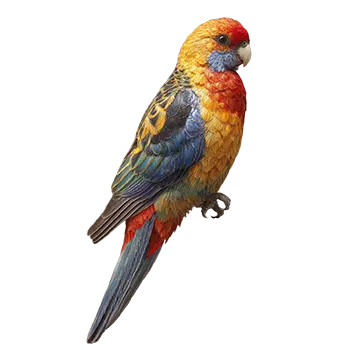
The Golden-Mantled Rosella reaches full physical maturity at approximately 12 to 18 months of age, entering a prime period that, with proper care, can extend well into the bird's second decade. By this stage, the juvenile molt has been completed and the bird displays the striking adult plumage that makes this subspecies one of the most visually appealing of all rosella varieties. The head and breast are a rich scarlet red, the cheek patches are a brilliant white to pale blue, the back feathers are black edged with golden yellow giving the distinctive mantle effect, and the lower body transitions through greens and blues along the rump and tail.

An adult Golden-Mantled Rosella in prime condition weighs between 90 and 120 grams and measures approximately 11 to 13 inches from the crown of the head to the tip of the tail. The body should feel firm and well-muscled when gently palpated, with the keel bone detectable but not prominently protruding. A bird whose keel bone is sharply prominent is underweight, while one whose keel is buried beneath soft tissue may be carrying excess fat. Both conditions warrant dietary review and veterinary consultation.

Behaviorally, the adult rosella has settled into a personality that is largely established. These birds are characteristically active, curious, and somewhat independent in temperament. They tend to prefer being near their human companions rather than on them, observing household activity from a favored perch rather than seeking constant physical contact. This independent streak is a feature of the species rather than a failure of socialization, and caregivers who appreciate and respect this trait are rewarded with a companion that is calm, reliable, and endlessly engaging to watch.

The adult years are also when the rosella's vocal repertoire reaches its fullest expression. While Golden-Mantled Rosellas are not prolific talkers in the way of African Greys or budgerigars, they produce a melodious range of whistles, chirps, and chattering calls that many keepers find more pleasant than the louder vocalizations of larger parrot species. Some individuals learn to whistle tunes or mimic specific household sounds. Vocal activity tends to peak in the early morning and late afternoon, aligning with the natural activity patterns of wild rosellas at dawn and dusk.

Optimal Adult Diet

Nutrition during the adult years is the single most controllable factor in determining the Golden-Mantled Rosella's long-term health, feather quality, and lifespan. The dietary foundation established during the juvenile period should now be well entrenched, with the bird accepting a varied diet built around pellets, fresh produce, and limited supplemental items. The adult years are not the time to relax nutritional vigilance. Many of the chronic health conditions that shorten rosella lifespans, including hepatic lipidosis, atherosclerosis, and vitamin A deficiency, are directly attributable to years of dietary imbalance.

A high-quality pelleted diet should continue to comprise 60 to 70 percent of the adult rosella's daily intake. Select a pellet formulated for Australian parakeets or small to medium parrots, and avoid pellets with added artificial colors, flavors, or excessive sugar. Colored pellets may seem more appealing, but they teach the bird to select by color rather than eating the complete formulation, which defeats the purpose of a balanced pellet. If the bird has been eating colored pellets, transition gradually to a natural formulation over several weeks by mixing the two and slowly increasing the proportion of the new pellet.

Fresh vegetables and greens should be offered daily, comprising 20 to 25 percent of total intake. Emphasize dark, leafy greens and deeply colored vegetables that are rich in vitamins A, C, and K, as well as calcium and iron. Rotate offerings regularly to provide nutritional variety and prevent the bird from fixating on a single item to the exclusion of others. Many rosellas enjoy their produce chopped finely and mixed together in a morning chop, which prevents selective eating and ensures broader nutrient coverage across each meal.

Seeds have a legitimate but strictly limited place in the adult rosella's diet. As ground foragers in the wild, rosellas naturally consume grass seeds, herb seeds, and the seeds of native plants as part of a diverse diet. In captivity, offering a small quantity of a quality seed mix, no more than one to two teaspoons per day, as a foraging reward or training treat maintains the dietary connection to wild behavior without the risks of a seed-dominant diet. Sunflower seeds and safflower seeds are particularly high in fat and should be minimized or eliminated from the mix.

Clean, fresh water must be available at all times. Golden-Mantled Rosellas are habitual food-dunkers and will frequently deposit pellets, vegetables, and other debris in their water dish. Change the water a minimum of twice daily, and more frequently during warm weather or if the bird has been particularly active in contaminating the bowl. Some keepers find that using a water bottle in addition to an open dish reduces contamination, though the bird should be confirmed to drink reliably from the bottle before removing the open dish entirely.

Exercise & Enrichment

An adult Golden-Mantled Rosella that does not receive adequate physical exercise and mental enrichment will inevitably develop problems, whether physical in the form of obesity and muscle atrophy, or behavioral in the form of feather destruction, aggression, or chronic screaming. Rosellas are built for movement. In the wild, they spend their days flying between foraging sites, navigating complex tree canopies, and engaging in social interactions that challenge them physically and mentally. Captive care must approximate these demands as closely as possible within the constraints of a domestic setting.

Daily out-of-cage flight time is the most important form of exercise for a companion rosella. A minimum of two to three hours of supervised flight in a bird-safe room allows the bird to exercise its full flight musculature, maintain cardiovascular fitness, and engage with its environment in ways that cage life cannot provide. Ensure the flight space is free of hazards including open water, hot surfaces, toxic plants, exposed electrical cords, and other pets. Close all windows and doors, and cover any mirrors or large glass surfaces that could cause collision injuries.

In-cage enrichment should be varied and rotated regularly to prevent habituation and boredom. Foraging toys that require the bird to manipulate, shred, or disassemble materials to access hidden food are among the most effective enrichment tools for rosellas. Wrap treats in paper, hide pellets inside foraging boxes, or thread vegetables onto stainless steel skewers to encourage problem-solving and physical manipulation. Natural wood branches from safe tree species such as eucalyptus, apple, or willow provide chewing opportunities that satisfy the bird's instinct to gnaw and also help maintain beak condition.

Ground foraging opportunities are particularly valuable for rosellas, as the species spends considerable time on the ground in its natural habitat. A shallow tray filled with clean pebbles, dried herbs, or crumpled paper with seeds scattered throughout allows the bird to engage in species-typical foraging behavior. Rotate the foraging substrate regularly to maintain novelty, and supervise ground foraging sessions if the bird has access to areas with potential floor-level hazards.

Social enrichment should not be overlooked. Even independent rosellas benefit from regular, positive interaction with their human companions. Training sessions using positive reinforcement are an excellent form of social and mental enrichment. Rosellas can learn target training, station training, and a variety of behaviors using small food rewards as motivation. Keep training sessions short, five to ten minutes, and end on a successful repetition to maintain the bird's enthusiasm. Training builds the cooperative relationship between bird and caregiver and provides a structured form of communication that benefits both parties.

Annual Molt & Feather Care

Adult Golden-Mantled Rosellas undergo a complete molt once per year, typically triggered by changes in photoperiod as day length shifts between seasons. In the southern hemisphere where the species originates, this corresponds roughly to late summer through autumn. Captive birds housed indoors may molt on a slightly different schedule depending on their exposure to artificial lighting, but most will still cycle through a distinct annual molt period. Understanding and supporting this process is essential for maintaining the vibrant plumage that defines the species.

The annual molt follows a predictable sequence. Flight feathers are replaced first, shedding symmetrically from both wings so that the bird retains the ability to fly throughout the process. Tail feathers follow, and then the body contour feathers are replaced in a wave that progresses from the head and neck downward across the body. The entire process takes approximately six to eight weeks, during which the bird may appear scruffy and produce noticeably more feather dust and discarded sheaths than usual.

Nutritional support during the molt is critical. Feather production is metabolically expensive, requiring substantial protein, amino acids, and specific micronutrients including biotin, zinc, and sulfur-containing amino acids such as methionine. Increase protein availability during the molt by offering hard-boiled egg, sprouted legumes, and cooked quinoa in addition to the regular pelleted diet. Ensure that calcium availability remains high through cuttlebone or mineral block access, as calcium supports the structural integrity of the growing feather shaft.

Bathing becomes especially important during the molt. Regular access to bathing water helps soften keratin sheaths on incoming pin feathers, making them easier for the bird to preen away, and soothes the skin irritation that often accompanies heavy feather replacement. Offer a shallow bath dish daily, or mist the bird gently with lukewarm water from a spray bottle. Most rosellas enjoy bathing and will splash enthusiastically, so position the bath in an area where water spray will not damage furniture or electronics.

Monitor feather quality as new plumage grows in. Healthy adult feathers should be smooth, uniformly colored, and free of stress bars or structural defects. Feathers that emerge with abnormal coloring, deformed shape, or excessive brittleness may indicate nutritional deficiency, liver disease, or infectious conditions such as Psittacine Beak and Feather Disease. A bird that appears to be in continuous molt, never fully completing feather replacement before starting again, should be evaluated by an avian veterinarian to identify the underlying cause.

Routine Health Maintenance

Preventive health care during the prime adult years establishes the patterns and baselines that protect the Golden-Mantled Rosella throughout the remainder of its life. Many avian diseases are insidious, producing no outward symptoms until they have progressed to an advanced stage. Annual veterinary examinations, combined with attentive daily observation by the caregiver, form a two-layered defense against the conditions that most commonly affect captive rosellas.

Annual wellness examinations should include a comprehensive physical assessment, a complete blood count, and a biochemistry panel. These blood tests evaluate organ function, detect early signs of metabolic disease, and establish individual reference ranges that make future abnormalities easier to identify. Fecal analysis screens for intestinal parasites and abnormal bacterial populations. Depending on the bird's history and risk factors, the veterinarian may also recommend periodic testing for Psittacine Beak and Feather Disease, Avian Polyomavirus, and Chlamydia psittaci.

Between veterinary visits, the caregiver's daily observations serve as the primary health monitoring system. Develop a habit of assessing the bird each morning during cage cleaning. Note the number, appearance, and consistency of overnight droppings. Observe the bird's posture, breathing, eye clarity, nare condition, and feather condition. Watch for changes in appetite, vocalization, activity level, and social behavior. Avian species are prey animals that instinctively mask signs of illness, so the changes that signal early disease may be extremely subtle: a bird that is slightly less active than usual, a slight change in the tone or frequency of vocalizations, or droppings that are marginally different from the established norm.

Nail and beak maintenance are ongoing aspects of adult rosella care. Nails that become overgrown can catch on cage bars, toys, or fabric, potentially causing injury. If the bird's natural activity on varied perch surfaces does not keep nails at an appropriate length, periodic trimming with a small nail clipper or rotary tool is necessary. Beak overgrowth is less common in rosellas that have adequate chewing opportunities but should be addressed by a veterinarian if it occurs, as it may indicate underlying liver disease or nutritional imbalance.

Weight monitoring provides one of the most objective measures of overall health. Weigh the bird weekly on a gram-accurate scale, recording the values to track trends over time. Gradual weight gain may indicate dietary excess or reduced activity, while gradual weight loss can be an early indicator of chronic disease. Sudden weight changes in either direction warrant prompt veterinary evaluation.

Behavioral Patterns & Common Challenges

The adult Golden-Mantled Rosella's behavioral profile is a blend of species-typical traits and individual personality shaped by genetics, early socialization, and ongoing environmental influences. Understanding what is normal for the species helps caregivers distinguish between healthy behavior and emerging problems that may require intervention. Rosellas are not beginner parrots, and their behavioral needs differ meaningfully from the more commonly kept cockatiel or budgerigar.

Territoriality is one of the most pronounced behavioral traits in adult rosellas. In the wild, Golden-Mantled Rosellas defend nesting sites and foraging territories with vigor, and this instinct persists in captivity. An adult rosella may become defensive of its cage, a favorite perch, or even a particular person in the household, displaying aggressive postures such as lunging, beak-striking, or wing-spreading when the perceived boundary is approached. This behavior is natural and manageable but must be understood in context rather than punished. Avoid reaching into the cage without warning, and use a trained step-up command to remove the bird from its cage rather than chasing or grabbing it.

Hormonal behavior typically peaks in the spring and early summer, coinciding with the natural breeding season. Even single birds that have no mate will experience hormonal surges that can produce behavioral changes including increased aggression, regurgitation directed at objects or people, territorial nesting behavior, and in hens, egg laying. Managing hormonal behavior involves limiting access to dark, enclosed spaces that simulate nest cavities, maintaining a strict light schedule of no more than 12 hours of daylight, and avoiding physical contact that may be interpreted as mating stimulation such as stroking the back, wings, or tail.

Feather-destructive behavior, while less common in rosellas than in cockatoos or African Greys, can develop in adult birds that are under-stimulated, stressed, or experiencing undiagnosed medical conditions. Once established, feather plucking is notoriously difficult to resolve, making prevention far more effective than treatment. Ensure the bird receives adequate exercise, enrichment, social interaction, and a nutritionally complete diet. Address environmental stressors such as proximity to perceived threats, inconsistent schedules, or disruptive household changes promptly.

Night frights are another concern for some rosella keepers. These episodes, in which the bird panics in the dark and thrashes violently inside the cage, can result in broken blood feathers, wing injuries, or lacerations from cage bars. If the bird is prone to night frights, provide a dim night light near the cage to prevent total darkness, and position the cage in a location where sudden noises or vibrations are minimized. A cage cover can help some birds feel more secure, though others find it claustrophobic, so test the bird's response before committing to routine covering.

Long-Term Companion Care

Maintaining a high quality of life for an adult Golden-Mantled Rosella over the many years of its prime requires a caregiver who is committed to consistency, adaptability, and ongoing education. The bird's needs do not diminish once adulthood is reached. If anything, the long-term nature of the relationship demands sustained attention to detail that prevents the gradual erosion of care standards that commonly occurs as the novelty of bird ownership fades. A well-cared-for rosella is a vibrant, engaged companion well into its teens and beyond.

Environmental consistency provides the foundation for a stable adult rosella. These birds thrive on routine and can become stressed by unpredictable changes in their schedule, location, or household dynamics. Maintain regular feeding times, consistent sleep schedules aligned with a 12-hour light and dark cycle, and a predictable daily routine of out-of-cage time and interaction. When changes are unavoidable, such as a household move or the introduction of a new family member, make transitions gradually and monitor the bird for signs of stress.

The relationship between a Golden-Mantled Rosella and its primary caregiver deepens over the years as both parties learn each other's communication patterns and preferences. Pay attention to the bird's body language, which is its primary means of communication. Relaxed body feathers, gentle beak grinding, one-foot resting posture, and soft vocalizations all indicate contentment. Pinned eyes, raised crest feathers, rapid tail fanning, and leaning postures communicate arousal that may tip into aggression if the trigger is not identified and managed.

Plan for the bird's care across the full span of its potential lifespan. A Golden-Mantled Rosella that lives 20 or more years will potentially outlive housing arrangements, job changes, relationship changes, and other major life transitions. Identify a trusted backup caregiver who is willing and able to take responsibility for the bird if you become unable to provide care. Include the bird in your estate planning if applicable. The knowledge that the bird's future is secured regardless of circumstances provides peace of mind and ensures that the quality of care does not decline during periods of personal upheaval.

Stay current with developments in avian medicine, nutrition science, and husbandry best practices. The standard of care for companion parrots has advanced considerably in recent decades, and practices that were considered acceptable even ten years ago may now be understood as harmful or suboptimal. Connect with reputable avian societies, attend bird club meetings if available in your area, and maintain an open dialogue with your avian veterinarian about emerging research that may benefit your bird.

Always consult a qualified professional before making any health-related decisions. This content is provided for informational reference only and should not replace professional guidance specific to your animal.