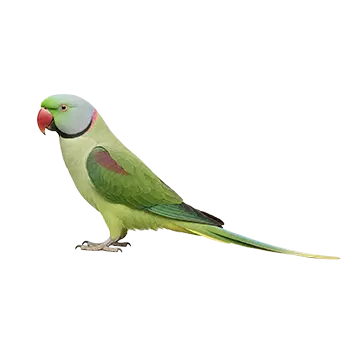

The Derbyan Parakeet reaches full physical maturity between two and three years of age, when the final adult plumage has come in and the bird has attained its full body size of approximately 18 to 20 inches from head to tail tip. The adult Derbyan is among the largest of the Psittacula parakeets, with a robust build, a broad head, and the striking coloration that makes the species visually distinctive. Males and females can be distinguished by bill color once mature — males develop a red-orange upper mandible with a yellow tip, while females have an entirely black upper mandible.
The adult plumage of a healthy Derbyan Parakeet is a rich tapestry of color. The head and breast are washed in violet-blue, transitioning to green across the mantle, wings, and back. A broad black chin stripe extends across the lower mandible area, and a distinctive green mustache stripe separates the violet breast from the dark chin. The thighs and lower abdomen carry a lavender wash, and the long, graduated tail feathers are blue above and yellowish below. This full adult coloration may take two to three complete molt cycles to achieve, so a bird in its second year may still show some immature color characteristics.
The annual molt is the most significant recurring physical event in an adult Derbyan's life. Molting typically occurs once per year and lasts six to eight weeks, during which the bird progressively replaces its flight feathers, contour feathers, and down. Molting places significant metabolic demands on the bird, and nutritional support during this period is essential. Increase protein-rich foods slightly, ensure adequate calcium and vitamin A availability, and provide bathing opportunities to help soften feather sheaths and ease the itching that accompanies new feather growth.
Monitor the bird's physical condition year-round by observing feather quality, weight stability, muscle tone over the keel bone, and the condition of the beak, nails, and feet. A healthy adult Derbyan should maintain a stable weight with slight fluctuations around molt time. The keel bone should be palpable but not prominent — a bird whose keel bone protrudes sharply is underweight, while a bird whose keel is buried in fat deposits is overweight. Both conditions warrant dietary evaluation and veterinary consultation.