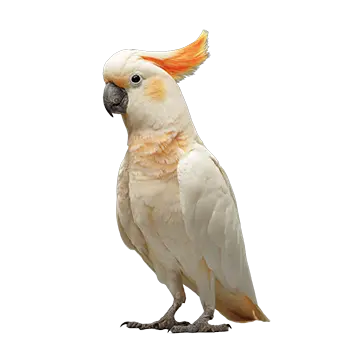

The juvenile period for a Citron-Crested Cockatoo represents one of the most dynamic and formative chapters in the bird's life. This stage typically begins around eight to ten weeks of age, when the chick has developed full feather coverage and is beginning to assert its independence from the hand-feeder or parent birds. The transition is not a sudden event but rather a gradual shift marked by increasing physical competence, expanding curiosity, and the emergence of behavioral patterns that will define the bird's personality for decades.
Physically, the juvenile Citron-Crested Cockatoo is now recognizably a cockatoo. The white plumage is largely complete, though it may still have a slightly softer, fluffier texture compared to adult feathering. The distinctive citron-orange crest feathers are present and functional, though they may not yet reach their full adult length or intensity of color. The beak and feet have hardened considerably from their neonatal softness, and the bird's grip strength has increased dramatically, allowing it to climb, perch, and manipulate objects with growing dexterity.
Behaviorally, the juvenile cockatoo is a study in contrasts. Moments of bold exploration alternate with sudden retreats to the comfort of a familiar perch or caregiver. This oscillation between confidence and caution is entirely normal and reflects the bird's developing ability to assess its environment for both opportunities and threats. The caregiver's role during this period is to provide a secure base from which the young bird can venture outward, knowing it can always return to safety.
The juvenile stage is also when the Citron-Crested Cockatoo's vocal repertoire begins to expand significantly. Beyond the begging calls of the neonatal period, the young bird experiments with a widening array of sounds, including contact calls, alarm calls, and the exploratory vocalizations that may eventually develop into mimicked words or phrases. Encourage vocal development by responding to the bird's calls and speaking to it regularly, as this reciprocal communication strengthens the social bond and supports cognitive growth.