Gamekeeper's Night Dog

Bullmastiff

Quick Facts

🐕 Breed Group
Working Group
📏 Size Category
Large
📏 Height
Males: 25-27 inches, Females: 24-26 inches
⚖️ Weight
Males: 110-130 lbs, Females: 100-120 lbs
⏱️ Life Expectancy
7-9 years
🧣 Coat Type
Short, dense, weather-resistant
🎨 Coat Colors
Fawn, red, brindle, with black muzzle mask
😀 Temperament
Loyal, brave, confident, docile, protective
🏃 Exercise Needs
Moderate
🎓 Training Difficulty
Moderate - intelligent but independent
👶 Good with Children
Good with family children when socialized
🐾 Good with Other Pets
Variable - requires careful introduction

Other Names & Breed Recognition

Gamekeeper's Night Dog is the name that tells the story of why this breed exists. Before it was called the Bullmastiff, before it appeared in any kennel club registry, this dog had a very specific job: accompany English gamekeepers on their nighttime patrols and take down poachers without killing them. The name comes directly from that 19th century working role and captures the essence of a breed created for silent, powerful enforcement under cover of darkness.

The poaching problem in Victorian-era England was severe enough that gamekeepers on large estates faced genuine physical danger from armed trespassers. They needed a dog that was fast enough to close distance quickly, powerful enough to knock a grown man to the ground, brave enough to confront armed strangers in the dark, and controlled enough to pin rather than maul. The Gamekeeper's Night Dog was the answer, and the name stuck among the working men who relied on these dogs nightly.

Today, the breed is universally known as the Bullmastiff, a name that reflects its ancestry as a cross between the Bulldog and the Mastiff. The AKC recognized the Bullmastiff in 1934 within the Working Group. The Kennel Club in the UK, the UKC, and the CKC all recognize the breed, as does the FCI under Group 2 among the Molossoid breeds. The American Bullmastiff Association serves as the AKC parent club and maintains the breed standard in the United States.

The historical name Gamekeeper's Night Dog has fallen out of everyday use but persists in breed literature, history books about English country estates, and among enthusiasts who appreciate the breed's working origins. Some owners use it with a note of pride, recognizing that their couch-loving companion descends from dogs that earned their keep through real physical work in genuinely dangerous conditions.

You may also encounter the breed referred to simply as the Bullmastiff or occasionally as the Gamekeeper's Dog without the Night qualifier. In South Africa, where the breed was used to guard diamond mines by the De Beers company in the early 20th century, it earned a reputation as a formidable security animal that extended the breed's working legacy well beyond English estates. Regardless of what you call it, you are talking about the same powerful, loyal guardian that traces its roots to those midnight patrols through the English countryside.

Gamekeeper's Night Dog Organizations & Standards

The American Bullmastiff Association (ABA) serves as the breed's AKC parent club and has maintained the breed standard in the United States since the breed's recognition in 1934. The ABA promotes responsible breeding, health research, and education about this historically significant working breed. In the United Kingdom, the breed falls under the oversight of The Kennel Club, which registered the Bullmastiff in its Working Group and maintains the standard that most closely reflects the breed's English origins.

The breed standard describes a dog that is powerfully built, symmetrical, and showing great strength without appearing cumbersome or sluggish. The ideal Bullmastiff presents an impression of massive, active, alert readiness. Males stand 25 to 27 inches at the shoulder and weigh 110 to 130 pounds. Females are slightly smaller at 24 to 26 inches and 100 to 120 pounds. The standard places significant emphasis on proportion and balance, requiring that the dog's weight be distributed evenly and that its movement reflect functional athleticism rather than lumbering heaviness.

The head is the breed's signature feature in the show ring. It should be large and square, with a fair amount of wrinkle when the dog is alert and a broad, deep muzzle that is roughly one-third the length of the entire head. The jaw is strong and carries a level or slightly undershot bite. Eyes are dark and medium-sized, set apart by the width of the muzzle. The expression should be alert and intelligent. Ears are V-shaped, set high, and carried close to the cheeks, giving the head a square appearance that enhances the breed's formidable look.

Health testing recommendations from the ABA include OFA hip and elbow evaluations, cardiac examination by a veterinary cardiologist, eye examination through the CAER program, thyroid evaluation, and PRA DNA testing. These tests reflect the breed's documented predispositions and represent the minimum screening that responsible breeders conduct before producing a litter. The FCI standard aligns closely with the AKC standard, though European judges may place slightly different emphasis on movement and structure.

The breed also has active clubs internationally, including organizations in Canada, Australia, and throughout Europe. The UKC classifies the Bullmastiff within its Guardian Dog group, which arguably captures the breed's original function more accurately than the broader Working Group designation. Breed clubs across the world emphasize the importance of temperament evaluation alongside physical health testing, recognizing that the Gamekeeper's Night Dog's behavioral stability is as critical to responsible breeding as its structural soundness.

Kennel Club Recognition

  • American Kennel Club (AKC): Recognized in 1934, Working Group
  • United Kennel Club (UKC): Recognized, Guardian Dog
  • Canadian Kennel Club (CKC): Recognized, Working Dogs
  • FCI: Recognized, Group 2: Pinscher and Schnauzer
  • The Kennel Club (UK): Recognized, Working

Gamekeeper's Night Dog Physical Description

The Gamekeeper's Night Dog is built for power at close range. Everything about this dog's physical structure reflects a breed created to sprint short distances, tackle a full-grown man, and pin him to the ground without mauling. The body is compact and symmetrical for a giant breed, with substantial bone and muscular development that communicates raw strength. Males stand 25 to 27 inches and carry 110 to 130 pounds of solid mass. Females are proportionally smaller but still powerfully constructed.

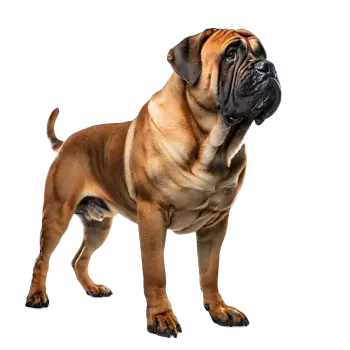
The head immediately commands attention. It is large, broad, and square when viewed from any angle, with enough wrinkle to give the face character without the excessive skin folds that cause health problems in some brachycephalic breeds. The muzzle is short, broad, and deep, accounting for roughly one-third of the total head length. The nose is broad with well-spread nostrils, and the flews hang slightly below the lower jaw. The jaw carries tremendous bite strength, a necessity in a breed that needed to hold a struggling poacher without causing fatal injuries. Eyes are dark, medium-sized, and set well apart beneath a slight furrow between them. The expression should communicate intelligence and alertness rather than aggression.

The neck is thick, muscular, and slightly arched, flowing into strong, sloping shoulders. The chest is wide and deep, reaching to the level of the elbows, providing ample lung capacity for the short bursts of explosive speed the breed was designed for. The back is short and straight, giving the impression of a compact, coiled power source. The loin is wide and muscular, and the hindquarters carry substantial muscular development through the upper thigh.

The forelegs are straight, well-boned, and set wide apart to accommodate the broad chest. Pasterns are straight and strong, supporting the breed's considerable weight without knuckling over. The feet are compact and catlike with well-arched toes and tough, dark pads that provided sure footing during those nighttime scrambles across uneven estate grounds. Hindquarters are broad and muscular, with moderate angulation at the stifle and hock. The overall impression from the side is of a dog loaded with controlled power, ready to launch forward at a moment's notice.

The skin deserves mention because it plays a functional role in this breed's design. The skin is slightly loose over the body and head, providing a degree of protection during physical confrontations. On the head, this looseness creates the characteristic wrinkles that give the Bullmastiff its expressive face. However, the standard calls for only moderate wrinkling, not the extreme skin folds seen in some other molosser breeds.

The coat is short, dense, and lies close to the body. It provides effective weather protection without requiring significant maintenance. Color options include fawn, red, and brindle, and all colors carry a characteristic black muzzle mask that fades toward the eyes. The darker coloring was historically preferred because dark-coated dogs were harder to see during nighttime patrols, which gave the Gamekeeper's Night Dog a tactical advantage in its original work.

Movement is smooth, powerful, and purposeful. The Bullmastiff covers ground with a surprisingly efficient gait for its size, showing good reach in front and strong drive from behind. There should be no lumber or roll in the movement. Despite its bulk, the properly built Gamekeeper's Night Dog moves with athletic coordination that hints at the speed these dogs can produce over short distances. The tail is set high on the croup, thick at the root, and tapers to the hocks. It is carried straight or slightly curved but never over the back.

Affectionate With Family
The Gamekeeper's Night Dog forms deep bonds with its household and shows genuine tenderness toward the people it considers its own.
Good With Young Children
Generally patient with family children but requires supervision due to its massive size. A well-socialized Bullmastiff is gentle, but accidental knockdowns happen with a dog this large.
Good With Other Dogs
Same-sex aggression is well documented in the breed, and introductions to unfamiliar dogs should be managed carefully. Early socialization helps but does not eliminate this tendency.
Shedding Level
Shedding is moderate and consistent year-round. You will find short hairs on clothing and furniture, but it is manageable with regular brushing.
Coat Grooming Frequency
The short, dense coat requires minimal grooming. A weekly brushing with a rubber curry brush removes loose hair and keeps the coat healthy.
Drooling Level
This breed drools, especially after drinking, eating, or during warm weather. Keeping a towel handy is standard practice for owners.
Coat Type
The coat is short, dense, and close-fitting, providing weather resistance without requiring significant maintenance. It lies flat against the body.
Openness To Strangers
The Gamekeeper's Night Dog is naturally reserved with strangers and will position itself between its family and an unfamiliar visitor until it assesses the situation.
Playfulness Level
Moderately playful, especially in younger years. The breed enjoys interactive games with family but is not a high-energy, fetch-obsessed athlete.
Watchdog/Protective Nature
Guarding is what this breed was born to do. The Gamekeeper's Night Dog is naturally vigilant, territorial, and capable of decisive protective action.
Adaptability Level
Surprisingly adaptable for a giant breed, the Bullmastiff can adjust to different living situations provided it has enough space to move comfortably and access to moderate exercise.
Trainability Level
Intelligent but independent-minded. This breed responds to confident, consistent handling but does not live to please the way some working breeds do.

Gamekeeper's Night Dog History & Development

The name Gamekeeper's Night Dog originated in 19th century England, during a period when poaching on large country estates was both widespread and dangerous. English gamekeepers were responsible for protecting their employer's game stocks, and confrontations with poachers could turn violent or even fatal. The penalty for poaching was severe, often transportation or imprisonment, which meant poachers had strong motivation to resist capture. Gamekeepers needed a dog that could give them a decisive physical advantage in these encounters.

The Mastiff was considered but found too slow to catch a fleeing man. The Bulldog of the period was tenacious and brave but lacked the size to knock down and pin an adult. The solution was a deliberate cross, roughly sixty percent Mastiff and forty percent Bulldog, that combined the Mastiff's mass and guarding instinct with the Bulldog's speed, agility, and courage. The resulting dog was exactly what the gamekeepers needed: fast enough to close distance in a short sprint, heavy enough to take a man off his feet, and temperamentally inclined to hold rather than savage its quarry.

The name Gamekeeper's Night Dog became common parlance among the estate workers and sporting circles who used these dogs. It was a functional description rather than a formal breed name, emphasizing the dog's working hours and its role within the estate hierarchy. Dark brindle dogs were particularly valued because they were nearly invisible during nighttime patrols. Training focused on silent approach, tackling on command, and pinning without biting. A dog that mauled a poacher was a liability, not an asset, because dead or severely injured trespassers created legal complications for the estate.

As formal breed recognition developed in the late 19th and early 20th centuries, the name Bullmastiff replaced Gamekeeper's Night Dog in official contexts. The Kennel Club in England recognized the breed in 1924, and the AKC followed in 1934. The breed's working role had already begun to shift by then, as changes in English game laws and estate management reduced the need for dedicated poacher-catching dogs. The Bullmastiff transitioned into a guardian and family companion, roles it still fills today.

The historical name persists because it captures something that Bullmastiff alone does not: the specific, dramatic working context that produced this breed. It reminds people that the Bullmastiff was not developed as a show dog or a pet but as a professional tool for a dangerous job. Understanding that origin helps explain the breed's temperament, its physical capabilities, and the seriousness with which experienced owners approach its training and socialization.

The breed's working legacy extended beyond English estates. In South Africa, the De Beers diamond mining company employed Bullmastiffs to patrol their mines and deter theft. The dogs proved equally effective in this role, combining physical intimidation with the controlled restraint that had been bred into them on English country estates. Military and police forces in several countries also adopted the breed during the early 20th century, though its use in professional service roles has declined as lighter, faster breeds became preferred for active duty work. Today, the Gamekeeper's Night Dog lives primarily as a family guardian, but its heritage as a working professional remains visible in every aspect of its behavior and build.

Gamekeeper's Night Dog Temperament & Personality

The temperament of the Gamekeeper's Night Dog reflects its original purpose with remarkable clarity. This is a breed that was designed to assess threats, make decisions independently, and act with controlled force. Those qualities persist in the modern Bullmastiff, even though the threats have changed from armed poachers to unexpected visitors at the front door. Understanding this working heritage is essential for anyone considering this breed, because the same qualities that made the Gamekeeper's Night Dog effective at its job can create serious problems in a home that does not provide proper leadership and socialization.

With its own family, the Bullmastiff is surprisingly gentle and deeply affectionate. This is a dog that wants to be near its people, will lean its massive body against your legs while you cook dinner, and will follow you from room to room with quiet devotion. The breed's loyalty is not performative. It runs deep and is expressed through steady presence rather than frantic attention-seeking. Many owners describe their Bullmastiff as a dog that seems to always be monitoring the family's wellbeing, positioned where it can see the door and the people it cares about simultaneously.

The breed's protective instinct is not something that needs to be trained. It is hardwired. A well-socialized Bullmastiff will distinguish between a welcome guest and an unwelcome intrusion without coaching. This natural discernment was the entire point of the breed. Gamekeepers needed a dog that would ignore authorized estate workers and confront unauthorized trespassers without being told which was which. In a modern home, this translates to a dog that is calm around regular visitors but immediately alert when something feels off.

One of the more remarkable aspects of this breed's temperament is its quietness. The Gamekeeper's Night Dog was specifically selected for silent work. Barking would have alerted poachers to the gamekeeper's presence, so dogs that worked silently were favored in breeding. This trait persists strongly today. The Bullmastiff is not a barker. When it does vocalize, something genuinely warrants attention. This silence, combined with the breed's sheer physical presence, creates a guardian that deters through intimidation and acts through decisive physical intervention rather than noise.

Same-sex aggression is a documented tendency in the breed and should not be dismissed or minimized. Male Bullmastiffs in particular may not tolerate other intact males, and even neutered males can display dominance-related friction. This is not universal, but it is common enough that multi-dog households need to plan carefully. Early socialization helps significantly, but it does not eliminate the breed's natural tendency toward dog-directed assertiveness.

When this breed's needs go unmet, the behavioral consequences match its size. A bored, under-exercised Bullmastiff may become destructive, targeting furniture, doors, and walls with a jaw that can cause significant damage. A Bullmastiff that lacks proper socialization may become overly suspicious of strangers, which in a dog of this size becomes a genuine safety concern. A Bullmastiff that does not respect its owner's authority may become pushy, demanding, and progressively harder to manage. These are not behavioral quirks. They are predictable outcomes of a powerful guardian breed that is not receiving the structure it needs.

Gamekeeper's Night Dog Family Life & Living Requirements

Living with a Gamekeeper's Night Dog means living with a dog that takes up a lot of space, both physically and emotionally. This is not a breed you can ignore or treat as a yard ornament. It wants to be part of the household, present during meals, nearby while you watch television, and ideally sleeping within earshot of the family. The bond it forms with its people is the foundation of its temperament, and weakening that bond by isolation creates problems that are much harder to fix than they are to prevent.

With children in the family, the Bullmastiff can be a wonderful companion, but size-appropriate supervision is non-negotiable. A well-socialized Bullmastiff is patient and gentle with kids it has grown up with, but at 120 pounds, even a friendly bump during play can knock a small child to the ground. Teaching children to respect the dog's space and teaching the dog calm behavior around children creates a relationship that works for everyone. This is not a breed that should be left unsupervised with toddlers regardless of how trustworthy it seems.

Housing requirements are practical rather than demanding. The Bullmastiff does not need a massive yard, though some outdoor space is appreciated. These dogs are surprisingly inactive indoors and will spend much of the day sleeping if given comfortable spots. What they do need is climate management. The Bullmastiff does not tolerate heat well due to its brachycephalic structure and dense muscle mass. Access to air conditioning during summer months is a genuine health necessity, not a luxury.

Multi-pet households require careful planning. The Bullmastiff's prey drive is relatively low, and many live peacefully with cats, especially when raised together. Other dogs are a more complex equation. Opposite-sex pairs generally coexist well, but same-sex combinations may produce conflict. Introducing a Bullmastiff into a home with an existing dog of the same sex requires experienced management and realistic expectations about what cooperation looks like between two large, confident animals.

The financial reality of owning this breed deserves mention. Veterinary costs for a giant breed are proportionally higher than for smaller dogs. Everything from medications to surgical procedures costs more when scaled to 120 pounds. The breed's predisposition to cancer, cardiac issues, and orthopedic problems means that veterinary bills over the dog's lifetime can be substantial.

Gamekeeper's Night Dog Training & Exercise Needs

Training a Gamekeeper's Night Dog requires confidence, consistency, and an understanding that this breed was designed to think for itself. The Bullmastiff is not a golden retriever that lives to please you. It is an independent working breed that will cooperate with a leader it respects and ignore a leader it does not. Establishing yourself as the decision-maker early in the dog's life, through structure, calm authority, and fair boundaries, is the most important thing you can do with this breed.

Positive reinforcement works well with Bullmastiffs, but it needs to be paired with clear boundaries. A treat alone will not convince this breed to comply if it has already decided it does not want to. What works is consistent structure: the same rules every day, the same expectations, the same calm responses to testing behavior. The Bullmastiff is constantly evaluating whether the rules still apply, and any inconsistency is noted and exploited. This is not stubbornness for its own sake. It is the independent judgment of a breed that was bred to make decisions without human input in high-stakes situations.

Socialization during puppyhood is absolutely critical with this breed and cannot be overemphasized. A Bullmastiff that misses its socialization window may become overly suspicious of strangers, reactive to unfamiliar dogs, and difficult to manage in public. Given that this is a dog capable of causing serious harm, undersocialization is not just inconvenient but potentially dangerous. Expose the puppy to as many people, environments, dogs, and situations as possible during the first four months of life.

Exercise needs are moderate for a giant breed. The Bullmastiff was built for short, explosive effort rather than sustained endurance, and its exercise routine should reflect that. Two or three moderate walks per day, some interactive play, and access to a yard for independent movement keep most Bullmastiffs fit and content. Avoid prolonged vigorous exercise in warm weather, as the breed overheats quickly. Young Bullmastiffs should have their exercise carefully managed to protect developing joints from the stress of their rapidly increasing body weight.

Swimming can be a good low-impact exercise option for this breed, though not all Bullmastiffs take to water naturally. Their dense, heavy build means they are not natural swimmers, so introduce water gradually and always supervise. Mental stimulation through food puzzles, scent work, and short training sessions helps keep the breed's mind engaged without overtaxing its body. A Bullmastiff that gets adequate physical and mental exercise is a calm, relaxed housemate. One that does not will find its own entertainment, and you will not enjoy the results.

Gamekeeper's Night Dog Health Concerns

The health profile of the Gamekeeper's Night Dog is the most sobering aspect of owning this breed. With a lifespan of only seven to nine years, the Bullmastiff is among the shorter-lived breeds, and the conditions that affect it are serious. Understanding these health realities before you commit is essential.

Hypothyroidism, bloat, and allergies round out the list of conditions that Bullmastiff owners should be aware of. Bloat, or gastric dilatation-volvulus, is a life-threatening emergency that strikes deep-chested breeds and can be fatal within hours without surgical intervention. Know the signs and have an emergency plan in place.

Common Health Issues

  • Lymphosarcoma - A cancer of the lymphatic system and one of the most common malignancies in the breed, often presenting as swollen lymph nodes and progressive lethargy.
  • Hemangiosarcoma - An aggressive cancer of blood vessel cells that typically develops in the spleen, liver, or heart, often undetected until internal rupture causes sudden collapse.
  • Subaortic stenosis (SAS) - A congenital heart defect where narrowing below the aortic valve restricts blood flow, potentially causing exercise intolerance, fainting, or sudden death.
  • Hip dysplasia - A heritable developmental condition of the hip joint causing pain, lameness, and progressive arthritis, common in large and giant breeds including the Bullmastiff.
  • Elbow dysplasia - Abnormal development of the elbow joint causing lameness, confirmed through OFA radiographic evaluation.
  • Entropion - Inversion of the eyelid causing the lashes to rub against the cornea, especially common in breeds with loose facial skin and heavy wrinkles.
  • Progressive retinal atrophy (PRA) - An inherited degenerative eye disease causing progressive vision loss and eventual blindness, detectable through DNA testing.
  • Gastric dilatation-volvulus (bloat) - A life-threatening emergency where the stomach fills with gas and rotates, cutting off blood supply to vital organs.

Preventive Care & Health Monitoring

  • OFA hip and elbow radiographic evaluations for all breeding stock - With screening recommended at or after 24 months of age.
  • Cardiac examination by a board-certified veterinary cardiologist - Including echocardiography to screen for subaortic stenosis and other structural heart defects.
  • CAER eye examination by a board-certified veterinary ophthalmologist - Performed annually to monitor for entropion, PRA, and other hereditary eye conditions.
  • PRA DNA test to identify affected and carrier dogs before breeding - Available through approved genetic testing laboratories.
  • Thyroid evaluation through OFA to screen for hypothyroidism - A condition with documented prevalence in the breed.
  • Awareness of bloat symptoms and emergency protocols - Including recognizing abdominal distension, unproductive retching, restlessness, and rapid decline as signs requiring immediate veterinary intervention.

Gamekeeper's Night Dog Grooming & Maintenance

Grooming the Gamekeeper's Night Dog is straightforward in terms of coat care but involves several breed-specific maintenance tasks that go beyond brushing. The short, dense coat requires only weekly brushing with a rubber curry brush or bristle brush to remove loose hair and distribute skin oils. The coat sheds moderately year-round and does not develop mats or tangles. Bathing is needed only occasionally, perhaps monthly or when the dog gets particularly dirty.

The more demanding grooming tasks center on the breed's facial structure. The wrinkles around the muzzle and forehead trap moisture, food particles, and bacteria if not cleaned regularly. Wiping the facial folds with a damp cloth followed by thorough drying should become a daily routine. Neglecting this allows bacterial and yeast infections to develop in the skin folds, causing irritation, odor, and discomfort for the dog. Pay particular attention to the area under the eyes and around the jowls.

Drool management is a fact of life with this breed. The Bullmastiff drools after drinking, after eating, during warm weather, and sometimes while watching you eat. Keeping towels strategically placed around the house and wiping the dog's mouth after water intake helps manage the mess, but you will not eliminate it entirely. If drool bothers you significantly, this is not your breed.

Ear care requires weekly inspection and cleaning. The V-shaped drop ears can trap moisture and debris, creating conditions for infection. Nail trimming should occur every two to three weeks, as overgrown nails affect the dog's gait and can cause long-term structural issues in a breed already predisposed to joint problems. Dental care is important across all breeds, and the Bullmastiff benefits from regular tooth brushing and periodic professional cleanings. Given the breed's predisposition to cardiac issues, maintaining good oral health helps reduce the bacterial load that can contribute to heart valve problems over time.