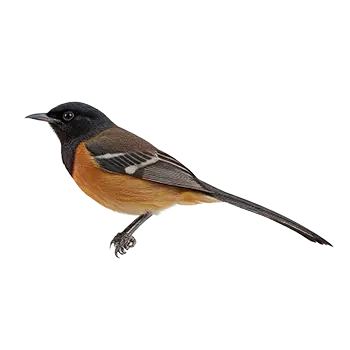

The Shama Thrush, more formally known as the White-rumped Shama (Copsychus malabaricus), is a member of the Old World flycatcher family Muscicapidae, native to the densely forested regions of South and Southeast Asia. Its natural range extends from the Indian subcontinent, including Sri Lanka, eastward through Nepal, Bangladesh, Myanmar, Thailand, Laos, Cambodia, Vietnam, peninsular Malaysia, and into the Indonesian archipelago. Within this vast geographic span, several subspecies have been described, each adapted to local conditions but sharing the defining characteristics of the species: a glossy blue-black head and upperparts, a rich chestnut belly, a conspicuous white rump patch, and a long, graduated tail that the male fans and flicks during courtship and territorial displays.
The species evolved to occupy the understory and lower canopy of tropical and subtropical broadleaf forests, where it forages among the leaf litter and low vegetation for insects, small invertebrates, and occasional fruit. Dense undergrowth, fallen logs, and tangled root systems provide both feeding grounds and nesting sites, with pairs typically selecting natural cavities in trees or stumps for their nests. The Shama Thrush's preference for mature, structurally complex forest makes it a reliable indicator species for habitat quality, and its presence or absence from a given tract of forest can signal the ecosystem's overall health.
The bird's most celebrated attribute, its song, is a product of the acoustic environment in which it evolved. The dense tropical forest canopy creates a soundscape in which lower-frequency, melodious vocalizations carry farther and more clearly than the high-pitched buzzes and trills favored by many open-country species. The Shama Thrush's vocal repertoire accordingly features rich, fluting phrases delivered with remarkable clarity and tonal variation. Males are prolific singers, especially during the breeding season, and their songs serve both to defend territories and to attract mates. Individual males develop distinctive vocal signatures, and the complexity and volume of a male's song appear to correlate with his fitness and territorial success.
Habitat loss through logging, agricultural conversion, and urban expansion has reduced the Shama Thrush's range in many parts of its native territory. Populations remain relatively stable in large protected areas and in regions where forest cover persists, but fragmentation poses ongoing challenges. The species' dependence on undisturbed forest understory means that even selective logging can degrade habitat quality sufficiently to reduce local populations, a dynamic that has shaped conservation strategies across South and Southeast Asia.