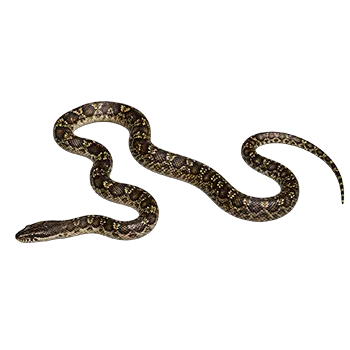

The Egg-Eating Snakes of the genus Dasypeltis represent one of the most remarkable examples of dietary specialization in the entire reptile world. Found across much of sub-Saharan Africa, these slender, non-venomous colubrids feed exclusively on bird eggs, a dietary niche so narrow that it has shaped virtually every aspect of their anatomy, behavior, and evolutionary trajectory. The genus comprises approximately sixteen recognized species, though taxonomic revision continues to refine this number as molecular studies reveal cryptic diversity within populations once considered a single widespread species.
The most commonly encountered and best-studied member of the group is Dasypeltis scabra, the Common or Rhombic Egg-Eating Snake, whose range extends from the savannas and woodlands of West Africa through Central and East Africa and southward into the grasslands and bushveld of Southern Africa. This species' extraordinary geographic range reflects its ecological flexibility, as it occupies habitats from sea-level coastal scrub to montane grasslands above five thousand feet in elevation, provided that populations of nesting birds are present to sustain it.
Despite their wide distribution and their frequent proximity to human settlements, Egg-Eating Snakes remained poorly understood by European science for a considerable period after initial contact. Early naturalists who encountered these snakes often failed to recognize the uniqueness of their feeding strategy, and the specialized vertebral apparatus that allows them to crack and compress eggshells internally was not fully described until the nineteenth century. The gap between local African knowledge of the snake's habits and European scientific understanding of the species illustrates a broader pattern in the colonial-era study of African herpetofauna.
The formal taxonomic history of Dasypeltis begins with the description of Dasypeltis scabra by Carl Linnaeus in 1758, making it one of the earliest African snake species incorporated into the Linnaean system of classification. Linnaeus worked from preserved specimens and secondhand accounts, and his original description captured the snake's rough-scaled texture but did not address the extraordinary feeding mechanism that would later make the genus famous among herpetologists. Subsequent researchers, including Andrew Smith and Wilhelm Peters, described additional species from different parts of the continent during the nineteenth century, gradually revealing the true diversity and geographic scope of the genus.