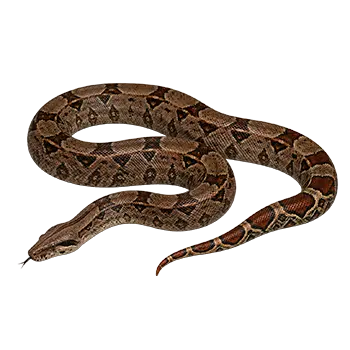

The Colombian Red-Tail Boa has served as one of the film industry's go-to snake species for decades, owing to a combination of visual appeal, manageable temperament, and widespread availability through animal wrangling companies. When a script calls for a large, impressive-looking constrictor that can be safely handled on set around actors and crew, the Colombian Red-Tail Boa is frequently the species selected. Its bold pattern of brown and tan saddles giving way to the distinctive deep red tail markings photographs beautifully under studio lighting, and its generally calm disposition makes it far more practical for on-set work than more unpredictable large snake species.
Hollywood's use of boas stretches back to the early decades of adventure cinema, when jungle-themed films demanded exotic animal props to establish atmosphere and tension. While early productions often used whatever large snake was available, the professionalization of animal wrangling for film from the 1970s onward led to increasing reliance on captive-bred Colombian Red-Tail Boas. These animals could be conditioned to tolerate the lights, sounds, and handling involved in film production, and experienced wranglers developed techniques for positioning boas to achieve specific visual effects, whether draped across an actor's shoulders, coiled on a branch in a jungle set, or moving across a carefully prepared surface.
The species' film appearances span genres from horror and adventure to comedy and drama. Boas have served as the menacing serpents in thriller sequences, as the exotic pets of villainous or eccentric characters, and as comedic foils in family-oriented films where a misplaced snake creates chaos. In each of these contexts, the Colombian Red-Tail Boa's physical characteristics, particularly its muscular build and vivid coloration, lend visual credibility to the narrative role assigned to it. Audiences may not distinguish between boa species or even between boas and pythons, but the visceral impact of a large, beautifully marked constrictor on screen is undeniable.
The relationship between the film industry and the herpetoculture community has been mutually beneficial in some respects. Film appearances introduce large audiences to the visual appeal of constrictors, and some keepers trace their initial interest in boa keeping to encounters with snakes in movies or television. Conversely, the herpetoculture community provides the film industry with access to healthy, well-socialized animals and the specialized expertise required to work with them safely. However, herpetologists and reptile advocates have also raised concerns about the way films sometimes reinforce negative stereotypes about snakes, depicting them primarily as threats or objects of fear rather than as the ecologically important and biologically fascinating animals they are.