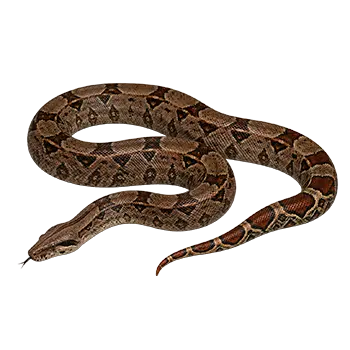

The Colombian Red-Tail Boa is a regional population of the common boa, historically classified under Boa constrictor imperator and now frequently recognized by many herpetologists as the distinct species Boa imperator. This boa inhabits the tropical and subtropical lowlands of Colombia, occupying a range that stretches from the Caribbean coastal plains and the Magdalena River valley through patches of seasonal dry forest, humid tropical forest edges, and agricultural landscapes. Its natural habitat preference for semi-open environments near water sources, forest clearings, and the margins of human settlement has placed the Colombian Red-Tail Boa in close proximity to human communities for millennia.
Western science first encountered boas from northern South America through specimens and accounts brought back by European naturalists during the age of colonial exploration. The broader species Boa constrictor was formally described by Carolus Linnaeus in 1758, making it one of the earliest New World snakes to receive a Linnaean binomial. However, the immense geographic range of boas across Central and South America meant that the taxonomic boundaries between regional populations remained poorly understood for centuries. The Colombian population was long grouped under the subspecific name Boa constrictor imperator, a designation coined by the French-American herpetologist Auguste Dumeril and his colleague Gabriel Bibron in 1844, which encompassed boa populations from Mexico through much of northern South America.
The taxonomic history of the Colombian Red-Tail Boa reflects broader debates within herpetology about how to delineate species and subspecies among wide-ranging constrictors. Genetic analyses conducted in the early twenty-first century provided support for elevating Boa imperator to full species status, separating it from the true red-tail boas of the Amazon Basin classified as Boa constrictor. Within the imperator group, the Colombian population is distinguished by its characteristically vivid red-brown tail saddles, robust build relative to other imperator locales, and generally calm disposition, traits that have made it particularly valued in captivity.
Indigenous peoples of Colombia were intimately familiar with this boa long before European contact. The snake's presence in the lowland ecosystems of the Magdalena and Cauca valleys, the Caribbean plain, and the Pacific lowlands meant that it was a well-known element of the local fauna for the various indigenous groups who inhabited these regions. Archaeological evidence from pre-Columbian sites across northern South America suggests that serpents, including large constrictors, held symbolic importance in the spiritual and artistic traditions of multiple indigenous cultures.