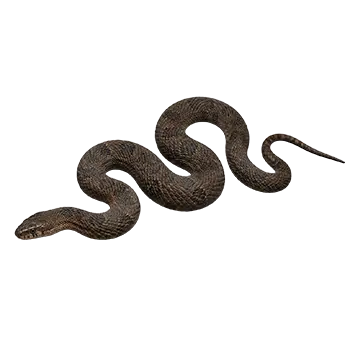

The Brown Water Snake (Nerodia taxispilota) is a large, heavy-bodied, non-venomous colubrid native to the riverine systems of the southeastern United States. Its range extends from southern Virginia through the Carolinas, Georgia, Florida, Alabama, and Mississippi, closely tracking the coastal plain and piedmont waterways where it is most abundant. The species is strongly aquatic, spending the majority of its life in or immediately adjacent to rivers, large creeks, reservoirs, and other permanent freshwater bodies, particularly those with overhanging vegetation and abundant fish populations.
The formal scientific description of the Brown Water Snake was published by the American naturalist John Edwards Holbrook in 1838 as part of his landmark multi-volume work North American Herpetology. Holbrook, a physician and zoologist based in Charleston, South Carolina, was ideally positioned to document the rich reptile fauna of the southeastern lowcountry, and his detailed descriptions and hand-colored illustrations set a high standard for the nascent discipline of American herpetology. He initially placed the species in the genus Tropidonotus, following the taxonomic conventions of the era, and it was subsequently reassigned through several generic reclassifications before settling into its current placement within Nerodia.
The specific epithet taxispilota derives from the Greek words taxis, meaning arrangement, and spilos, meaning spot, referencing the distinctive pattern of dark, squarish dorsal blotches arranged in a roughly alternating pattern along the snake's back. This patterning, combined with the species' robust build, broad head, and keeled scales, gives the Brown Water Snake a superficial resemblance to venomous pit vipers, a resemblance that has had profound consequences for human attitudes toward the species throughout its recorded history.
Prior to Holbrook's formal description, the Brown Water Snake was undoubtedly well known to the Indigenous peoples of the southeastern woodlands, including the Cherokee, Creek, Choctaw, and Seminole nations, who inhabited the river valleys where the species is most abundant. While specific ethnographic records of Indigenous names and cultural associations for the Brown Water Snake are limited compared to those for more conspicuous species like the Eastern Diamondback Rattlesnake, the general importance of serpents in southeastern Indigenous cosmology suggests that this prominent aquatic snake would have been recognized and incorporated into local ecological knowledge systems.