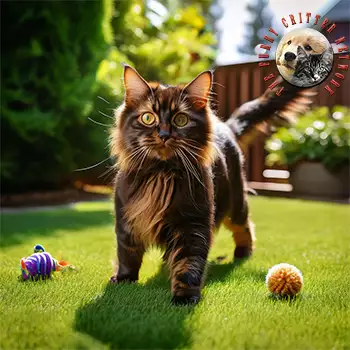

The York Chocolate owes its existence to a single unplanned litter born in 1983 on Janet Chiefari's small farm in the rural town of Grafton, New York. Chiefari kept a mixed-breed black longhaired female and a black-and-white longhaired male as working barn cats, and when a kitten appeared in their litter displaying a striking, solid chocolate-brown coat, the surprise was immediate. The kitten, named Brownie, possessed a rich, even color and a soft, flowing coat unlike anything seen in her parents, suggesting the convergence of recessive genes for both the chocolate color dilution and the longhair trait that had been silently carried through multiple generations of the farm's unregistered feline population.
Brownie grew into an exceptionally handsome cat whose temperament was as remarkable as her appearance. She was calm, sociable, and strongly bonded to her human caretaker, qualities that contrasted with the semi-feral disposition common among barn cats. When Brownie herself produced a litter the following year that included a solid chocolate male kitten Chiefari named Minky, the breeder recognized she might have stumbled upon a reproducible genetic combination rather than a one-time anomaly. The consistent reappearance of the chocolate coloring across two generations provided the initial evidence that the trait could be stabilized through selective breeding.
Chiefari, who had no prior experience in pedigree cat breeding, began researching coat color genetics and reached out to established cat fanciers for guidance. She learned that the chocolate color in cats is produced by a recessive allele at the Brown locus, designated b, which modifies the production of eumelanin pigment to produce a warm brown instead of the typical black. For a kitten to display the color, it must inherit two copies of the recessive allele, one from each parent, meaning both Brownie's sire and dam had been carriers without showing the trait themselves.
Armed with this understanding, Chiefari undertook a careful breeding program using Brownie, Minky, and subsequent offspring as foundation stock. She named the developing breed the York Chocolate, combining a reference to her home state of New York with a description of the breed's defining coat color. By the mid-1980s, she had produced several generations of cats that bred true for the chocolate or lavender coat, establishing a small but genetically consistent breeding population.