
Origins & Development

The Peterbald is a young breed by feline standards, tracing its beginnings to 1994 in St. Petersburg, Russia. The breed emerged from the work of Olga Mironova, who set out to combine the distinctive hairless quality of Russia's Donskoy (Don Sphynx) with the long, refined silhouette of the Oriental Shorthair. The result was a cat that paired an exotic, sometimes bare coat with the graceful, almost architectural body type prized in the Oriental group.

The breed's name is a compact tribute to its roots. "Peter" honors St. Petersburg, the city of its creation, while "bald" nods to the hairlessness that gave the breed its early identity. Together the name captures both place and signature trait in a single word, a fitting label for a cat developed deliberately rather than discovered by chance.

Unlike landrace breeds that develop slowly across centuries of regional isolation, the Peterbald was the product of a clear breeding vision. Early breeders worked to fix the desired body type and the range of acceptable coats while expanding a healthy gene pool. That intentional, well-documented beginning is part of what makes the breed's short history easy to trace compared with older, folklore-laden cat types.

From a handful of foundation cats, the Peterbald spread first through Russian breeding circles and then outward into Europe and North America. Its development remains relatively recent, and the breed continues to be refined by dedicated breeders who balance the pursuit of consistent type with careful attention to genetic diversity and health.

Foundation & Genetics

The Peterbald's most talked-about feature is its coat, or in some cats the near-absence of one. Hairlessness in the breed is governed by a dominant gene inherited from the Donskoy side of its ancestry. This is a meaningful genetic distinction from the better-known Sphynx, whose hairlessness arises from a different, recessive mutation. The two breeds look superficially similar but are not genetically related in the way casual observers often assume.

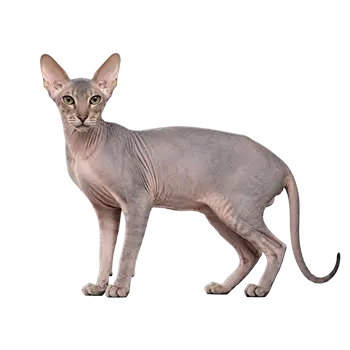
Rather than a single "bald" look, Peterbalds occur along a spectrum of coat types. These range from the completely bare "naked" cat with warm, slightly tacky skin, to the barely-there "flock" or "chamois" texture, the soft "velour," the wiry and often wavy "brush" coat, and finally the fully coated "straight" variety. Straight-coated cats carry no hairless gene but remain valuable in breeding programs for maintaining diversity and producing healthy litters.

To build a sound foundation, early breeders outcrossed to Oriental Shorthairs and Siamese, breeds that share the slender body, large flaring ears, and almond eyes that define the Peterbald's elegant frame. These outcrosses reinforced the breed's signature type while broadening the gene pool during its formative years.

A small but charming genetic quirk distinguishes many Peterbalds: notably long, dexterous toes with slight webbing. Owners often report that their cats use their paws with unusual deftness, gripping objects and opening doors in ways that feel almost hand-like. This trait, combined with the breed's expressive face, contributes to the Peterbald's reputation as an unusually interactive companion.

Cultural Symbolism

Hairless and near-hairless cats have long occupied a special place in the human imagination. Their exposed skin, prominent ears, and large eyes give them an appearance that many describe as otherworldly or even sculptural. For the Peterbald, this striking look has helped the breed become a symbol of novelty and refined exoticism, particularly within the modern cat fancy.

In Russia, where the breed originated, the Peterbald carries an association with elegance and a certain cosmopolitan flair, fitting for a cat named after one of the country's most culturally storied cities. The breed's emergence in the post-Soviet era, a period of renewed international exchange in the cat-breeding world, ties it to a moment of openness and experimentation.

More broadly, hairless cats tend to be read through a lens of rarity and distinction. Because a bare or sparse coat is uncommon, these cats are often perceived as luxury companions, prized as much for their unusual aesthetic as for their affectionate natures. The Peterbald sits comfortably within that tradition while bringing its own slender, oriental grace to the archetype.

It is worth noting that the symbolism attached to hairless cats can cut both ways. Some people find the look enchanting, while others find it unsettling. This polarizing quality has itself become part of the cultural conversation, ensuring that breeds like the Peterbald rarely go unnoticed in any room they enter.

Breed Clubs & Standards

As a deliberately developed breed, the Peterbald moved through the formal recognition process relatively quickly compared with many older cat types. It was first recognized within Russian feline organizations, where breeders established the early standards that defined acceptable body type and the spectrum of permitted coats.

International recognition followed as the breed spread beyond Russia. The Peterbald gained acceptance in major registries including The International Cat Association (TICA) and the World Cat Federation (WCF), among others. Within TICA the breed advanced to championship competition status, a milestone that allowed Peterbalds to compete formally and signaled the breed's growing maturity.

Breed standards describe the Peterbald as a medium-sized, muscular yet elegant cat with a long, wedge-shaped head, very large ears, almond-shaped eyes, and a slim, whippy tail. The standards account for the full range of coat types, from completely bald to brush and straight, recognizing that a single breeding program will naturally produce several textures.

Breed clubs play a central role in maintaining these standards, educating new owners, and promoting responsible breeding practices. Because the Peterbald is still relatively uncommon, these organizations also help connect the small but committed community of breeders working to keep the gene pool healthy and the type consistent across countries.

The Breed Today

Today the Peterbald remains a relatively rare breed, far less common than mainstream cats but with a steadily growing international following. Established breeding programs exist in Russia, across Europe, and in North America, and interest continues to rise as more cat lovers discover the breed's distinctive look and famously affectionate personality.

Modern Peterbald breeders place strong emphasis on health and temperament alongside appearance. Because the breed is young and its gene pool comparatively small, responsible breeders pay close attention to genetic diversity, careful pairing, and the inclusion of straight-coated cats to keep lines robust. Outcrossing within the Oriental group continues to be an accepted tool for maintaining vigor.

Prospective owners are often drawn to the Peterbald's combination of an exotic coat and a deeply people-oriented nature. These cats tend to bond closely with their families, follow their humans from room to room, and seek out warmth and contact, traits that make them rewarding companions for households able to meet their particular care needs.

The breed's rarity means that finding a Peterbald typically involves contacting dedicated breeders and sometimes joining a waiting list. This relative scarcity, paired with the breed's striking appearance, helps explain why the Peterbald is often described as a connoisseur's cat within the broader fancy.

Notable Individuals & Ambassadors

Because the Peterbald is a young and uncommon breed, it has not produced the long roster of historically famous individuals associated with older, more populous cats. Instead, the breed's reputation has been built collectively by show champions, breeding-program foundation cats, and the everyday companions whose owners share them with the world.

The breed's earliest ambassadors were its foundation cats, the small group of animals bred from the original Donskoy and Oriental Shorthair pairing in St. Petersburg. These cats and their immediate descendants established the type and traits that define the Peterbald today, and pedigrees across the breed trace back to this modest beginning.

In the show ring, championship-titled Peterbalds serve as living advertisements for the breed standard, demonstrating the ideal balance of elegant body, large ears, and expressive face. Their successes help raise the breed's profile and attract new breeders and owners to the community.

Perhaps the most influential ambassadors of the modern era are the countless pet Peterbalds whose photogenic, attention-loving personalities have found audiences online. Rather than a single iconic cat, the breed's fame rests on a broad and growing chorus of individuals who showcase its charm one household at a time.

Always consult a qualified professional before making any health-related decisions. This content is provided for informational reference only and should not replace professional guidance specific to your animal.