
Origins & Development

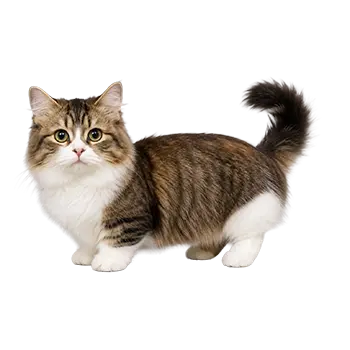
The Kinkalow is a relatively young dwarf cat breed that emerged in the United States during the 1990s. It was developed by Terri Harris, who set out to combine two distinctive feline traits into a single small, charismatic cat. The breed's name is a portmanteau evoking its two signature features: the "kink" of its curled-back ears and the "low" stance produced by its short legs.

Harris's program crossed the Munchkin, known for its short legs, with the American Curl, known for ears that curl backward. The goal was a compact cat that carried both traits reliably while retaining a sociable, kitten-like personality. Early breeding work focused on establishing the look while monitoring the health of the resulting kittens.

Because both founding traits arise from genetic mutations, the Kinkalow was developed slowly and with attention to outcrossing. Breeders typically continued to introduce Munchkin and American Curl lines to maintain genetic diversity rather than pairing two short-legged or two curl-eared cats together, a practice intended to reduce the risk of compounding skeletal issues.

The Kinkalow remains rare today, and most individuals trace back to a small number of foundation cats. Its recent origin means the breed standard is still considered developmental rather than fully fixed.

Foundation Breeds: Munchkin and American Curl

Understanding the Kinkalow begins with its two parent breeds. The Munchkin first drew widespread attention in the early 1990s and is defined by short legs caused by a dominant genetic mutation affecting long-bone growth. Munchkins are otherwise typical cats in body and temperament, and they move with a distinctive low, quick gait.

The American Curl contributes the breed's other hallmark. First documented in California in the early 1980s, the American Curl carries a spontaneous dominant mutation that causes the ear cartilage to curl away from the face. Kittens are born with straight ears that begin to curl within the first weeks of life, settling into their final shape by around four months.

Blending these lineages, the Kinkalow inherits the Munchkin's stature and the American Curl's curled ears. Not every kitten in a litter expresses both traits, since the genetics do not pass on uniformly, so breeders often produce a mix of short-legged, curl-eared, and standard-bodied kittens.

This dual heritage also shapes the breed's temperament. Both parent breeds are known for being affectionate, playful, and people-oriented, qualities the Kinkalow inherits and is valued for.

Cultural Significance

As a designer breed of recent origin, the Kinkalow does not carry the centuries of folklore or working history attached to older cat populations. Its cultural footprint is instead tied to the modern enthusiasm for distinctive, photogenic companion animals and to the broader rise of dwarf cat breeds.

The Kinkalow sits within a small family of dwarf and "designer" cats that became popular among hobby breeders and pet owners seeking unusual appearances. Within this niche, the breed is prized for its compact size and expressive ears, and it has a dedicated following among enthusiasts of small and rare cats.

The breed also occupies a place in ongoing conversations about feline welfare and ethics. Because it combines two mutation-based traits, the Kinkalow is frequently cited in discussions about whether breeding for such features is appropriate, making it culturally notable as a focal point of debate as much as for its appearance.

For owners, the Kinkalow's significance is largely personal: it is a companion cat whose looks and affectionate nature inspire strong attachment, and its community is built around shared interest rather than long tradition.

Breed Recognition & Standards

The Kinkalow is recognized as an experimental or developmental breed by The Dwarf Cat Association, an organization that documents and sets guidelines for short-legged cat varieties. This recognition supports record-keeping and standard development but is distinct from championship status in the larger international registries.

Major registries such as the Cat Fanciers' Association and The International Cat Association do not recognize dwarf cat breeds, including the Kinkalow, for championship competition. Their positions reflect both the breed's recent origin and ongoing concerns about breeding cats that carry the dwarfism mutation.

A developmental standard describes the Kinkalow as a small cat with short legs, a long tail, a rounded head, and ears that curl backward. Coat length may be short or long, and a range of colors and patterns is accepted. Because the breed is still being refined, the standard emphasizes overall health and balanced proportions.

The absence of broad championship recognition means the Kinkalow is bred and kept primarily as a companion and by specialist hobbyists rather than as a competitive show cat.

The Kinkalow Today

Today the Kinkalow remains an uncommon breed maintained by a small network of dedicated breeders, mostly in the United States. Interest is driven by enthusiasm for small, novel companion cats, and waiting lists are common because litters are limited and not every kitten displays the signature traits.

Responsible breeders place strong emphasis on health screening, outcrossing, and transparency about the breed's genetic background. Prospective owners are typically encouraged to ask about the health of parent cats and to understand the care needs associated with a small, short-legged cat.

The breed's profile has grown alongside social media, where photogenic cats attract attention quickly. This visibility has increased interest but has also intensified scrutiny from welfare advocates, keeping the Kinkalow at the center of discussion about designer breeds.

For most owners, the Kinkalow today is simply a lively, affectionate housecat. Its small size suits apartment living, and its playful temperament makes it a popular companion for those drawn to its distinctive look.

Notable Individuals & Community

Because the Kinkalow is rare and recent, it has not produced famous individual cats in the way some long-established breeds have. The breed is more often represented collectively through breeder showcases and the social media accounts of individual owners.

The most influential figure in the breed's story is its founder, Terri Harris, whose breeding work established the Kinkalow and gave it its name. Subsequent breeders have built on that foundation, and the small community that maintains the breed shares lineage information and care practices.

Online communities play a central role in the breed's culture. Owners gather in social media groups and forums dedicated to dwarf and rare cats, where they exchange photos, health information, and breeder recommendations.

These communities also serve a practical function, connecting prospective owners with reputable sources and helping to spread awareness of responsible breeding practices and the welfare considerations that accompany the breed.

Always consult a qualified professional before making any health-related decisions. This content is provided for informational reference only and should not replace professional guidance specific to your animal.