
Origins & Development

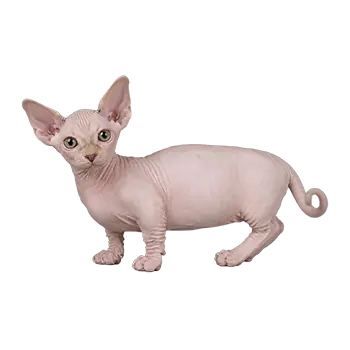
The Dwelf is one of the newest and rarest breeds in the cat world, first developed in the United States in the late 2000s. Its name is a blend of “dwarf” and “elf,” capturing both its diminutive, short-legged body and the elfin impression created by its curling ears and large, expressive eyes.

The breed was created by crossing three established cats, each contributing a single signature trait: the Sphynx for hairlessness, the Munchkin for its short legs, and the American Curl for its backward-curving ears. The result is a cat that looks unlike almost any other, combining several uncommon features in one small package.

Because it draws on multiple genetic mutations, the Dwelf has remained an experimental breed produced by only a handful of dedicated breeders. Litters are small and carefully planned, and the breed’s overall population is tiny compared with established cats, making the Dwelf a genuine rarity rather than a mainstream choice.

Development is ongoing, with breeders working to stabilize type and temperament while maintaining genetic diversity within a limited gene pool. As a young breed, the Dwelf is still defining itself, and much of its history is being written by the small community that surrounds it.

The Three Parent Breeds

Understanding the Dwelf means understanding the three breeds behind it. The Sphynx, developed from naturally occurring hairless kittens in Canada during the 1960s and 1970s, supplies the breed’s most obvious feature: a coat reduced to a fine down that leaves the cat appearing bald and warm to the touch.

The Munchkin contributes the Dwelf’s short legs. This trait comes from a naturally occurring dominant mutation affecting the long bones, and the Munchkin itself rose to wider attention in the United States during the 1980s and 1990s. It is the source of the Dwelf’s low-slung, compact stance.

The American Curl provides the distinctive ears that curl backward away from the face. First noticed in California in the early 1980s, the Curl’s ear shape results from a dominant mutation affecting the ear cartilage, and it gives the Dwelf much of its whimsical, pixie-like character.

Each of these foundation breeds is itself relatively modern, which underscores how recent the Dwelf truly is. The breed is essentially a layering of three twentieth-century discoveries into a single twenty-first-century cat.

The Rise of Designer Cats

The Dwelf belongs to a broader movement that gathered momentum in the late twentieth and early twenty-first centuries: the deliberate creation of “designer” or hybrid cat breeds built by combining distinctive mutations. Cats such as the Bambino, a Sphynx and Munchkin cross, and the Minskin emerged from similar experimentation.

What sets the Dwelf apart within this trend is the sheer number of features it brings together. Where many designer breeds combine two traits, the Dwelf layers three, making it one of the most elaborate examples of the hybrid-breed approach.

This movement is driven partly by fascination with novel appearances and partly by the appeal of small, “forever kitten” body types that keep a youthful look into adulthood. Enthusiasts celebrate the creativity involved, while welfare advocates question the wisdom of stacking multiple structural mutations, and the Dwelf sits squarely at the center of that conversation.

Cultural Symbolism & the Elf Aesthetic

Hairless cats have long carried an aura of mystery. Their bare skin and watchful eyes invite comparisons to the cats of ancient Egypt, to sphinxes, and to creatures from myth, and they tend to provoke strong reactions ranging from fascination to unease.

The Dwelf amplifies this otherworldly quality. Its curled ears, oversized eyes, and small frame evoke the elves and pixies of fantasy, a resemblance written directly into its name. For many admirers, the appeal is precisely this sense of encountering a living storybook creature.

In a culture increasingly drawn to the unusual and to the meeting point of cute and strange, the Dwelf occupies a particular niche. It functions almost as a living curiosity, a conversation piece whose appearance challenges expectations of what a domestic cat should look like.

Registries, Standards & the Recognition Debate

The Dwelf is not recognized as a championship breed by the major cat registries and is generally classified as experimental or simply rare. This places it outside the formal show system that governs more established cats.

Its parent breeds illustrate why recognition is complicated. The Munchkin, for instance, is accepted by some registries such as TICA but declined by others, including organizations that have chosen not to register breeds founded on what they regard as deforming mutations. A cat that combines several such traits inevitably inherits this controversy.

The result is an ongoing debate within the cat fancy about whether breeds built on multiple structural mutations should be encouraged. Supporters point to the Dwelf’s affectionate nature and singular appearance, while critics and some welfare bodies raise concerns about long-term health. These pages aim to present that debate factually so readers can weigh it for themselves.

The Breed Today & Its Community

Today the Dwelf remains among the rarest of cats, bred by a small and specialized group of enthusiasts rather than produced in any volume. Acquiring one usually involves seeking out the few breeders who work with the type and often joining a waiting list.

Owners tend to form close-knit communities, frequently online, where they share guidance on the breed’s particular needs, from skin care to keeping a hairless cat comfortably warm. This shared knowledge is valuable precisely because the breed is so uncommon and mainstream resources are scarce.

Social media has given the Dwelf a visibility well out of proportion to its numbers. A single photogenic cat can reach audiences far larger than the breed’s actual population, and this online presence has become central to how the Dwelf is known and discussed.

Always consult a qualified professional before making any health-related decisions. This content is provided for informational reference only and should not replace professional guidance specific to your animal.