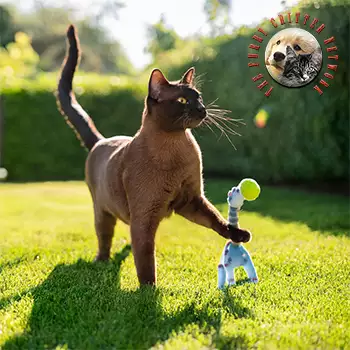

The Burmese cat traces its ancestry to Southeast Asia, where cats with similar rich brown coats were kept in temples and royal households throughout what is now Myanmar, formerly known as Burma. Ancient manuscripts from the region, including the celebrated Thai Cat-Book Poems dating to the Ayutthaya period, describe copper-colored cats that scholars believe to be early ancestors of the modern Burmese. These cats were treasured as spiritual companions and were thought to bring good fortune to the monasteries and homes they inhabited.
The breed's documented Western history begins in the early 1930s when a small, dark-brown female cat named Wong Mau was brought from Rangoon to San Francisco by a sailor and given to Dr. Joseph Cheesman Thompson, a retired U.S. Navy psychiatrist with an interest in feline genetics. Wong Mau's appearance was distinct from the Siamese cats popular at the time—she was more compact, darker in color, and possessed a rounder head and shorter muzzle. Dr. Thompson recognized she represented something genuinely different and set out to establish her unique traits as a separate breed.
Working with geneticists at Harvard University, Dr. Thompson bred Wong Mau with Siamese males, and through careful selective breeding over several generations, he isolated the gene responsible for the darker sable coat. The resulting kittens confirmed that Wong Mau carried a distinct color gene, and the offspring that bred true to her type became the foundation of the modern Burmese breed in the West. This pioneering work represented one of the earliest scientific approaches to cat breeding in America.
The cultural roots of the Burmese in Southeast Asia run deep. In Burmese Buddhist tradition, cats were believed to carry the souls of departed monks during the transition to the afterlife. Keeping and caring for these temple cats was considered an act of merit, and the cats lived in relative comfort alongside the monks. While the exact lineage connecting ancient temple cats to the modern Burmese is impossible to verify with certainty, the cultural association has remained a meaningful part of the breed's identity and lore.