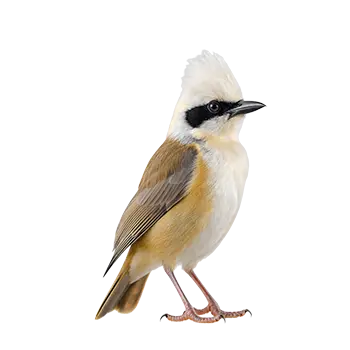

The White-crested Laughingthrush has appeared in a number of wildlife documentaries focused on Himalayan and Southeast Asian ecosystems, though it has rarely been the sole subject of a feature-length production. Its most prominent screen time has come in broader explorations of montane forest biodiversity, where the bird's gregarious behavior and unmistakable calls make it a natural scene-setter. Producers filming in the foothills of Nepal, the hill forests of northern Thailand, or the biodiversity hotspots of Yunnan Province frequently capture laughingthrush flocks as part of establishing sequences that convey the acoustic richness of these environments.
BBC Natural History Unit productions exploring Asian forests have featured the species in segments highlighting cooperative behavior among birds. The laughingthrush's habit of foraging in tightly coordinated social groups, with sentinels watching for predators while other members probe the leaf litter, provides visually compelling footage that illustrates concepts of reciprocal altruism and group dynamics. These sequences have been used effectively in educational programming aimed at demonstrating that complex social behavior is not confined to mammals.
In regional television markets, particularly in India and China, the White-crested Laughingthrush appears more frequently. Indian nature programs produced for channels covering wildlife in the Western Ghats and the northeastern states have profiled the species in episodes about the songbirds of the Himalayan foothills. Chinese nature documentaries focusing on the biodiversity of Yunnan and Sichuan provinces have similarly featured the bird, often in the context of segments about traditional bird-keeping culture and the ecological cost of trapping.
The species' vocalizations have also found use beyond strictly ornithological programming. Sound designers working on films and television series set in tropical or subtropical Asian landscapes have used laughingthrush calls as part of ambient soundscapes, even when the bird itself does not appear on screen. The cascading, laughter-like quality of the call is sonically distinctive enough to immediately evoke a forested mountain setting, and it has appeared in the background audio of travel programs, cooking shows filmed in Southeast Asia, and fictional productions seeking atmospheric authenticity.