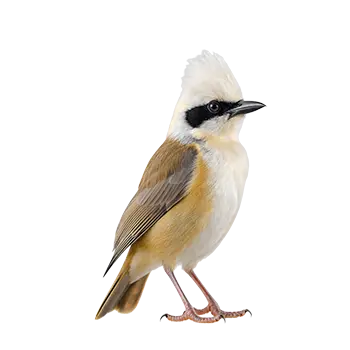

The White-crested Laughingthrush (Garrulax leucolophus) is a passerine bird belonging to the family Leiothrichidae, a group that was historically placed within the sprawling Old World babbler assemblage before molecular phylogenetics clarified its distinct lineage. The species occupies a broad geographic range across the southern slopes of the Himalayas, extending from the western foothills in northern Pakistan and India through Nepal, Bhutan, and into the hill forests of Myanmar, Thailand, Laos, Vietnam, and parts of southern China. Within this range the bird inhabits dense broadleaf and mixed forests at elevations typically between 300 and 2,500 meters, favoring undergrowth tangles, bamboo thickets, and the edges of montane clearings where leaf litter is deep and invertebrate prey is abundant.
The species thrives in humid subtropical and tropical montane environments where the canopy is sufficiently closed to create the shaded forest floor conditions it prefers. White-crested Laughingthrushes forage primarily on or near the ground, turning over leaf litter with powerful lateral sweeps of the bill to expose beetles, caterpillars, earthworms, snails, and other invertebrates. They also consume a variety of small fruits, berries, and seeds, making them functionally omnivorous within their forest ecosystem. Their preference for dense undergrowth means they are far more often heard than seen, and the species' distinctive cascading calls echoing through misty valleys are one of the most recognizable sounds of Himalayan forests.
Several subspecies have been described across the bird's extensive range, reflecting geographic variation in plumage tones, crest size, and the extent of the dark facial mask. Populations in the western Himalayas tend to be somewhat paler on the upperparts than those in Southeast Asia, and vocalizations show regional dialects that experienced listeners can distinguish. Despite this variation, the overall appearance remains consistent: a robust, medium-sized bird with a prominent erectile white crest, a bold black eye mask extending behind the head, warm rufous-brown upperparts, and a white breast that transitions to brownish flanks.
Ecologically, the White-crested Laughingthrush plays a meaningful role in seed dispersal and invertebrate population regulation within its forest habitat. Its cooperative breeding behavior and strong social bonds make it a keystone social species within mixed-species foraging flocks that are characteristic of Asian montane forests. These flocks, which can include multiple laughingthrush species alongside babblers, minlas, and fulvettas, move through the forest understory as cohesive units, and the White-crested Laughingthrush's loud contact calls often serve as the rallying signal for the entire assemblage.