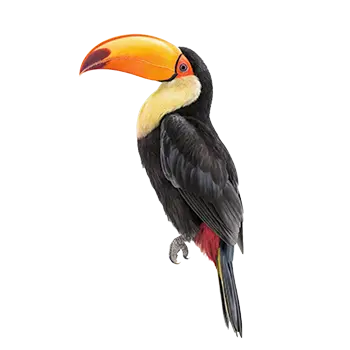

Toucans belong to the family Ramphastidae, a group of neotropical birds that evolved in the forests of Central and South America. The family encompasses roughly forty species spread across several genera, with the most widely recognized being the toco toucan (Ramphastos toco) and the keel-billed toucan (Ramphastos sulfuratus). Fossil evidence suggests that the ramphastid lineage diverged from barbets and other related birds millions of years ago, developing their signature oversized bills as an adaptation to their frugivorous lifestyle and tropical environment.
The toucan's most striking feature, its enormous and brightly colored bill, has been the subject of scientific curiosity for centuries. Early European naturalists who encountered toucans during colonial expeditions were puzzled by the bill's apparent impracticality, speculating that it served as a weapon or a device for capturing prey. Modern research has revealed that the bill plays multiple roles, including thermoregulation, fruit harvesting, and social signaling. The bill's interior is a lightweight honeycomb structure of keratin and bone, making it far lighter than its size suggests.
Toucans inhabit a range of forest environments, from lowland tropical rainforests to montane cloud forests at elevations exceeding two thousand meters. Their distribution spans from southern Mexico through Central America and into South America as far south as northern Argentina. Each species has adapted to its particular ecological niche, with variations in bill size, plumage coloration, and vocalizations reflecting the diversity of habitats they occupy.
The natural history of toucans is deeply intertwined with the ecology of tropical forests. As prolific fruit eaters, toucans play a vital role in seed dispersal, carrying seeds away from parent trees and depositing them throughout the forest canopy. This ecological service makes them important contributors to forest regeneration and biodiversity. Their nesting behavior, which involves occupying natural tree cavities or abandoned woodpecker holes, also connects them to the broader community of cavity-nesting species in tropical ecosystems.