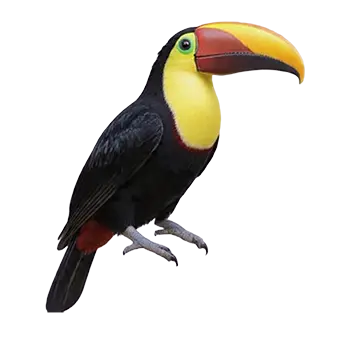

The Toucan as a Visual Icon

Few bird families possess the immediate visual impact of the toucans, and among the large Ramphastos species, Swainson's Toucan stands out for the sheer scale and contrast of its appearance. The massive bicolored bill, vivid yellow chest bordered by red, and glossy black plumage create an image that reads clearly at any size, from a postage stamp to a billboard. This graphic clarity has made toucans in general, and large species like Swainson's in particular, among the most frequently reproduced birds in visual media worldwide. The silhouette alone is sufficient for instant recognition, a quality that few other bird families can claim.

The toucan's visual appeal operates on multiple levels. In design terms, the bird offers bold primary contrasts, a distinctive profile, and a playful quality rooted in the apparent disproportion of its bill. These characteristics translate effortlessly across media formats, whether rendered in photorealistic detail for a nature magazine cover or abstracted into a flat graphic for a product label. The result is a bird that functions as visual shorthand for the tropics, for biodiversity, and for a kind of exuberant natural spectacle that commands attention even in image-saturated environments.

Swainson's Toucan specifically has benefited from its range overlapping with Costa Rica, one of the world's most photographed countries for wildlife tourism. The species appears regularly in the portfolios of professional nature photographers working in Central American rainforests, and its images circulate widely on social media, stock photography platforms, and travel publications. Because the bird is relatively approachable in the wild, particularly around fruiting trees and at forest edges near lodges and research stations, high-quality photographs are abundant, reinforcing the species' visibility in popular media.

The visual ubiquity of toucans has created a feedback loop in which familiarity drives further representation. Editors, designers, and content creators reach for toucan imagery because audiences already associate the bird with the tropics and with vibrant natural beauty. This self-reinforcing cycle has elevated the toucan to the status of a cultural icon, though it has also raised questions about whether the constant reproduction of toucan images risks trivializing the ecological realities facing the bird and its habitat.

Documentary Film & Television

Toucans have been a staple of natural history filmmaking since the genre's earliest decades. The bird's striking appearance, active foraging behavior, and loud vocalizations make it an ideal subject for the camera, and footage of toucans feeding, calling, and interacting with one another has appeared in virtually every major documentary series focused on tropical ecosystems. Productions from the BBC Natural History Unit, National Geographic, and other leading nature documentary producers have featured Ramphastos toucans extensively, often using them as flagship species to represent the richness of Neotropical rainforests.

Swainson's Toucan has appeared in numerous documentary segments filmed in Costa Rica and Panama, where the concentration of research stations and ecotourism infrastructure provides filmmakers with reliable access to wild populations. The species' habit of visiting fruiting trees at predictable times of day makes it particularly filmable, and its tolerance of human presence in habituated areas allows for close-range footage that reveals behavioral details difficult to capture with more skittish species. Scenes of Swainson's Toucans tossing fruit in their bills, engaging in courtship displays, and interacting at communal roosts have become familiar components of tropical wildlife programming.

Beyond traditional nature documentaries, toucans have appeared in travel shows, cooking programs set in tropical locations, and educational children's programming. The bird's charismatic appearance and accessible behavior make it a natural fit for content aimed at younger audiences, and animated or narrated segments featuring toucans have been used to introduce children to concepts of tropical ecology, biodiversity, and conservation. These appearances, while often brief, contribute to the cumulative cultural visibility that keeps toucans in the public consciousness.

The rise of streaming platforms and online video has expanded the documentary landscape for tropical wildlife, and toucans have benefited from this proliferation. Independent filmmakers, wildlife vloggers, and citizen scientists regularly produce toucan content for platforms such as YouTube, creating a decentralized but vast archive of footage that ranges from professionally produced mini-documentaries to casual field observations recorded on smartphones. This digital ecosystem has democratized access to toucan imagery and information, making the bird more visible to global audiences than at any previous point in its history.

Advertising & Commercial Branding

The toucan's role in commercial branding represents one of the most significant intersections of wildlife imagery and consumer culture in the 20th and 21st centuries. The most famous commercial toucan, a cartoon mascot created in the 1960s for a major breakfast cereal brand, drew on the Ramphastos toucan's general body plan and exaggerated its colorful bill into a character that became one of the most recognized advertising figures in North American history. While this mascot was not modeled on Swainson's Toucan specifically, the character drew from the visual vocabulary established by large, brightly billed toucan species, and its success owed much to the real bird's inherent graphic appeal.

Beyond the cereal aisle, toucan imagery has been deployed across a wide range of commercial contexts. Airlines, beverage companies, resort chains, and outdoor apparel brands have all used toucan motifs to evoke the tropics, adventure, and ecological awareness. In Costa Rica, where Swainson's Toucan is among the most visible wildlife species, local businesses routinely incorporate toucan imagery into their branding, from small eco-lodges and surf shops to large tourism operators and craft breweries. The bird's image has become intertwined with the country's national brand as a destination for sustainable tourism and adventure travel.

The commercial use of toucan imagery has sparked discussion about the ethics and accuracy of wildlife branding. Critics argue that cartoonish or overly stylized toucan mascots can trivialize the species, creating a perception that the bird is more of a commercial property than a living organism facing real conservation challenges. Proponents counter that commercial visibility keeps the toucan in the public eye and can indirectly support conservation by building affinity between consumers and tropical wildlife. The tension between these perspectives reflects a broader debate about how commercial culture interacts with the natural world.

Swainson's Toucan specifically has appeared in promotional materials for ecotourism operations in Costa Rica and Panama, where its status as the region's largest toucan makes it a draw for birdwatchers and wildlife photographers. Tour operators often feature the species prominently in their marketing, and sightings of Swainson's Toucan are highlighted in trip reports and reviews as markers of a successful wildlife experience. This commercial value has reinforced the economic argument for habitat conservation, as the bird's presence in a given area can directly influence tourism revenue.

Literature, Art & Illustration

Toucans entered the Western literary and artistic imagination almost immediately upon European contact with the Americas. The earliest published illustrations of toucans date to the 16th century, and by the 18th century, the bird had become a standard subject in the lavishly illustrated ornithological folios that defined the era's approach to natural history. Artists such as Edward Lear, whose hand-colored lithographs of parrots and toucans remain prized by collectors, brought the toucan's form to life with a precision and aesthetic sensitivity that elevated the bird to the status of fine art subject. John Gould, who formally described Swainson's Toucan, also produced detailed plates of the species for his ornithological monographs, ensuring that the bird was documented with both scientific accuracy and visual elegance.

In literature, toucans have appeared as symbols of the exotic, the untamed, and the aesthetically extraordinary. Travel writers and novelists working in tropical settings have frequently invoked the toucan's call or appearance as atmospheric detail, using the bird to establish a sense of place that signals remoteness, biological richness, and the sensory intensity of the rainforest. While specific literary references to Swainson's Toucan by name are uncommon, the toucan as a general figure is a well-established presence in the literature of tropical exploration and adventure.

Contemporary visual artists continue to draw on the toucan's form for both representational and abstract work. The bird's bold color blocks and distinctive silhouette lend themselves to graphic art, screen printing, and digital illustration, and toucan-themed artwork appears regularly in galleries, online marketplaces, and design publications. In Latin American art specifically, toucan imagery often carries additional layers of meaning related to national identity, environmental advocacy, and the relationship between indigenous and modern cultures.

Children's literature has embraced the toucan with particular enthusiasm. The bird's colorful appearance and the inherent curiosity of its oversized bill make it a natural character for picture books, alphabet primers, and early readers focused on animals and nature. These literary appearances introduce young readers to the toucan long before they might encounter one in the wild or even in a zoo, establishing a familiarity and affection that can persist into adulthood and, in some cases, inspire future engagement with conservation or ornithology.

Social Media & Digital Culture

The digital age has transformed the toucan's cultural presence, amplifying its visibility through platforms that reward visually striking content. Swainson's Toucan and its Ramphastos relatives are among the most shared and liked bird species on platforms such as Instagram, where high-resolution photographs and short video clips of toucans feeding, calling, and interacting routinely attract thousands of engagements. The species' photogenic qualities, particularly the vivid contrast between its dark plumage and brightly colored bill and bib, translate exceptionally well to the square-format, scroll-driven aesthetics of social media feeds.

Wildlife photographers and ecotourism operators have leveraged the toucan's social media appeal to build audiences and promote conservation messaging. Accounts dedicated to Neotropical birdlife frequently feature Swainson's Toucan alongside other charismatic species, using the bird's visual magnetism to draw attention to less photogenic but equally important aspects of tropical ecology. Hashtags related to toucans, birdwatching, and rainforest wildlife generate substantial engagement, and viral toucan posts have on multiple occasions driven spikes in interest toward ecotourism destinations in Costa Rica and Panama.

The toucan has also found a place in the informal visual language of internet culture. Toucan imagery appears in memes, reaction images, and decorative graphics shared across platforms, often divorced from any specific ecological or geographic context. While this decontextualized usage can strip the bird of its biological identity, it also ensures that the toucan's image remains current and culturally relevant in rapidly evolving digital spaces. The bird has become, in effect, a universal symbol of color, exuberance, and the appeal of the natural world, accessible to audiences who may have no direct connection to tropical forests.

Citizen science platforms have added another digital dimension to the toucan's cultural footprint. Platforms such as eBird and iNaturalist allow birdwatchers and nature observers to log sightings of Swainson's Toucan and other species, creating publicly accessible datasets that inform both scientific research and public engagement. The gamification elements built into many of these platforms, including species checklists, achievement badges, and community leaderboards, have turned toucan sightings into a form of participatory culture that bridges the gap between casual interest and substantive conservation awareness.

Education & Public Awareness

Swainson's Toucan and its relatives play a prominent role in environmental education programs across the Americas and beyond. In Costa Rica and Panama, where the species is a familiar presence in national parks and biological reserves, toucan imagery features centrally in interpretive signage, visitor center displays, and ranger-led educational programs. The bird's charismatic appearance makes it an effective ambassador species, capable of engaging visitors who might otherwise find tropical ecology abstract or inaccessible. By focusing attention on a single, visually compelling species, educators can introduce broader concepts of habitat connectivity, seed dispersal, dietary ecology, and the interdependence of forest organisms.

Zoos and aquariums worldwide maintain Swainson's Toucans as part of their living collections, and these captive individuals serve as focal points for educational programming aimed at both children and adults. Keeper talks, behind-the-scenes tours, and interactive feeding demonstrations featuring toucans are among the most popular programming formats at institutions that house the species. The bird's active behavior, willingness to engage with enrichment items, and responsiveness to keeper interaction make it a natural performer in educational settings, and the visual impact of seeing a large toucan at close range leaves a lasting impression on visitors.

In formal education, toucans appear in biology and ecology curricula at multiple levels, from elementary school units on tropical animals to university courses in ornithology and conservation biology. The toucan's bill, in particular, has become a case study in evolutionary adaptation, used to illustrate concepts of thermoregulation, sexual selection, and the functional morphology of feeding structures. Research published on the thermal properties of the Ramphastos bill, which functions as a radiator for dissipating body heat, has reached both academic and popular audiences, making the toucan a frequent reference point in discussions of biological engineering and biomimicry.

Non-governmental organizations focused on tropical conservation have adopted toucan imagery as a fundraising and awareness tool. The bird's immediate recognizability and positive associations make it an effective icon for campaigns promoting rainforest protection, sustainable agriculture, and the economic value of biodiversity. Swainson's Toucan, as a species tied to the internationally celebrated conservation success story of Costa Rica, carries particular weight in these contexts, embodying the possibility that economic development and ecological stewardship can proceed in tandem.

Always consult a qualified professional before making any health-related decisions. This content is provided for informational reference only and should not replace professional guidance specific to your animal.