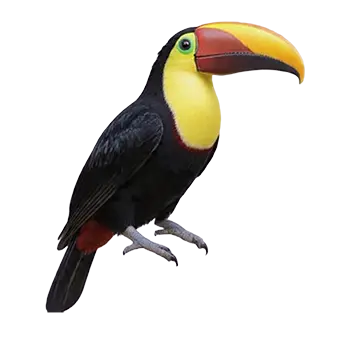

The international trade in Swainson's Toucan is governed primarily by the Convention on International Trade in Endangered Species of Wild Fauna and Flora (CITES), a multilateral treaty to which more than 180 countries are party. All species in the genus Ramphastos, including Swainson's Toucan, are listed under CITES Appendix II. This designation means that international commercial trade in the species is permitted but must be regulated to prevent levels of exploitation that would be detrimental to wild populations. Any shipment of Swainson's Toucans or their parts across international borders requires export permits issued by the CITES Management Authority of the country of origin, and these permits are granted only when the exporting nation's Scientific Authority has confirmed that the trade will not harm the species' survival.
The CITES Appendix II listing does not prohibit trade outright, but it establishes a framework of documentation, monitoring, and enforcement that significantly constrains the movement of toucans across international boundaries. Each specimen or product must be accompanied by valid permits, and importing countries are required to verify these documents before allowing entry. Countries may also impose stricter domestic measures under CITES Article XIV, and several nations have done so, either by banning all imports of wild-caught Ramphastos toucans or by limiting imports to captive-bred specimens accompanied by breeding facility registration documentation.
The European Union has historically maintained some of the strictest import controls for CITES-listed species, requiring not only valid export permits but also import permits issued by the EU CITES Management Authority of the destination member state. The United States enforces CITES regulations through the Lacey Act and the Endangered Species Act, with the U.S. Fish and Wildlife Service serving as the designated Management Authority. Both jurisdictions require that any person or entity importing Swainson's Toucans demonstrate compliance with the exporting country's laws, the importing country's laws, and all applicable CITES provisions.
Violations of CITES regulations carry significant penalties, including seizure of specimens, substantial fines, and criminal prosecution in serious cases. Enforcement agencies in multiple countries collaborate through INTERPOL's Environmental Security Sub-Directorate and the World Customs Organization to detect and intercept illegal shipments of wildlife, including toucans. Despite these efforts, illegal trade in wild-caught toucans persists at varying levels, driven by demand in the pet trade and by the difficulty of monitoring vast stretches of tropical forest and remote border crossings in Central and South America.