
Origins & Natural Habitat

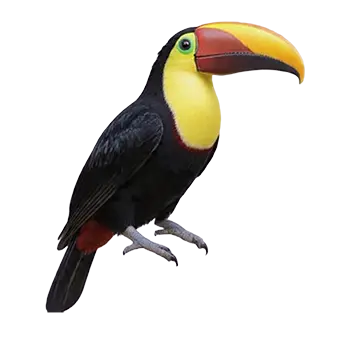
Swainson's Toucan (Ramphastos swainsonii) is a large ramphastid native to the humid lowland and premontane forests stretching from southeastern Honduras through Nicaragua, Costa Rica, Panama, and into the Pacific slopes of western Colombia and northwestern Ecuador. It is the largest toucan found in Central America and one of the most visually commanding birds in its range, identifiable by its massive bicolored bill, predominantly black plumage, bright yellow bib bordered by a narrow band of red, and vivid chestnut-red undertail coverts. The species occupies an ecological niche centered on the canopy and upper mid-story of mature tropical forest, though it readily exploits forest edges and semi-open habitats where fruiting trees are abundant.

The bird's preferred habitat lies within the tropical wet and premontane wet life zones, typically from sea level up to approximately 1,500 meters in elevation, though occasional records exist from somewhat higher altitudes. Within these forests, Swainson's Toucan depends on large-cavity nesting sites, most often in the hollows of standing dead trees, a requirement that ties its reproductive success to the structural integrity of old-growth and secondary-growth forests alike. Its diet is dominated by a wide variety of fruits, particularly those of Cecropia, Ficus, and palms, though it supplements with insects, small lizards, bird eggs, and nestlings when opportunities arise.

As a canopy-dwelling frugivore, the species plays a significant role in seed dispersal within its ecosystem. Toucans swallow fruits whole and regurgitate or defecate intact seeds at distances from the parent tree, facilitating forest regeneration across the landscape. This ecological function links the toucan's wellbeing directly to forest health and underscores the ecological consequences of population declines. Deforestation, particularly the conversion of lowland forest to cattle pasture and agriculture, has fragmented the species' range in parts of Honduras and Colombia, though substantial populations persist in Costa Rica and Panama where protected areas remain large and contiguous.

The species' evolutionary lineage places it within the family Ramphastidae, a Neotropical radiation closely related to woodpeckers and barbets in the order Piciformes. The oversized bill, which can account for nearly one-third of the bird's total length, serves multiple functions including thermoregulation, fruit processing, and social signaling. Fossil and molecular evidence suggests that toucans diversified rapidly during the late Miocene and Pliocene as the Andes uplifted and created new habitat corridors and barriers across Central and South America, driving speciation within the group.

Indigenous Significance & Pre-Colonial History

Long before European naturalists catalogued the fauna of the Neotropics, the indigenous peoples of Central and South America recognized toucans as culturally important animals. Among the various peoples inhabiting the tropical lowlands of present-day Costa Rica, Panama, and Colombia, toucans featured prominently in cosmological narratives, artistic traditions, and material culture. The bird's striking bill and bold coloration made it a potent visual symbol, and its feathers, particularly those of large Ramphastos species, were used in ceremonial regalia, headdresses, and body ornamentation across multiple cultural groups.

In pre-Columbian Mesoamerica and lower Central America, toucan imagery appears on gold ornaments, ceramic vessels, and stone carvings produced by cultures including the Diquis, Chiriqui, and Muisca. Gold pendants shaped in the form of toucans have been recovered from archaeological sites in Costa Rica and Panama, suggesting that the bird held spiritual or elite status in these societies. The precise species represented in these artifacts is often difficult to determine, but Swainson's Toucan, as the largest and most conspicuous toucan in the region, is a strong candidate for the model behind many of these depictions.

Among the Bribri and Cabecar peoples of Costa Rica's Talamanca region, toucans occupy a place in oral tradition as messengers or mediators between the natural and spiritual worlds. Their loud, far-carrying calls, which echo across the forest canopy at dawn and dusk, have been interpreted as announcements or omens in various indigenous frameworks. The specific cultural meanings attached to toucans vary among communities, but a recurring theme is the bird's association with the upper realm of the forest and, by extension, with the sky, the weather, and the domain of powerful spiritual beings.

The use of toucan bill sheaths as trade items and prestige goods further illustrates the bird's cultural value in pre-colonial societies. The keratinous outer casing of the bill, lightweight yet visually dramatic, was fashioned into decorative objects or exchanged along trade routes connecting highland and lowland communities. This trade in toucan materials created economic linkages that extended the bird's cultural footprint well beyond the forests it physically inhabited, embedding it in networks of exchange and meaning that spanned significant portions of the isthmus.

European Discovery & Scientific Description

The arrival of Spanish and Portuguese explorers in the Americas during the late 15th and 16th centuries brought toucans to European attention for the first time. Early colonial-era chroniclers were captivated by the toucan's extraordinary bill, which had no parallel among European birds, and descriptions of the bird appeared in natural history compilations almost as soon as systematic accounts of New World fauna began to circulate. The Swiss naturalist Conrad Gessner included toucan illustrations in his monumental Historiae Animalium in the mid-1500s, and subsequent works by naturalists such as Georg Marcgraf, Ulisse Aldrovandi, and the Comte de Buffon expanded European knowledge of the group.

Swainson's Toucan itself was formally described in 1834 by the English naturalist John Gould, who named the species in honor of William Swainson, a prolific illustrator and ornithologist whose contributions to the classification of birds were widely recognized during the 19th century. Gould's description was based on specimens collected in the forests of Central America, and the bird was placed within the genus Ramphastos alongside its closest relatives. The choice of eponym reflected the collaborative and often competitive world of Victorian-era natural history, in which naming rights carried both scientific and social significance.

During the 18th and 19th centuries, toucan specimens became prized items in the cabinets of curiosities and natural history museums that were proliferating across Europe. Mounted toucans, preserved bills, and detailed illustrations appeared in the collections of institutions from London to Paris to Berlin, cementing the toucan's status as one of the most recognizable birds of the Neotropics. The vividness of the bill and plumage made toucans popular subjects for the hand-colored lithographic plates that defined the golden age of ornithological illustration, and artists such as John Gould, Edward Lear, and Jacques Barraband all produced notable toucan images.

The scientific study of Swainson's Toucan advanced steadily through the 20th century as field ornithologists working in Central America documented its ecology, behavior, and distribution in greater detail. Research stations established in Costa Rica and Panama, including those affiliated with the Organization for Tropical Studies and the Smithsonian Tropical Research Institute, provided institutional support for long-term studies of toucan biology. These efforts produced foundational knowledge about the species' diet, breeding behavior, home range, and interactions with other cavity-nesting species, laying the groundwork for the conservation initiatives that would follow.

Cultural Symbolism Across Traditions

The toucan's symbolic resonance extends far beyond the indigenous cultures of its native range. In the broader popular imagination, toucans have become emblematic of tropical biodiversity, appearing as shorthand for the lush, vibrant ecosystems of Central and South America. Swainson's Toucan, with its dramatic size and coloration, has contributed to this symbolic association, even when the specific species is not identified by name. The bird's image evokes the rainforest in ways that are immediate and visceral, serving as an unofficial ambassador for tropical conservation in contexts ranging from educational materials to ecotourism marketing.

Within Costa Rica, toucans hold a special place in the national cultural consciousness. The country's reputation as a global leader in conservation and ecotourism is closely tied to its charismatic wildlife, and toucans are among the most frequently depicted animals in Costa Rican visual culture. They appear on souvenirs, restaurant signs, hotel logos, and public murals, functioning as symbols of the country's commitment to protecting its natural heritage. Swainson's Toucan, as the largest toucan species in Costa Rica, is a frequent subject of wildlife photography and features regularly in birding guides and promotional materials for the country's national parks and biological reserves.

The symbolic weight of the toucan has also been felt in the world of commerce and branding. The most famous commercial toucan, though based on a generalized rather than species-specific design, helped establish the toucan as a universally recognizable figure in global consumer culture. This commercial visibility has had a complex legacy: it has raised public awareness of toucans as a group but has also flattened the diversity of toucan species into a single, stylized image, obscuring the ecological and taxonomic distinctions among the more than 40 species in the family Ramphastidae.

In art and design, the toucan's bold lines and contrasting colors have made it a recurring motif in graphic design, textile patterns, and decorative arts. Mid-century modern designers and tropical-themed artists have drawn on the toucan's form for everything from wallpaper prints to ceramic figurines. This aesthetic appeal has kept the toucan in the visual vocabulary of contemporary design, ensuring that even people with no direct experience of tropical forests can recognize the bird's distinctive silhouette.

Conservation History & Modern Challenges

The conservation history of Swainson's Toucan reflects broader patterns of habitat loss and species management across the Neotropics. For much of the 20th century, the primary threat to the species was deforestation driven by agricultural expansion, logging, and infrastructure development. In Honduras and parts of Nicaragua, large tracts of lowland forest were converted to banana plantations, cattle ranches, and subsistence farms, fragmenting the toucan's habitat and reducing the availability of nesting cavities. Similar pressures affected populations in western Colombia and northwestern Ecuador, where forest clearance for agriculture and urbanization has been extensive.

International conservation efforts began to address these threats in the latter half of the 20th century. The Convention on International Trade in Endangered Species of Wild Fauna and Flora (CITES) listed all Ramphastos toucans under Appendix II, regulating their international trade and establishing monitoring requirements for exporting countries. Within range states, the establishment of national parks and biological reserves provided critical habitat protection. Costa Rica's extensive protected area network, which covers more than a quarter of the country's land area, has been particularly important for maintaining viable populations of Swainson's Toucan and other large forest birds.

Despite these protections, the species continues to face challenges. Habitat fragmentation isolates populations and reduces genetic exchange, while illegal capture for the domestic and international pet trade persists at varying levels across the range. Climate change poses an emerging threat, with shifting temperature and precipitation patterns potentially altering the distribution of fruiting trees and the timing of breeding seasons. Conservation biologists are increasingly focused on maintaining and restoring forest corridors that connect fragmented populations, recognizing that long-term viability depends on landscape-level connectivity rather than isolated reserves alone.

Community-based conservation initiatives have emerged as an important complement to formal protected areas. In Costa Rica and Panama, programs that engage local communities in forest monitoring, reforestation, and sustainable livelihoods have shown promise in reducing deforestation pressures and building local support for wildlife conservation. Ecotourism, in particular, has provided economic incentives for forest protection, as birdwatchers and nature tourists bring revenue to rural communities where toucans and other charismatic species can be reliably observed. The economic value of a living toucan in a healthy forest has, in some areas, come to exceed the value of the timber that would be gained by cutting the trees down.

Swainson's Toucan in Aviculture

Swainson's Toucan has been kept in captivity since at least the mid-19th century, when European zoos and private collectors began importing Neotropical birds in significant numbers. Early captive keeping was largely experimental, with high mortality rates reflecting a poor understanding of the species' dietary and environmental needs. Toucans proved more delicate than many other tropical birds in captivity, requiring diets rich in fresh fruit and low in iron to avoid the iron storage disease (hemochromatosis) that plagues ramphastids in captive settings. This dietary sensitivity remained poorly understood until the latter decades of the 20th century, when avian veterinarians and aviculturists identified the condition and developed management protocols.

Modern aviculture has substantially improved outcomes for captive Swainson's Toucans. Specialized softbill diets formulated with low-iron fruit pellets, supplemented with diced fresh fruits such as papaya, blueberries, and melon, have reduced the incidence of hemochromatosis and extended captive lifespans. Breeding programs in accredited zoos and private facilities have achieved consistent reproductive success, with birds typically nesting in enclosed wooden nest boxes that simulate the natural tree cavities they would use in the wild. The Association of Zoos and Aquariums (AZA) manages a Species Survival Plan for Ramphastos toucans that coordinates breeding efforts across participating institutions in North America.

In the private aviculture community, Swainson's Toucan is regarded as a charismatic but demanding species that requires spacious flight enclosures, consistent access to high-quality fruit, and attentive veterinary care. Keepers note the bird's playful and curious temperament, its responsiveness to human interaction, and its tendency to engage in bill-fencing and object-tossing behaviors that appear to serve both social and enrichment functions. The species' intelligence and sociability make it rewarding for experienced aviculturists, though the commitment of time, space, and resources it demands places it beyond the reach of casual hobbyists.

The role of captive populations in conservation remains a subject of discussion within the avicultural and conservation communities. While captive breeding maintains a genetic reservoir and provides opportunities for public education and awareness, the primary conservation need for Swainson's Toucan remains the protection and restoration of wild habitat. Captive individuals serve as ambassadors for their wild counterparts, and well-managed zoo exhibits and educational programs have proven effective at building public support for tropical forest conservation. The challenge going forward is to ensure that captive management practices continue to improve while maintaining the focus on wild population health as the ultimate measure of conservation success.

Always consult a qualified professional before making any health-related decisions. This content is provided for informational reference only and should not replace professional guidance specific to your animal.