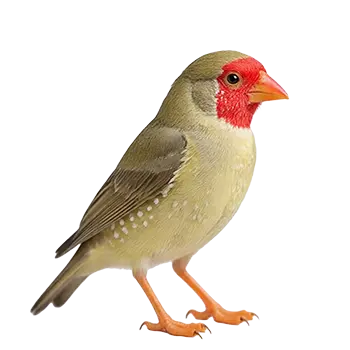

The Star Finch owes much of its early visibility beyond Australia to the tradition of ornithological illustration that flourished in the 19th century. John Gould's The Birds of Australia, published between 1840 and 1848, included a hand-colored lithograph of the Star Finch that remains one of the most iconic depictions of the species. Gould's plates, prepared through a labor-intensive process involving pencil sketches, stone lithography, and meticulous hand coloring, captured the bird's olive-green plumage, crimson face, and signature white spotting with a fidelity and aesthetic grace that set a benchmark for subsequent illustrators. The image circulated widely among natural history collectors and institutions, introducing the Star Finch to audiences who would never encounter it in the wild.
Gould was not the only artist to depict the species during this period. As Australian birds entered European collections, other illustrators incorporated the Star Finch into comprehensive works on the world's avifauna. Gregory Mathews' The Birds of Australia, published in the early 20th century, provided updated plates that reflected the evolving understanding of the species' subspecific variation. These illustrations served a dual purpose: they were scientific tools, used by taxonomists and museum curators to compare plumage characters, and they were objects of beauty, appreciated by a growing public audience with an appetite for natural history art.
The tradition of painting Australian finches proved enduring. Mid-20th-century bird artists, working in both watercolor and gouache, continued to produce portraits of the Star Finch for field guides, monographs, and avicultural handbooks. The species' compact form, vivid face, and intricate spotting made it a rewarding subject, and many of these illustrations achieved a level of detail that photographs of the era struggled to match. Even as photography gradually supplanted illustration as the primary medium for bird identification, painted images of the Star Finch retained their value as aesthetic and educational objects.
The legacy of these early and mid-period illustrations persists in modern reprints, museum exhibitions, and the broader cultural appreciation of natural history art. Gould's Star Finch plate, in particular, is regularly reproduced in books on the history of ornithology and is occasionally featured in exhibitions dedicated to 19th-century scientific illustration. For many people, their first encounter with the Star Finch is still through one of these carefully rendered images rather than through a photograph or a live bird.