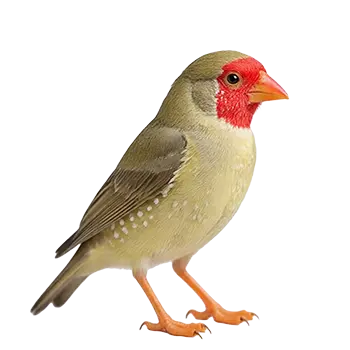

The Star Finch (Neochmia ruficauda) is a small passerine bird endemic to the tropical and subtropical grasslands of northern Australia. Its range stretches in a broad arc from the Kimberley region of Western Australia through the Top End of the Northern Territory and into coastal and sub-coastal Queensland, roughly following the belt of tall-grass savanna that flanks the continent's northern rim. Within this range the species favors habitat where open grassland meets watercourses — the margins of rivers, creeks, swamps, and artificial stock dams where seeding grasses grow densely and reliable drinking water is close at hand.
Three subspecies have been described. The nominate form, Neochmia ruficauda ruficauda, occupies the eastern portion of the range across Queensland. Neochmia ruficauda clarescens is found in the Northern Territory and parts of the Kimberley, and is sometimes noted for a marginally paler plumage. A third subspecies, Neochmia ruficauda subclarescens, has been proposed for populations in the western Kimberley, though not all authorities recognize this division. Across all forms, the Star Finch is distinguished by its olive-green upperparts, bright red face, and a scattering of fine white spots across the flanks and breast that give the bird the celestial appearance from which its common name derives.
Ecologically, the Star Finch is a ground-feeding granivore that depends on the annual cycle of grass seeding in Australia's wet-dry tropics. During the wet season, pairs breed in loose colonies, constructing domed nests of grass in low shrubs or tussocks near water. As the dry season progresses and surface water contracts, flocks concentrate around remaining water sources, sometimes forming aggregations of several hundred birds. This seasonal rhythm ties the species closely to the health of its grassland habitat, making it sensitive to changes in fire regime, grazing pressure, and water management.
The evolutionary origins of the Star Finch are rooted in the broader radiation of the Estrildidae, the waxbill family, which diversified extensively across Australasia, Africa, and southern Asia. Within Australia, the genus Neochmia includes the closely related Crimson Finch, and molecular studies place these species within a clade of Australasian grassfinches that adapted to the continent's unique mosaic of tropical grassland, woodland, and wetland habitats over millions of years. By the time European naturalists arrived in Australia, the Star Finch was a well-established component of the northern savanna avifauna, occupying an ecological niche shaped by fire, flood, and the deep seasonal pulse of the Australian tropics.