
Literature & Classical Poetry

The Spotted Dove has occupied a quiet but persistent place in the literary traditions of South and Southeast Asia for centuries. In classical Sanskrit and Tamil poetry, doves appear as emblems of tenderness, longing, and domestic fidelity. While ancient poets rarely distinguished species with the precision of modern ornithology, the pervasive presence of the Spotted Dove in Indian village life means it was almost certainly among the birds that inspired literary references to cooing doves perched in flowering trees, calling at dawn, or nesting near temple courtyards. The dove's soft, repetitive vocalization became a ready metaphor for the constancy of devotion and the gentle persistence of memory.

In Chinese literary tradition, doves and turtledoves appear in poetry dating back to the Shijing, the Classic of Poetry compiled around the 6th century BCE. Later poets of the Tang and Song dynasties referenced doves in pastoral imagery, associating them with rural tranquility and the arrival of spring. The Spotted Dove, as one of the most common dove species in southern China, would have been a familiar part of the landscape that inspired these verses. Its call, a measured three-note phrase repeated at intervals, lent itself to poetic descriptions of morning calm and garden solitude.

In the modern literary period, the Spotted Dove has occasionally appeared in the work of South Asian and Southeast Asian writers as a symbol of continuity with an older, more pastoral way of life. Indian novelists and short story writers have used the dove's cooing as atmospheric detail, evoking the sensory texture of small-town or village settings. In Malay and Indonesian literature, doves carry similarly gentle associations, often standing in for domesticity, simplicity, or the beauty of the natural world as it exists alongside human habitation.

Western literature has engaged with the Spotted Dove more sparingly, largely because the species was unfamiliar to European and American audiences until the 20th century. Where it does appear, it tends to function as an element of local color in fiction or travel writing set in South or Southeast Asia. Naturalist writers and memoirists describing life in colonial India, British Malaya, or the Dutch East Indies occasionally mentioned the Spotted Dove by name, noting its prevalence and its contribution to the soundscape of tropical gardens and verandas.

Visual Arts & Illustration

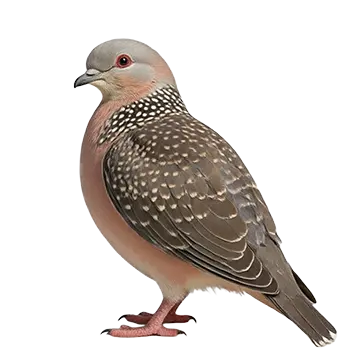
The Spotted Dove has a distinguished presence in the visual arts of Asia, particularly within the traditions of Chinese, Indian, and Southeast Asian painting and decorative arts. In Chinese brush painting, doves are a recurrent subject, rendered perched on branches of plum blossom, bamboo, or wisteria in compositions that emphasize harmony between the natural and cultivated worlds. While artists did not always depict species with strict fidelity, the general form and posture of the Spotted Dove, with its rounded body, long tail, and distinctive neck pattern, can be recognized in numerous works from the Ming and Qing dynasties.

In the Mughal miniature painting tradition of the Indian subcontinent, birds were rendered with extraordinary naturalistic precision, and doves appear regularly in garden scenes, hunting compositions, and studies of court life. The artists of the Mughal ateliers, working under emperors who took a keen personal interest in natural history, produced detailed avian portraits that sometimes allow identification to the species level. While the Spotted Dove was not as prominently featured as raptors or peacocks, it appears in the background of pastoral compositions that sought to represent the complete richness of the Indian landscape.

The tradition of Western ornithological illustration incorporated the Spotted Dove during the 18th and 19th centuries, as European naturalists documented the avifauna of South and Southeast Asia. Artists such as John Gould and his collaborators produced lithographic plates of the species for ornithological publications, capturing the delicate patterning of the neck patch and the warm brown tones of the plumage with considerable accuracy. These illustrations served as primary identification references for decades before the advent of field photography and remain aesthetically valued by collectors and natural history enthusiasts.

In contemporary visual culture, the Spotted Dove appears most frequently in the context of wildlife photography and digital media. The species' tolerance of close approach and its habit of perching on exposed branches, fences, and rooftops make it an accessible and photogenic subject for bird photographers at all skill levels. Photography communities in India, Australia, and Southeast Asia regularly feature Spotted Dove images in online galleries and competitions, and the bird's combination of subtle plumage beauty and widespread availability ensures a steady stream of high-quality portraits that keep the species visible in modern visual media.

Film, Television & Documentary

The Spotted Dove's appearances in film and television have been largely incidental rather than starring, but the species has contributed to the auditory and visual atmosphere of countless productions set in tropical and subtropical Asia. Filmmakers working on location in India, Thailand, Indonesia, and other countries within the dove's native range frequently capture its cooing on ambient sound recordings, and the call has become an almost subliminal signifier of South or Southeast Asian settings in both regional and international cinema. Audiences familiar with the sound can identify it as a background element in dramas, romances, and historical films set in village or small-town environments.

In Bollywood and regional Indian cinema, outdoor scenes filmed in gardens, courtyards, and rural landscapes often include Spotted Doves as natural extras, visible on walls, wires, and tree branches. While individual doves are rarely the focus of a scene, their consistent presence reflects the species' deep integration into the visual landscape of the Indian subcontinent. Similarly, in Thai, Vietnamese, and Indonesian cinema, the Spotted Dove is a background constant in scenes depicting everyday life, contributing to the sense of place without drawing explicit attention to itself.

Nature documentaries have given the Spotted Dove somewhat more deliberate screen time. Productions focused on Asian wildlife, urban ecology, or introduced species in Australia and Hawaii have included segments on the Spotted Dove, highlighting its adaptability, its breeding behavior, and its interactions with native fauna. These documentary appearances tend to position the species as an example of successful coexistence with humanity, contrasting its quiet establishment with the more disruptive introductions of other non-native species.

The species has also appeared in educational programming aimed at younger audiences, where its gentle temperament and recognizable appearance make it a useful subject for teaching basic ornithology and wildlife observation skills. Children's nature programs produced in India and Australia have featured segments on identifying Spotted Doves, observing their nesting behavior, and understanding their role in urban ecosystems. These appearances, while modest in scale, contribute to the species' familiarity among new generations of potential birdwatchers and wildlife enthusiasts.

Photography & Birdwatching Communities

Within the global birdwatching community, the Spotted Dove occupies an interesting position as a species that is simultaneously common and photogenic, making it a frequent subject for both beginners and experienced wildlife photographers. In countries like India, where the birding community has grown rapidly in recent decades, the Spotted Dove is often among the first species that new birdwatchers learn to identify. Its conspicuous perching behavior, reliable presence in gardens and parks, and distinctive neck pattern make it an ideal entry-level subject for developing field identification skills and photographic technique.

Bird photography forums and social media groups dedicated to avian imagery regularly feature Spotted Dove photographs, and the species benefits from the sheer volume of encounters that photographers have with it. Images capturing courtship displays, nesting behavior, feeding interactions, and the dove's characteristic head-bobbing walk are widely shared and discussed. The species' willingness to tolerate close human presence allows photographers to achieve intimate portraits and behavioral documentation that would be difficult or impossible with more wary species.

In Australia, where the Spotted Dove is an introduced but well-established resident, the species has a somewhat different cultural valence within birding communities. Some Australian birders regard it with mild ambivalence, acknowledging its beauty while noting its non-native status and potential competitive effects on native dove species. Nevertheless, the Spotted Dove is routinely included in backyard bird counts, citizen science surveys such as the Aussie Backyard Bird Count, and regional checklists, ensuring that it remains part of the active observational record.

The rise of digital platforms and smartphone-based bird identification apps has further cemented the Spotted Dove's visibility in birding culture. Applications that allow users to upload photographs for community identification frequently receive Spotted Dove submissions from across the species' native and introduced range. These platforms serve as informal monitoring tools, generating distribution data and phenological observations that complement formal ornithological surveys and contribute to a continuously updated picture of the species' status and movements.

Dove-Cooing Competitions & Cultural Events

One of the most distinctive cultural traditions associated with the Spotted Dove and its close relatives is the practice of dove-cooing competitions, a pastime with deep roots in Southeast Asian culture. In Thailand, Malaysia, Singapore, and parts of Indonesia and the Philippines, competitions in which captive male doves are judged on the quality, resonance, and duration of their calls have been practiced for generations. While the Zebra Dove is the most prominent species in Thai cooing competitions, the Spotted Dove participates in regional variants of the tradition, particularly in areas where it is the locally dominant species.

These competitions are often elaborate social and cultural events, drawing participants from across a region and generating significant local interest and economic activity. Birds are raised, trained, and conditioned over months or years, with dedicated keepers developing specialized diets and housing arrangements intended to optimize vocal performance. The judging criteria typically assess the number of coo repetitions within a set period, the tonal quality and volume of the call, and the bird's composure and consistency under the pressure of a competition environment.

The cultural significance of dove-cooing competitions extends well beyond the events themselves. In many communities, dove keeping is a multigenerational tradition, with knowledge of breeding, conditioning, and training passed from fathers to sons. The social networks that form around dove keeping serve as community bonds, linking enthusiasts across socioeconomic boundaries in shared appreciation of the birds and the skills involved in raising them. Prize-winning doves can command substantial prices, and successful breeders enjoy considerable local prestige.

In recent years, the practice has attracted attention from animal welfare advocates and conservation organizations, particularly in cases where wild birds are captured to supplement captive breeding stock. This scrutiny has prompted some competition organizers to adopt rules requiring that competing birds be sourced exclusively from captive-bred populations, and broader discussions about the welfare standards appropriate for birds kept and trained for vocal performance continue to evolve alongside shifting cultural attitudes toward animal use.

Digital Media & Contemporary Presence

The Spotted Dove has established a modest but enduring presence in the digital media landscape of the 21st century. On social media platforms, the species appears regularly in posts by bird enthusiasts, garden photographers, and nature lovers across its range. Hashtags related to birdwatching, backyard birding, and urban wildlife frequently include Spotted Dove images and observations, contributing to a decentralized but voluminous body of informal natural history documentation. The dove's photogenic qualities and its habit of appearing in accessible, well-lit settings ensure a steady supply of shareable content.

YouTube and other video-sharing platforms host a substantial library of Spotted Dove content, ranging from simple recordings of the species' call to more produced videos documenting nesting behavior, chick development, and interactions with other garden birds. Some of these videos have accumulated significant viewership, reflecting broad public interest in the intimate details of a familiar bird's daily life. The appeal of such content lies in its simplicity and authenticity, offering viewers a window into the natural world that exists in their own backyards and neighborhood parks.

Citizen science platforms have amplified the Spotted Dove's digital footprint in ways that blend recreation with scientific contribution. Platforms that allow birders to log sightings, upload photographs, and contribute to species distribution databases have generated tens of thousands of Spotted Dove records from across the globe. These contributions help researchers track the species' range dynamics, monitor population trends in both native and introduced areas, and identify emerging patterns such as range expansion or contraction in response to environmental change.

The species' presence in digital media also extends to educational and reference contexts. Online bird identification guides, natural history databases, and avicultural forums all maintain detailed entries on the Spotted Dove, providing information on identification, behavior, care, and conservation status. For a species that lacks the charismatic appeal of large parrots or birds of prey, this digital infrastructure ensures that the Spotted Dove remains accessible to anyone seeking to learn about it, from casual backyard observers to students and researchers. The cumulative effect is a species that, while rarely the subject of headlines or viral content, maintains a quiet and consistent visibility across the digital spaces where nature and culture intersect.

Always consult a qualified professional before making any health-related decisions. This content is provided for informational reference only and should not replace professional guidance specific to your animal.