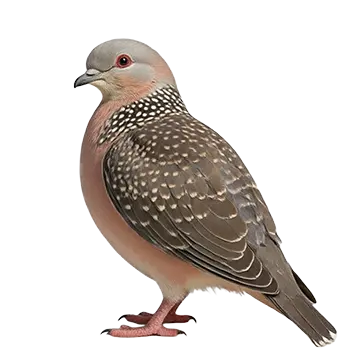

International Wildlife Trade Regulations

The Spotted Dove's legal status under international wildlife trade frameworks reflects its relatively stable conservation standing. Unlike many parrot species and raptors, the Spotted Dove is not currently listed on any appendix of the Convention on International Trade in Endangered Species of Wild Fauna and Flora (CITES). This absence from the CITES appendices means that international trade in Spotted Doves does not require the species-specific permits, export certificates, or import documentation mandated for CITES-listed species. However, the absence of CITES listing does not mean that trade is entirely unregulated, as individual countries maintain their own wildlife trade laws that may impose restrictions regardless of a species' CITES status.

The International Union for Conservation of Nature classifies the Spotted Dove as Least Concern, a designation that reflects the species' large global population, extensive range, and absence of significant population decline. This classification reduces the likelihood of future CITES listing, though it does not preclude individual nations from implementing protections based on local conservation priorities or ecological concerns. Countries where the Spotted Dove is native may regulate its capture and trade under domestic wildlife protection statutes even in the absence of international treaty obligations.

For individuals involved in aviculture or the pet trade, the practical implication of the Spotted Dove's non-CITES status is a simplified regulatory pathway for legal transactions. Breeders and dealers can typically export and import captive-bred Spotted Doves without the extensive paperwork required for appendix-listed species, though they must still comply with general customs, quarantine, and veterinary inspection requirements imposed by importing and exporting countries. These requirements vary significantly between jurisdictions and can change with little notice, making it essential for anyone involved in international trade to consult current regulations before arranging shipments.

It is worth noting that the regulatory landscape surrounding wildlife trade is subject to periodic review and revision. Species that are currently unlisted can be proposed for CITES inclusion if evidence of unsustainable trade or significant population decline emerges. While this scenario appears unlikely for the Spotted Dove in the near term, ongoing monitoring of wild populations and trade volumes by conservation organizations ensures that any emerging threats would be identified and addressed through the appropriate international channels.

National Wildlife Laws in Native Range Countries

Within its native range across South and Southeast Asia, the Spotted Dove is subject to a patchwork of national and subnational wildlife protection laws that vary considerably in scope, specificity, and enforcement rigor. In India, the species is protected under the Wildlife Protection Act of 1972, which broadly prohibits the hunting, capture, and trade of most wild bird species. Under this legislation, keeping a wild-caught Spotted Dove without appropriate authorization is illegal, and violations can result in fines and imprisonment. The Act has been amended multiple times since its original passage, and its schedules, which categorize species by their level of protection, have been updated to reflect changing conservation priorities.

In countries such as Thailand, Malaysia, and Indonesia, national wildlife laws similarly regulate the capture and trade of native bird species, though enforcement varies considerably by region and the specific provisions applicable to the Spotted Dove depend on its classification under each country's regulatory framework. In Thailand, where dove-cooing competitions are a significant cultural tradition, the regulatory environment must balance wildlife protection objectives with the deeply rooted cultural practice of dove keeping. This balance has led to nuanced regulatory approaches in some jurisdictions, with provisions that permit the keeping and breeding of certain dove species under specified conditions while prohibiting wild capture.

The Philippines, where the Spotted Dove occurs naturally on several island groups, enforces wildlife protection through the Wildlife Resources Conservation and Protection Act. This legislation establishes a permitting system for the collection, transport, and trade of wildlife, including birds, and designates penalties for unauthorized activities. As with other countries in the region, the effectiveness of these protections depends heavily on the capacity and commitment of enforcement agencies, which can be stretched thin across large, ecologically diverse territories.

Across the native range, a common regulatory challenge is the difficulty of distinguishing captive-bred birds from wild-caught individuals. The Spotted Dove breeds readily in captivity, and captive-bred birds are visually indistinguishable from their wild counterparts. This complicates enforcement efforts, as traders may claim that wild-caught birds are captive-bred to circumvent capture prohibitions. Some jurisdictions have addressed this issue by requiring breeders to maintain records, use closed leg bands on captive-bred birds, or register their breeding operations with wildlife authorities, but the effectiveness of these measures varies.

Regulations in Introduced Range Countries

In countries where the Spotted Dove has been introduced and established feral populations, the legal framework governing the species is shaped less by conservation concerns than by considerations of invasive species management, agricultural protection, and public health. In Australia, where the Spotted Dove is one of the most common introduced bird species, it is not protected under national environmental legislation such as the Environment Protection and Biodiversity Conservation Act 1999. Instead, its legal status is determined primarily by state and territory laws, which generally classify it as an introduced or pest species subject to management but not formal eradication programs.

In the Australian states where the Spotted Dove is most abundant, such as Victoria, New South Wales, and Queensland, the species may be managed under provisions that allow for the control of introduced birds that cause damage to crops, infrastructure, or native wildlife. In practice, however, the Spotted Dove is rarely the target of organized control efforts, as it is not considered a significant agricultural pest and its ecological impacts are generally viewed as modest compared to those of species such as the Common Starling or Indian Myna. The species occupies a regulatory gray zone: not protected, but not actively persecuted.

In the United States, the Spotted Dove's legal status is somewhat unusual. The species is not protected under the Migratory Bird Treaty Act, which covers native and some naturalized species. This means that feral Spotted Doves in states such as California and Hawaii do not receive the federal protections afforded to native doves and pigeons. State-level regulations may apply, however, and individuals considering keeping or managing Spotted Doves in the United States should consult their state's fish and wildlife agency for current guidance on permitting, hunting seasons if applicable, and any restrictions on the import or release of non-native bird species.

New Zealand, which has some of the world's most stringent biosecurity laws, treats the Spotted Dove as an introduced species subject to monitoring and potential management under its Biosecurity Act and associated regulations. The country's strong focus on protecting native avifauna from competition and displacement by introduced species means that any established or incipient Spotted Dove population would be subject to scrutiny and potentially active management if it were determined to pose a threat to native species or ecosystems.

Captive Breeding & Ownership Laws

The legal requirements for keeping Spotted Doves in captivity vary widely depending on jurisdiction, the source of the bird, and whether it is classified as a native or introduced species in the relevant region. In countries within the Spotted Dove's native range, ownership of captive-bred individuals may be permitted under licensing or registration systems, while possession of wild-caught birds is typically prohibited or restricted under national wildlife protection laws. Prospective keepers in these regions should verify current regulations with local wildlife authorities before acquiring a bird, as the specifics of licensing requirements, permitted species lists, and enforcement practices can differ significantly between jurisdictions.

In many Western countries where the Spotted Dove is not native, avicultural regulations treat it as an exotic or non-native species. In the United States, there is no federal prohibition on keeping captive-bred Spotted Doves, but state and local regulations may impose permit requirements, cage size standards, or restrictions on breeding and sale. Some states require permits for keeping any non-native bird species, while others exempt commonly kept avicultural species from individual permitting. The regulatory landscape is fragmented, and keepers are responsible for determining and complying with the rules applicable in their specific jurisdiction.

In Australia, the regulatory treatment of the Spotted Dove in captivity is complicated by its dual status as an established introduced species that is not native wildlife. Some Australian states and territories regulate the keeping of introduced bird species under avicultural licensing systems, while others do not require permits for species that are already established in the wild. The distinction between keeping a captive-bred Spotted Dove and simply tolerating the wild birds that frequent one's garden can be difficult to define in legal terms, and few enforcement actions are taken against individuals keeping small numbers of doves in private aviaries.

Regardless of jurisdiction, responsible keepers should ensure that their birds are housed in conditions that meet or exceed applicable animal welfare standards. Minimum cage or aviary dimensions, access to natural light, appropriate diet, veterinary care, and provisions for social interaction are among the factors that may be regulated or recommended by animal welfare legislation, industry codes of practice, or avicultural society guidelines. The Spotted Dove's relatively modest space and enrichment requirements compared to larger psittacine species mean that compliant housing is achievable for most hobbyist keepers, but attention to legal requirements remains essential to avoid unintentional violations.

Invasive Species Legislation & Management

The Spotted Dove's status as an introduced species in several countries places it within the scope of invasive species legislation, a rapidly evolving area of environmental law that seeks to manage the ecological and economic impacts of non-native organisms. In Australia, the primary legislative framework for invasive species management at the national level is the Environment Protection and Biodiversity Conservation Act 1999, supplemented by state and territory legislation that addresses the identification, monitoring, and control of pest species. While the Spotted Dove is recognized as an introduced bird in Australia, it has not been designated as a species of national environmental significance or subjected to formal eradication or containment programs.

The absence of aggressive management action against the Spotted Dove in Australia reflects a pragmatic assessment of the species' relatively low ecological impact compared to more destructive introduced species. Resources for invasive species management are finite, and agencies typically prioritize species that cause the greatest economic or ecological damage. The Spotted Dove, which occupies urban and suburban environments and has not been convincingly linked to significant declines in native bird populations, falls below the threshold that would trigger large-scale intervention. This triage approach does not imply endorsement of the species' presence but rather a recognition that its management is a lower priority within a constrained resource environment.

In Hawaii, where introduced species have profoundly altered the islands' native ecosystems, the Spotted Dove is part of a large assemblage of non-native birds that now dominate lowland habitats. Hawaiian invasive species legislation and management programs focus primarily on preventing new introductions and managing established species that pose the greatest threat to endangered native birds, plants, and invertebrates. The Spotted Dove, while recognized as non-native, is not the subject of active removal efforts and is generally tolerated as a component of the islands' heavily modified lowland avifauna.

The legal and policy frameworks governing invasive species continue to develop as scientific understanding of invasion ecology advances and as the economic and ecological costs of biological invasions become more fully documented. For the Spotted Dove, the most likely regulatory developments in the near term involve tighter controls on the importation and release of non-native bird species in countries that have identified introduced columbids as potential competitors with native fauna. Individuals involved in the avicultural trade should remain attentive to changes in import regulations, quarantine requirements, and species-specific restrictions that could affect the legal movement of Spotted Doves across international borders.

Ethical Considerations & Emerging Policy

Beyond the formal legal frameworks governing ownership, trade, and management of the Spotted Dove, a broader set of ethical and policy considerations shapes the contemporary discourse around the species. Animal welfare organizations, conservation groups, and avicultural societies each bring distinct perspectives to questions about the appropriate use and management of Spotted Doves, and these perspectives increasingly influence legislative and regulatory outcomes.

The welfare of captive Spotted Doves is a concern that spans both the avicultural hobby and the cultural tradition of dove-cooing competitions. Animal welfare advocates have raised questions about the conditions under which competition birds are housed, the stresses associated with transport and public performance, and the welfare implications of selective breeding for vocal characteristics. In response, some competition organizers and avicultural societies have adopted codes of practice that establish minimum standards for housing, nutrition, veterinary care, and handling. These self-regulatory measures are supplemented in some jurisdictions by statutory animal welfare protections that apply to all captive animals, including birds.

The ethics of introducing non-native species, even inadvertently, have also become a more prominent element of policy discussions in countries where the Spotted Dove has established feral populations. While the original introductions occurred in a historical context with different ecological awareness and regulatory standards, the continued release or escape of captive Spotted Doves into non-native environments raises questions about the responsibilities of keepers and the adequacy of regulations designed to prevent new introductions. Some jurisdictions have responded by tightening requirements for aviary security, imposing conditions on outdoor flight enclosures, or prohibiting the keeping of species with a demonstrated history of establishment following escape.

Looking ahead, the legal landscape for the Spotted Dove is likely to be shaped by the intersection of wildlife trade regulation, invasive species policy, and animal welfare law. Each of these domains is evolving in response to new scientific evidence, shifting public attitudes, and the growing recognition that the management of wildlife, whether native or introduced, requires integrated approaches that consider ecological, economic, and ethical dimensions simultaneously. For keepers, breeders, and enthusiasts, staying informed about these developments is not merely a legal obligation but a matter of responsible stewardship of a species that has shared human spaces and human history for centuries.

Always consult a qualified professional before making any health-related decisions. This content is provided for informational reference only and should not replace professional guidance specific to your animal.