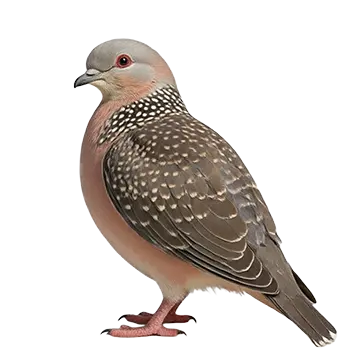

The Spotted Dove (Spilopelia chinensis) is a medium-sized columbid native to the Indian subcontinent and Southeast Asia. Its historical range extends from the foothills of the Himalayas and the plains of the Indian peninsula eastward through Myanmar, Thailand, Laos, Vietnam, Cambodia, and the Malay Peninsula, and south into the Indonesian archipelago. Several subspecies have been described across this expansive range, with regional populations exhibiting subtle differences in plumage tone, the extent of the distinctive black-and-white neck patch, and overall body size. The nominate subspecies, S. c. chinensis, was first described from specimens collected in southern China, lending the bird its specific epithet.
In its native range, the Spotted Dove inhabits a remarkably broad spectrum of environments. It thrives in light woodland, scrubland, agricultural margins, and the edges of tropical and subtropical forests. Unlike many columbids that depend on deep forest interiors, this species has long demonstrated a preference for semi-open habitats and human-altered landscapes. Village gardens, rice paddies, temple grounds, and the fringes of towns have served as core habitat for the Spotted Dove for centuries, a pattern of human association that predates any formal record-keeping.
The species feeds primarily on seeds and grains gathered from the ground, supplemented by small fruits, buds, and occasional invertebrates. Its foraging behavior is characteristically unhurried, with pairs or small groups walking steadily across open ground, pausing to pick at fallen seeds beneath shrubs and cultivated plants. This terrestrial foraging style, combined with a calm and approachable temperament, made the Spotted Dove one of the most visible and familiar birds in rural Asian life long before Western naturalists began cataloguing the region's avifauna.
Ecologically, the Spotted Dove occupies a niche that positions it as a generalist seed predator and minor seed disperser within its native ecosystems. Its tolerance for habitat disturbance and its capacity to exploit agricultural landscapes have been key factors in its historical abundance across southern and eastern Asia. These same traits would later prove instrumental in the species' success as an introduced bird in regions far removed from its ancestral range.