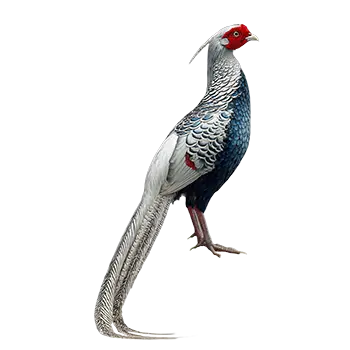

The Silver Pheasant has been a subject of artistic fascination in East Asian painting traditions for well over a thousand years. In Chinese brush-and-ink painting, the species appears in the huaniao (flower-and-bird) genre that reached its classical maturity during the Song dynasty. Court painters and scholar-artists alike rendered the Silver Pheasant with meticulous attention to the fine vermiculations of its white plumage, the glossy depth of its black breast, and the vivid red of its facial skin and legs. These paintings were not merely exercises in naturalistic observation; they embedded the bird within symbolic landscapes that communicated moral and aesthetic ideals central to Confucian and Daoist philosophy.
The association of the Silver Pheasant with the fifth civil rank of the imperial bureaucracy gave the bird a specific iconographic function in Chinese decorative arts. Embroidered rank badges, or buzi, depicting Silver Pheasants were produced in enormous quantities during the Ming and Qing dynasties, and surviving examples are now held in museum textile collections around the world. The finest of these badges display extraordinary craftsmanship, with individual feather barbs rendered in silk thread and couched gold outlining the bird's form against a background of stylized clouds and waves. These badges represent one of the most consistent and prolific uses of a specific bird species in the history of official insignia.
Beyond rank badges, the Silver Pheasant adorns a vast range of Chinese material culture, including porcelain vases and dishes, carved jade and ivory ornaments, painted folding screens, and woven silk textiles. In Qing-dynasty porcelain, Silver Pheasants frequently appear in garden settings paired with peonies, rocks, and flowering prunus, compositions that draw on established symbolic vocabularies to convey wishes for prosperity, beauty, and official success. The bird's long, arching tail was particularly suited to the flowing compositional rhythms favored in Chinese decorative design.
Japanese art also embraced the Silver Pheasant, though less systematically than Chinese traditions. The species appears in Edo-period screen paintings and woodblock prints, often rendered within the broader context of scenes depicting exotic or imported birds. Japanese textile artists incorporated Silver Pheasant imagery into kimono fabrics and obi designs, drawing on the Chinese symbolic tradition while adapting the motif to Japanese aesthetic sensibilities that favored asymmetry, negative space, and seasonal reference.