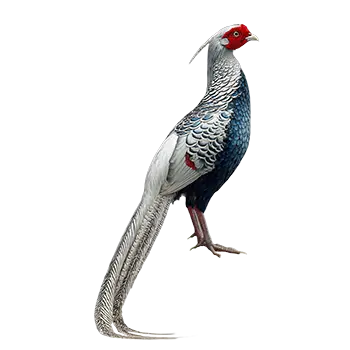

The Silver Pheasant (Lophura nycthemera) is a large gallinaceous bird native to the montane and submontane forests of mainland Southeast Asia and southern China. Its natural range extends from southeastern Tibet and Yunnan Province through Myanmar, Thailand, Laos, Cambodia, and Vietnam, with some populations reaching as far south as peninsular Malaysia. The species inhabits a broad altitudinal range, from lowland bamboo thickets and evergreen forests up to mixed deciduous woodlands at elevations of roughly 2,000 meters, though the densest populations tend to cluster between 600 and 1,500 meters in undisturbed forest.
The genus Lophura, to which the Silver Pheasant belongs, is one of the most species-rich genera within the family Phasianidae. Taxonomists have recognized as many as fifteen subspecies of Lophura nycthemera, differentiated primarily by the extent of black versus white patterning on the males' upperparts and tail, as well as by subtle variations in leg color and facial wattle size. This remarkable subspecific diversity reflects the fragmented geography of the bird's range, where mountain chains, river valleys, and climatic gradients have promoted genetic isolation over millennia.
Male Silver Pheasants are among the most visually striking of all galliforms. The adult cock displays a sweeping white mantle and tail barred or vermiculated with fine black lines, set against a glossy blue-black breast and underparts. A bare crimson facial patch and matching legs complete the display. Females, by contrast, are cryptically plumaged in olive-brown with pale-edged feathers, a camouflage adaptation suited to ground nesting in dense undergrowth. This sharp sexual dimorphism has contributed to the species' longstanding appeal to both naturalists and aviculturists.
In the wild, Silver Pheasants are primarily terrestrial foragers that scratch through leaf litter for seeds, fallen fruit, invertebrates, and tender shoots. They roost in trees at night and form small social groups outside the breeding season, typically comprising a dominant male with several hens. The species' reliance on intact forest with a well-developed understory makes it a useful indicator of habitat quality, and its presence or absence has been used by ecologists as a proxy for the health of Southeast Asian forest ecosystems.