
Origins & Natural Habitat

The Shaft-tail Finch (Poephila acuticauda), also widely known as the Long-tailed Finch, is a grassfinch native to the tropical and semi-arid savannas of northern Australia. Its range extends from the Kimberley region of Western Australia eastward across the Top End of the Northern Territory and into the far northwestern corner of Queensland. Within this broad geographic band, the species occupies open eucalyptus woodland, pandanus-fringed watercourses, and the grassy margins of monsoon vine thickets, showing a consistent preference for habitats that combine accessible water sources with ample seeding grasses.

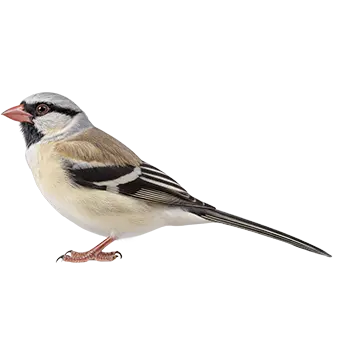
Two subspecies are formally recognized, distinguished most readily by bill color. The nominate form, Poephila acuticauda acuticauda, carries a yellow bill and predominates across the western portion of the range, from the Kimberley into the western Northern Territory. The eastern subspecies, Poephila acuticauda hecki, displays a red bill and occupies the eastern Northern Territory and adjacent Queensland. A zone of intergradation exists where the two forms meet, producing individuals with orange or intermediate bill coloring that has fascinated both field ornithologists and aviculturists.

The species derives its common name from the elongated central tail feathers that taper to fine, wire-like shafts extending well beyond the rest of the tail. This distinctive feature, combined with a bold black bib, blue-grey head, and warm fawn body plumage, gives the Shaft-tail Finch an appearance of refined elegance that sets it apart from many of its estrildid relatives. In the wild, these finches are highly gregarious, forming loose flocks that move through the landscape in search of ripe grass seeds, their primary food source.

The ecological niche occupied by the Shaft-tail Finch is closely tied to the seasonal rhythms of the Australian monsoon. Breeding activity typically coincides with the latter part of the wet season and early dry season, when seed availability peaks and water remains plentiful. Nests are constructed in tree hollows, dense shrubbery, or occasionally in the abandoned nests of other species, and both parents share incubation and chick-rearing duties. This dependence on intact savanna ecosystems with natural water access points has made the species sensitive to changes in land management, fire regimes, and pastoral development across its range.

Early History with Humans

The Shaft-tail Finch inhabits country that has been managed and occupied by Aboriginal Australians for tens of thousands of years. The Indigenous peoples of the Kimberley and Top End regions developed intricate ecological knowledge systems that encompassed the birds, plants, and seasonal cycles of the savanna landscape. While the Shaft-tail Finch does not hold the same prominent ceremonial significance as certain raptors or large waterbirds in Aboriginal tradition, small finches and grassfinches broadly feature in Indigenous ecological narratives as indicators of season, seed ripeness, and water availability.

European contact with the Shaft-tail Finch came through the gradual exploration and settlement of northern Australia during the 19th century. The naturalist John Gould, whose monumental work The Birds of Australia documented the continent's avifauna for a European audience, formally described the species in 1840. Gould's detailed lithographic illustrations brought the Shaft-tail Finch to the attention of ornithologists and collectors in Britain and continental Europe, establishing it as one of the visually striking grassfinches of the Australian north.

By the latter half of the 19th century, live specimens of Australian finches were beginning to reach European aviaries, though the Shaft-tail Finch was not among the earliest or most commonly traded species. The logistical challenges of transporting small, delicate birds from remote northern Australian settlements to distant markets limited initial availability. It was not until improved shipping routes and more refined husbandry knowledge developed in the early 20th century that the Shaft-tail Finch became a recognized presence in European and later North American aviculture.

The early decades of captive keeping were marked by trial and error. European breeders accustomed to hardier species such as the Zebra Finch or Society Finch found that the Shaft-tail Finch demanded more attention to temperature, humidity, diet, and social grouping. These challenges, rather than discouraging interest, helped establish the species as a bird for the more dedicated and knowledgeable aviculturist, a reputation it retains to this day.

Cultural Symbolism & Folklore

Within the Indigenous cultures of northern Australia, the Shaft-tail Finch exists as part of a broader tapestry of ecological knowledge rather than as a singularly mythologized creature. Aboriginal peoples of the Top End and Kimberley have long classified birds within complex systems that connect species to seasons, food sources, and landscape management. Small seed-eating finches, including the Shaft-tail, serve as practical indicators within these systems. Their presence at a waterhole or their flocking behavior in certain grasses can signal the timing of seasonal transitions, informing decisions about movement, burning, and resource gathering.

In the broader Australian cultural imagination, the grassfinches of the north have come to symbolize the vast, sparsely populated landscapes of the tropical savanna. The Shaft-tail Finch, with its refined appearance and association with remote watercourses and ancient sandstone escarpments, evokes the distinctive character of regions like the Kimberley and Arnhem Land. For many Australians who have traveled through these areas, the sight of a flock of long-tailed finches perched on a wire fence or drinking at a stock trough is an emblematic memory of the outback north.

Among aviculturists worldwide, the Shaft-tail Finch holds a cultural significance rooted in aesthetics and the pursuit of breeding excellence. The species is widely regarded as one of the most elegant of all estrildid finches, and its presence in an aviary is often seen as a mark of the keeper's skill and dedication. Avicultural societies in Australia, Europe, and North America have long featured the Shaft-tail prominently in exhibitions and shows, where the quality of plumage, bill color, and tail length are judged against exacting standards.

The subspecific bill-color variation has itself become a point of cultural interest within the avicultural community. Breeders often specialize in either yellow-billed or red-billed birds, and the relative merits of each form are a perennial topic of discussion at club meetings and in specialty publications. This focus on preserving and refining the distinct characteristics of each subspecies reflects a broader ethic within finch keeping that values authenticity and respect for the natural forms of captive species.

Scientific Study & Recognition

The formal scientific description of the Shaft-tail Finch by John Gould in 1840 placed the species within the growing catalog of Australian birds being documented for the first time under Linnaean taxonomy. Gould assigned it the name Poephila acuticauda, with the specific epithet meaning sharp-tailed, a direct reference to the elongated central rectrices that are the bird's most striking morphological feature. The genus Poephila, meaning grass-loving, aptly describes the dietary habits and habitat preferences shared by the Shaft-tail and its close relatives, the Black-throated Finch and the Masked Finch.

Subsequent taxonomic work refined the understanding of variation within the species. The red-billed eastern form was described as a distinct subspecies, Poephila acuticauda hecki, by Heinroth in 1900. The recognition of these two subspecies set the stage for decades of research into the biogeography of Australian grassfinches, including investigations into how climatic barriers, river systems, and habitat gradients have shaped the distribution and differentiation of closely related forms across the northern Australian savanna belt.

In the latter half of the 20th century, the Shaft-tail Finch attracted the attention of behavioral ecologists studying mate choice, sexual selection, and the evolution of ornamental traits. The elongated tail feathers, which differ subtly in length between males and females, have been examined as a potential signal of individual quality in the context of sexual selection theory. Researchers have also studied the role of bill color in mate preference, with experiments exploring whether females of one subspecies show preference for males with matching or contrasting bill coloration. These studies have contributed to broader theoretical frameworks in evolutionary biology.

More recently, the Shaft-tail Finch has been included in population genetics and conservation biology research aimed at understanding the effects of habitat fragmentation and altered fire regimes on savanna bird communities. Genetic analyses have helped clarify the degree of differentiation between the two subspecies and assess the connectivity of populations across the species' range. This body of scientific work has elevated the Shaft-tail Finch from an attractive aviary subject to a species of genuine importance in understanding the ecology and evolution of Australian savanna ecosystems.

The Breed Today

The Shaft-tail Finch occupies a well-established position in contemporary aviculture, maintained by dedicated breeders across Australia, Europe, Japan, and North America. In Australia, where the species can still be observed in the wild across its northern range, captive populations benefit from a relatively deep gene pool and ongoing interest from finch societies. Australian aviculturists have been particularly active in maintaining pure lines of both the yellow-billed and red-billed subspecies, recognizing the importance of preserving the genetic integrity of each form in captivity.

Outside Australia, the Shaft-tail Finch is regarded as a moderately challenging species that rewards experienced keepers with its striking appearance and engaging social behavior. European breeders, particularly in the United Kingdom, the Netherlands, Germany, and Belgium, have cultivated strong captive populations over many decades. The species is a regular competitor at national and international bird shows, where judges evaluate condition, plumage quality, bill color intensity, and the length and symmetry of the characteristic tail shafts.

In the wild, the Shaft-tail Finch remains reasonably common across much of its historical range, though localized declines have been documented in areas affected by intensive cattle grazing, altered fire management, and the degradation of riparian habitats. The species is not currently listed as threatened at the national or international level, but conservation biologists have flagged the broader decline of granivorous bird assemblages in northern Australia as a concern that warrants ongoing monitoring. The Shaft-tail Finch's dependence on intact grass-seed resources and reliable water access makes it a useful indicator of savanna health.

The avicultural community has increasingly embraced the concept of captive populations as a form of insurance against wild declines. Studbook programs and cooperative breeding networks, while more commonly associated with larger parrot species, have begun to gain traction among finch breeders concerned about maintaining genetic diversity. The Shaft-tail Finch, with its well-defined subspecific variation and established captive history, is well suited to these efforts and stands as a species where aviculture and conservation share a clear common interest.

Legacy in Aviculture & Conservation

The Shaft-tail Finch has played a quietly significant role in shaping the standards and practices of modern finch aviculture. As one of the more demanding Poephila species to breed successfully in captivity, it has served as a benchmark for avicultural skill. Breeders who master the requirements of the Shaft-tail, including its need for spacious, well-planted aviaries, carefully balanced seed and live-food diets, and appropriate social groupings, often go on to work with other challenging grassfinch species. In this way, the Shaft-tail has functioned as a gateway species that elevates the overall standard of finch keeping.

The species' influence extends to aviary design and management philosophy. The recognition that Shaft-tail Finches thrive best in large, naturalistic planted aviaries rather than small breeding cages helped drive a broader shift in avicultural thinking during the late 20th century. Breeders who invested in creating habitat-style enclosures with native grasses, natural perching, and seasonal planting schedules found that their Shaft-tails bred more reliably and produced healthier offspring, an observation that reinforced the value of welfare-centered husbandry across the hobby.

In the conservation arena, the Shaft-tail Finch's story intersects with the larger narrative of savanna bird declines in northern Australia. Research conducted in the early 21st century revealed troubling population trends among several granivorous finch species in the Top End, driven by a complex interplay of changed fire regimes, feral animal impacts, and habitat degradation. While the Shaft-tail Finch has fared better than some of its more threatened relatives, such as the Gouldian Finch, the shared ecological pressures underscore the importance of landscape-scale conservation measures that benefit entire bird communities rather than single species.

The Shaft-tail Finch's legacy is ultimately one of quiet distinction. It lacks the vivid rainbow plumage of the Gouldian Finch or the ubiquity of the Zebra Finch, yet it has earned a devoted following among those who appreciate its understated beauty, its complex social behavior, and its connection to some of Australia's most spectacular and ecologically important landscapes. As both a subject of scientific inquiry and a treasured aviary bird, the Shaft-tail Finch continues to reward those who take the time to understand and care for it properly.

Always consult a qualified professional before making any health-related decisions. This content is provided for informational reference only and should not replace professional guidance specific to your animal.