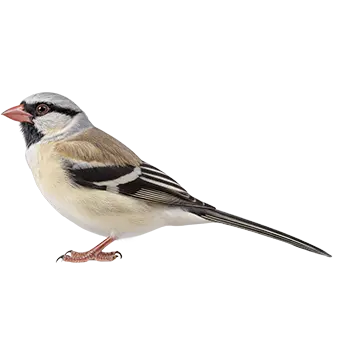

The Shaft-tail Finch is scientifically classified as Poephila acuticauda, with the genus name Poephila derived from Greek 'poa' meaning grass and 'philos' meaning loving, literally translating to 'grass-loving,' which perfectly describes this species' natural habitat preference for grasslands and savanna. The species name 'acuticauda' comes from Latin 'acutus' meaning pointed or sharp and 'cauda' meaning tail, directly referencing the bird's most distinctive and diagnostic feature—the elongated, pointed central tail feathers that give the species its common name. The genus Poephila comprises several closely related Australian grassfinch species, all sharing similar body plans, habitat preferences, and social behaviors.
The most widely used common name is Long-tailed Grassfinch, which accurately describes both the bird's distinctive elongated tail and its ecological association with grassland habitats. This name is particularly common in Australian ornithological literature and among Australian bird enthusiasts. The alternate name Shaft-tail Finch or Shaft-tailed Finch specifically references the distinctive structure of the elongated central tail feathers, which have narrow vanes creating a shaft-like appearance, particularly noticeable during flight when these feathers trail behind the bird. Both names are widely recognized and used interchangeably in aviculture and ornithological contexts internationally.
In Australia, where the species is native, they are commonly called simply Long-tailed Finch or Shafttail in informal usage, with birders and locals familiar with these distinctive grassland birds. Indigenous Australian peoples have traditional names for these finches in various Aboriginal languages spoken across their northern Australian range, reflecting thousands of years of observation and cultural connection, though many of these traditional names are not widely documented in ornithological literature. The species' distinctive appearance and habitat make them familiar to people living within their range.
Historically, various names have been used in older avicultural and ornithological literature including Heck's Grassfinch, referencing early aviculturists or collectors, though these names have fallen out of common usage in favor of the more descriptive Long-tailed Grassfinch or Shaft-tail Finch. In European aviculture, the German name 'Spitzschwanzamadine' (pointed-tail finch) and French 'Diamant à longue queue' (long-tailed diamond) reflect the bird's distinctive tail structure.
There are two recognized subspecies of Poephila acuticauda showing geographic variation in plumage characteristics. The nominate subspecies Poephila acuticauda acuticauda, commonly called the Yellow-billed or Heck's Shaft-tail, occurs in western and central portions of the species' range and features a distinctive pale yellow to horn-colored beak, creating an attractive contrast against the grey facial plumage. This subspecies is generally considered more common in both wild and aviculture populations. Poephila acuticauda hecki, commonly called the Red-billed Shaft-tail, occurs in eastern portions of the range and features a bright red to coral-red beak, making it easily distinguishable from the yellow-billed form. The red-billed subspecies is highly prized in aviculture for its striking beak color and is generally more expensive and harder to obtain than the yellow-billed form.
Beyond beak color, the two subspecies are virtually identical, showing the same body size, plumage pattern and coloration, tail structure, and behavioral characteristics. Where their ranges meet, intermediate individuals showing orange or mixed beak coloration can occur, suggesting some interbreeding in contact zones. In aviculture, both subspecies are bred, and crosses between them occasionally occur, producing offspring with intermediate beak colors. Most aviculturists prefer keeping the subspecies separate to maintain pure lines, though both forms make equally suitable aviary birds.
Color mutations have been developed through selective breeding in captivity, including fawn mutations showing diluted brownish rather than grey plumage, white or pied mutations showing white feathers mixed with normal coloration, and silver mutations showing lightened grey tones. However, these mutations are relatively uncommon compared to mutations in more popular species like Zebra Finches, with most Shaft-tail Finches in aviculture displaying natural wild-type coloration. The species' relatively specialized care requirements and lower reproduction rates compared to some other finches have limited mutation development.
In aviculture worldwide, Shaft-tail Finches have been popular for decades, appreciated for their distinctive appearance, elegant movements, relatively peaceful temperament, and suitability for mixed-species aviaries. They are considered moderately challenging to breed compared to more prolific species like Zebra or Society Finches, requiring appropriate conditions and experienced management for consistent breeding success. Their popularity and availability vary regionally, with the yellow-billed form more commonly available while the red-billed form commands premium prices when available.