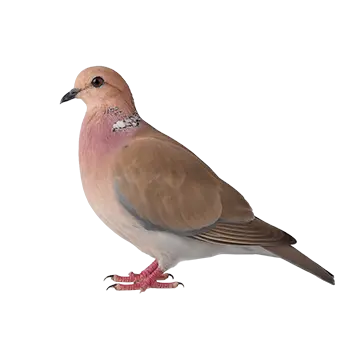

The Senegal Dove, known across much of its range as the Laughing Dove, has occupied a distinctive place in the literary traditions of the regions it inhabits. In classical Arabic poetry the dove, or hamama, is among the most frequently invoked birds, and while poets did not always distinguish among species, the small, warm-toned dove with its murmuring trill that frequented gardens and courtyard walls was unmistakably the Laughing Dove to readers in the Arabian Peninsula and North Africa. Pre-Islamic and early Islamic poets used the dove's call as a vehicle for themes of separation, yearning, and the bittersweet passage of time, conventions that persisted through the Abbasid literary flowering and into the Andalusian poetic tradition.
In Urdu and Persian literature the fakhta, the common name for the Laughing Dove on the Indian subcontinent, became a staple image in the ghazal tradition. Poets from Mir Taqi Mir to Mirza Ghalib employed the dove's cooing as a metaphor for the lover's lament, drawing on the bird's association with dawn and dusk, when its call is most prominent, to evoke moments of reflection and longing. The dove at the window, the dove on the parapet, the dove calling from a ruined garden wall: these images recur across centuries of Urdu verse, grounding abstract emotional states in the familiar, concrete presence of a bird that every reader would have known from daily life.
In the oral literary traditions of West and East Africa the Laughing Dove appears in a different register. Hausa, Yoruba, and Swahili folk tales often feature the dove as a moral exemplar, embodying virtues of constancy, humility, and domestic devotion. In some Swahili narrative poetry the dove's repetitive song is interpreted as a prayer or a lesson repeated until it is learned, lending the bird an almost pedagogical quality. These stories were transmitted orally for generations before being collected by colonial-era ethnographers and, more recently, by African literary scholars working to preserve indigenous storytelling traditions.
The Laughing Dove's literary presence is distinguished by its consistency rather than its prominence. It is rarely the subject of an entire work, but it appears again and again as a background detail, a passing image, a sound effect in the landscape of a poem or story. This peripheral ubiquity mirrors the bird's ecological role: always present, seldom the center of attention, yet fundamentally part of the texture of the world being described.