
Origins & Natural Habitat

The Senegal Dove (Spilopelia senegalensis), more widely known as the Laughing Dove for its distinctive bubbling, descending coo, is a small columbid native to a vast swath of the Old World. Its original range encompasses the drier woodlands, scrub savannas, and semi-arid margins of sub-Saharan Africa, stretching from Senegal and Mauritania in the west across the Sahel belt to Ethiopia, Somalia, and the Horn of Africa in the east. From there its distribution extends northward into the Arabian Peninsula and eastward through Iran, Afghanistan, Pakistan, and the Indian subcontinent as far as Bangladesh. Few doves occupy so broad and ecologically varied a range, and this adaptability is central to the species' historical story.

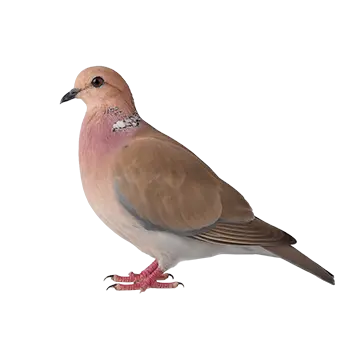
In its ancestral habitats the Senegal Dove favors open country with scattered trees, thorn scrub, and cultivated fields rather than dense closed-canopy forest. It is a ground forager that feeds primarily on small seeds, supplemented by fallen grain, tiny invertebrates, and the occasional berry. Its compact body, measuring roughly 25 centimeters from bill to tail tip, and its soft pinkish-brown plumage with a diagnostic band of black-speckled rufous feathers across the upper breast allow it to blend inconspicuously into the sun-baked landscapes it inhabits. The species nests on low platforms of twigs in bushes, ledges, and the eaves of buildings, a habit that would prove pivotal to its long relationship with human settlements.

Taxonomically the Senegal Dove was originally placed in the genus Streptopelia alongside turtle doves and collared doves, but molecular phylogenetic work in the early 21st century led to its reclassification into the resurrected genus Spilopelia. Several subspecies have been described across its range, reflecting subtle variations in plumage tone and size that track climatic gradients. The nominate subspecies, S. s. senegalensis, occupies much of the African range, while S. s. cambayensis is the form most commonly encountered on the Indian subcontinent.

The species' ecological flexibility is remarkable. It thrives in habitats ranging from Sahelian thorn scrub receiving barely 200 millimeters of annual rainfall to the lush irrigated gardens of the Indian plains. This tolerance of diverse conditions, combined with a rapid breeding cycle and a willingness to nest in close proximity to people, positioned the Senegal Dove for a history of human association that few other wild columbids can match.

Early History with Humans

The Senegal Dove's relationship with humans likely predates recorded history. As one of the earliest birds to colonize the margins of agricultural settlements in Africa and the Near East, it would have been a familiar presence around granaries, threshing floors, and village wells for millennia. Archaeological sites across the Sahel and the Levant have yielded columbid remains that, while difficult to assign to species with certainty, are consistent with the small-bodied doves of the Spilopelia lineage. The bird's willingness to glean spilled grain from human activity areas made it a natural commensal long before any formal domestication or captive keeping was attempted.

In the ancient civilizations of Mesopotamia and Egypt, doves held broad symbolic and practical importance, though much of the iconographic record conflates multiple dove species. The Senegal Dove, given its range extending into the Arabian Peninsula and the fringes of the Fertile Crescent, was almost certainly among the small doves known to traders and townspeople of those regions. Its soft, repetitive call, often described as a gentle laughing trill, became part of the ambient soundscape of oasis towns and caravan stops along trans-Saharan and Arabian trade routes.

As Islamic civilization expanded across North Africa, the Arabian Peninsula, and into South Asia during the 7th through 13th centuries, the Senegal Dove appears to have followed, aided by the creation of irrigated gardens, grain markets, and urban settlements that provided ideal foraging and nesting habitat. Arab naturalists of the medieval period described small laughing doves frequenting mosque courtyards and palace gardens, and the birds became closely associated with the aesthetic ideals of Islamic garden design, where fountains, fruit trees, and the murmur of doves combined to create an atmosphere of contemplative tranquility.

The species' arrival on the Indian subcontinent is difficult to date precisely, but it is well established in Sanskrit and later Mughal-era literature as a common garden bird. By the time European colonial naturalists began cataloging Indian avifauna in the 18th and 19th centuries, the Laughing Dove was thoroughly entrenched across the plains and was considered one of the most characteristic birds of Indian towns and villages. Whether this Indian population represents a natural range extension or was partly facilitated by human landscape modification remains a subject of ecological debate.

Cultural Symbolism & Folklore

Across its enormous range the Senegal Dove has accumulated a rich body of cultural associations, many of them rooted in its gentle demeanor and melodious call. In West African oral traditions the Laughing Dove frequently appears as a character embodying patience, fidelity, and quiet perseverance. Among the Hausa people of Nigeria and Niger, the bird's repetitive cooing is sometimes interpreted as a moral refrain, and folk tales cast the dove as a faithful spouse or a humble creature that triumphs through steadfastness rather than cunning. In Wolof-speaking Senegal, where the species takes its common English name, the dove's presence near homesteads is traditionally regarded as a sign of domestic harmony.

In Islamic culture the dove occupies a place of particular reverence, and the Senegal Dove shares in this esteem wherever its range overlaps with Muslim communities. Doves are associated with peace, purity, and divine mercy in Islamic tradition, and the Laughing Dove's habit of nesting on mosque ledges and in the courtyards of religious schools has reinforced its status as a bird of sacred spaces. In parts of the Arabian Peninsula and the Horn of Africa, harming a dove near a mosque is considered deeply inauspicious, a belief that has provided the species with an informal but effective form of cultural protection.

On the Indian subcontinent the Laughing Dove carries its own set of symbolic meanings. In Hindu tradition doves are associated with Kamadeva, the god of love, and the soft cooing of the Laughing Dove is woven into the poetic imagery of romantic longing in classical Hindi and Urdu verse. The Mughal miniature painting tradition occasionally depicts small doves perched on garden walls or the hands of courtly figures, reinforcing the bird's connection to themes of beauty, devotion, and the cultivated landscape.

The dove's call itself has been a subject of interpretation across cultures. Depending on the listener and the tradition, the Senegal Dove's burbling trill has been heard as laughter, weeping, prayer, or song. This ambiguity has made the bird a versatile symbol, capable of carrying meanings that range from joyful contentment to quiet sorrow. Few birds of comparable size and plainness have inspired such a varied tapestry of human meaning.

Scientific Study & Taxonomic History

The Senegal Dove was first formally described by Carl Linnaeus in 1766 in the twelfth edition of Systema Naturae, where it was placed in the genus Columba as Columba senegalensis, based on specimens from Senegal. Subsequent taxonomic revisions moved the species into Streptopelia, where it remained for most of the 19th and 20th centuries alongside a large assemblage of Old World turtle doves and collared doves. The common English name Laughing Dove became standard in most ornithological literature, though the name Senegal Dove persisted in avicultural and pet trade contexts.

The major taxonomic upheaval came in the early 2000s when molecular phylogenetic analyses revealed that the traditional genus Streptopelia was not monophyletic. Studies based on mitochondrial and nuclear DNA sequences demonstrated that the Laughing Dove and its closest relatives formed a distinct clade separate from the core Streptopelia group. This led to the reinstatement of the genus Spilopelia, originally erected by Sundevall in 1873, with the Laughing Dove redesignated as Spilopelia senegalensis. The change was adopted by the International Ornithological Congress and most major taxonomic authorities, though some regional field guides were slow to update.

Ecological and behavioral research on the Senegal Dove has focused on its remarkable success as a commensal species. Studies conducted in cities across India, the Middle East, and East Africa have documented the bird's dietary flexibility, its tolerance of human disturbance, and its ability to breed year-round in tropical and subtropical climates. Reproductive biology research has shown that pairs can produce multiple clutches per year, with incubation lasting approximately 13 to 15 days and fledging occurring roughly two weeks after hatching. This rapid reproductive turnover is a key factor in the species' ability to sustain dense urban populations.

More recent research has examined the Senegal Dove's role in urban ecosystems, including its interactions with invasive species, its contribution to seed dispersal, and its susceptibility to avian diseases such as trichomoniasis and pigeon paramyxovirus. The species has also served as a model organism in studies of avian thermoregulation in arid environments, given its capacity to maintain body condition in extreme heat with limited access to free water. While it lacks the celebrity status of parrots or corvids in cognitive research, the Senegal Dove has quietly contributed to the scientific understanding of avian ecology and urban adaptation.

The Senegal Dove Today

In the 21st century the Senegal Dove remains one of the most abundant and widely distributed dove species on Earth. BirdLife International classifies it as a species of Least Concern, and its global population is believed to be stable or increasing across most of its range. Urbanization, rather than threatening the species, has generally benefited it by creating new habitat in the form of parks, gardens, grain storage facilities, and the ledges and rafters of buildings that serve as nesting sites. In many African and South Asian cities the Laughing Dove is among the most commonly encountered wild birds, outnumbered perhaps only by house sparrows and feral pigeons.

The species has also established introduced populations well beyond its native range. Laughing Doves were introduced to Perth, Western Australia, in the late 19th century, likely through avicultural escapes or deliberate release, and have since spread across much of southwestern Australia. Smaller introduced populations exist in parts of the Caribbean, the Canary Islands, and scattered locations in the Americas. These introductions have generally proceeded without the ecological disruption associated with more aggressive invasive species, though monitoring continues.

In aviculture the Senegal Dove occupies a modest but steady niche. It is kept by dove enthusiasts and small-bird breeders who appreciate its manageable size, gentle temperament, and pleasant vocalizations. Unlike larger psittacines, the Laughing Dove does not demand intensive social interaction or elaborate enrichment, making it accessible to keepers with limited space or experience. Captive-bred birds are available through specialty breeders and occasionally through general pet trade channels, though they are far less commercially prominent than budgerigars, cockatiels, or domestic pigeons.

Conservation concerns for the Senegal Dove are minimal at the species level, though localized pressures exist. In parts of North Africa and the Middle East, the species is sometimes trapped for food or shot for sport, though this harvest is not believed to affect overall population stability. Habitat degradation in certain Sahelian regions, driven by desertification and overgrazing, may reduce local populations, but the dove's adaptability to human-modified landscapes largely offsets these losses. The Senegal Dove's story is ultimately one of quiet success, a species that has prospered by living alongside humans without depending on them entirely.

Legacy & Continuing Significance

The Senegal Dove's legacy is defined not by dramatic episodes of discovery or controversy but by a sustained, largely unremarked intimacy with human civilization across three continents. Unlike birds that became famous through the pet trade or through conservation crises, the Laughing Dove has simply been present, cooing from walls and rooftops, gleaning seeds from swept courtyards, and nesting in the eaves of homes, schools, and temples for as long as anyone can remember. This very ordinariness is the core of its cultural significance. It is a bird that belongs to the background of daily life, and its absence would be felt as deeply as the loss of any more celebrated species.

In the literary traditions of Urdu, Arabic, and Swahili, the dove's voice remains a touchstone for evocations of home, longing, and the passage of time. Contemporary poets and songwriters in these languages continue to draw on imagery of the cooing dove at dawn or dusk, a testament to the enduring emotional resonance of a bird that most people encounter without conscious notice. The Laughing Dove does not demand attention; it rewards it.

For the global birdwatching community the Senegal Dove holds a particular place as one of the first wild birds that many observers in Africa, the Middle East, and South Asia learn to identify. Its approachable nature and tolerance of human proximity make it an ideal gateway species, introducing novice birders to the pleasures of field observation before they move on to rarer or more elusive targets. In this sense the Laughing Dove serves as an ambassador for avian diversity, quietly encouraging interest in the broader world of birds.

The species' continued success in human-dominated landscapes also offers a lesson in coexistence. At a time when habitat loss and climate change threaten countless bird species worldwide, the Senegal Dove demonstrates that some forms of wildlife can thrive alongside human development when conditions are even modestly favorable. Its story is not one of heroic rescue or dramatic decline but of persistent, adaptable survival, a narrative that deserves recognition alongside the more dramatic conservation sagas that tend to dominate public attention.

Always consult a qualified professional before making any health-related decisions. This content is provided for informational reference only and should not replace professional guidance specific to your animal.