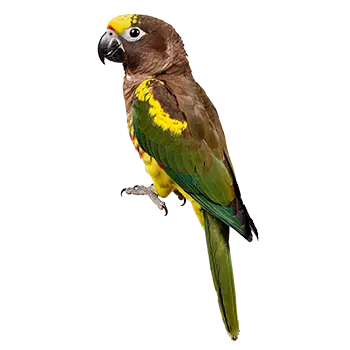

Meyer's Parrot (Poicephalus meyeri) was first described by the German naturalist Philipp Jakob Cretzschmar in 1827. The species was named in honor of the German botanist and ornithologist Bernhard Meyer, whose contributions to early European natural history helped shape the classification of African birdlife. The original specimens were collected from areas in what is now Ethiopia, marking the beginning of Western scientific interest in this understated but widespread parrot.
The species belongs to the genus Poicephalus, a group of stocky, short-tailed parrots endemic to the African continent. Within this genus, Meyer's Parrot is one of the most geographically widespread members, found across a broad swath of sub-Saharan Africa from the eastern Sahel through central woodlands to the southern savannas. Its range spans more than a dozen countries, making it one of the most commonly encountered Poicephalus parrots in the wild.
Early European explorers and colonial naturalists frequently noted Meyer's Parrots in their field journals, describing flocks moving through miombo woodland and riverside gallery forests. However, the species attracted far less commercial attention than the larger and more colorful African Grey or Senegal Parrot during the height of the exotic bird trade. This relative obscurity in the Western world would persist until aviculture began to take a more serious interest in Poicephalus species during the latter half of the twentieth century.
Taxonomists have identified six recognized subspecies of Meyer's Parrot, each varying slightly in the extent and intensity of their yellow and turquoise markings. These subspecies are distributed across different ecological zones, from the drier acacia woodlands of East Africa to the moister forests of the Congo basin. The subtle variation among populations reflects the species' adaptability and long evolutionary history across Africa's diverse landscapes.