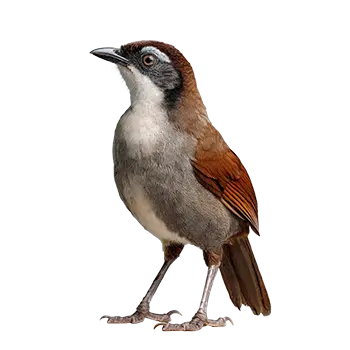

Film & Television

The laughing thrush has made its strongest mark on screen through wildlife documentary programming, where its dramatic group vocalizations and photogenic plumage have secured it recurring appearances in major natural history productions. The BBC's long-running natural history unit has featured laughing thrushes in several series exploring Asian forest ecosystems, with the White-crested Laughing Thrush's raucous dawn choruses serving as an iconic audio signature for montane cloud forest sequences. Producers have frequently used the birds' communal calling behavior to illustrate concepts of social cooperation and group dynamics in the animal kingdom, making the laughing thrush a go-to species when a segment requires both visual spectacle and behavioral complexity.

Chinese television has given the laughing thrush, particularly the Hwamei, a more culturally embedded screen presence. Dramatic series set in historical periods frequently include scenes of bird-keeping as a marker of cultivated leisure, and the Hwamei's ornate cage and melodious song have appeared as set dressing and plot elements in productions ranging from Tang Dynasty court dramas to Republican-era Shanghai period pieces. The bird's presence in these contexts communicates social status, refinement, and connection to traditional Chinese aesthetics in ways that audiences immediately recognize without exposition.

The laughing thrush has also appeared in regional cinema across South and Southeast Asia. Indian films set in the northeastern hill states have used the White-crested Laughing Thrush's distinctive calls as part of their ambient soundscapes, grounding narratives in specific geographic and ecological settings. Vietnamese filmmakers have similarly incorporated laughing thrush vocalizations into soundtracks for films depicting rural highland life, where the bird's call carries cultural associations with forest communities and traditional ways of living.

In animated and children's programming, the laughing thrush has found occasional representation, though less frequently than parrots or birds of prey. Several Asian-produced educational nature series have dedicated episodes to the laughing thrush family, emphasizing their cooperative social structures and vocal learning abilities as subjects that translate well into content aimed at younger audiences. The birds' expressive group behavior — huddling, allopreening, synchronized calling — lends itself to characterization in animation, and a handful of short-form animated features produced for regional broadcast in China and Malaysia have drawn on these qualities to create laughing thrush characters that function as comic ensembles.

Literature & Published Works

The laughing thrush's literary presence is deeply rooted in the classical poetry and prose traditions of China, where the Hwamei's song has been a subject of literary contemplation for over a millennium. Tang and Song dynasty poets composed verses celebrating the bird's vocal artistry, often positioning the Hwamei's call as a counterpoint to human speech — a purer, more spontaneous form of expression uncontaminated by social artifice. These poems circulated through anthologies and painted scrolls, embedding the laughing thrush in the Chinese literary consciousness as a symbol of natural eloquence and aesthetic refinement.

In the Western ornithological literature, laughing thrushes feature prominently in the foundational field guides and expedition accounts of the colonial and post-colonial periods. E.C. Stuart Baker's multi-volume work on the birds of British India devotes extensive coverage to several laughing thrush species, combining field observations with the kind of narrative natural history writing that characterized early 20th-century ornithology. Salim Ali and S. Dillon Ripley's landmark Handbook of the Birds of India and Pakistan similarly treats the laughing thrushes at length, and Ali's popular writings introduced the White-crested and Rufous-breasted Laughing Thrushes to a broad Indian readership that might otherwise never have encountered these forest-interior species.

Contemporary birding literature has given the laughing thrush renewed visibility. Field guides covering Southeast Asia, such as Craig Robson's guide to the birds of the region, have helped Western birders appreciate the diversity and identification challenges posed by the laughing thrush complex. The taxonomic upheaval surrounding the group — the splitting of Garrulax into multiple genera — has itself generated a body of published commentary in journals like Forktail, the Bulletin of the British Ornithologists' Club, and Ibis, making the laughing thrushes a frequent subject of discussion in both popular and scientific ornithological writing.

Beyond strictly ornithological texts, the laughing thrush has appeared in travel writing and literary nonfiction that uses birdlife as a lens for exploring Asian cultures and landscapes. Authors writing about trekking in the Himalayas, birding in Yunnan, or exploring the remnant forests of Java have used encounters with laughing thrushes as narrative anchors — moments that crystallize the sensory experience of being in a particular place. The birds' conspicuous presence, unmistakable calls, and cooperative group behavior make them natural characters in this kind of immersive nature writing, offering authors both descriptive material and thematic resonance.

Social Media & Digital Communities

The laughing thrush has developed a significant presence on social media platforms, driven primarily by two overlapping communities: the global birding and bird photography network, and the East and Southeast Asian songbird-keeping community. On platforms like Instagram, Facebook, and the Chinese social media ecosystem (Weibo, Douyin, and Xiaohongshu), laughing thrushes appear in content that ranges from field photographs and birding trip reports to carefully produced videos of captive birds in full song. The birds' dramatic vocalizations make them particularly effective subjects for short-form video, and clips of laughing thrush choruses — especially the cascading group calls of the White-crested species — have achieved wide circulation as shareable content.

YouTube hosts a substantial library of laughing thrush content spanning multiple languages and production levels. Professional wildlife videographers have uploaded high-definition footage of wild laughing thrushes in their native habitats, attracting dedicated viewership from birding enthusiasts and naturalists. At the other end of the production spectrum, hobbyist birdkeepers in China, Vietnam, Indonesia, and Malaysia regularly post videos of their captive Hwamei and other laughing thrush species singing in competition settings, in parks, and at home. These videos frequently accumulate tens of thousands of views and generate active comment sections where keepers exchange advice on training, diet, and vocal conditioning.

Specialized online forums and Facebook groups dedicated to softbill aviculture have become important hubs for laughing thrush keepers worldwide. Groups focused on Garrulax and related genera connect breeders across continents, facilitating the exchange of husbandry knowledge, breeding records, and genetic diversity information that would have been extremely difficult to coordinate before the internet era. These communities have played a meaningful role in advancing captive breeding outcomes for several endangered species by enabling direct communication between holders of small, geographically dispersed breeding populations.

The laughing thrush has also become a subject of conservation-focused digital campaigns. Organizations working to combat the illegal songbird trade in Southeast Asia have used social media to publicize the plight of traded species, and laughing thrushes — as charismatic, vocalizing birds whose calls can be embedded directly in social media posts — have proven effective ambassadors for these campaigns. The contrast between a laughing thrush calling freely in a forest canopy and one confined to a small competition cage provides a visually and aurally compelling narrative that translates effectively across cultural and linguistic boundaries on digital platforms.

Video Games & Digital Media

The laughing thrush's appearance in video games is concentrated in titles that emphasize naturalism, ecological simulation, or East Asian cultural settings. Open-world games set in fictionalized Asian landscapes have incorporated laughing thrush vocalizations into their ambient sound design, using the birds' distinctive calls to signal to players that they are in highland forest or bamboo thicket environments. Sound designers working on titles with Southeast Asian or Himalayan settings have drawn on field recordings of laughing thrush choruses to build immersive audio environments, and the birds' calls have appeared in the sound libraries of multiple major game studios alongside other signature Asian forest sounds.

Birdwatching simulation games and nature-focused mobile apps have given the laughing thrush more explicit representation. Titles in the bird identification and collection genre have included multiple laughing thrush species as discoverable entries, often accompanied by information cards that describe the bird's range, behavior, and conservation status. The visual distinctiveness of species like the Red-tailed Laughing Thrush, with its vivid crimson plumage, and the Silver-eared Laughing Thrush, with its striking facial pattern, make them appealing collectible assets in games that reward players for finding rare or visually spectacular species.

In the broader digital media landscape, the laughing thrush appears in educational apps and interactive nature guides developed for both Western and Asian markets. Chinese-language educational platforms have produced interactive modules on native songbirds that feature the Hwamei prominently, incorporating audio playback of the bird's song alongside illustrated guides to identification and behavior. Similar content has been developed for birdwatching apps used across South and Southeast Asia, where the laughing thrush complex presents a genuine identification challenge that app developers have addressed with side-by-side comparison tools, sonogram visualizations, and AI-assisted song recognition features.

Podcasts and audio-based digital media have also given the laughing thrush a platform. Birding podcasts regularly feature discussions of laughing thrush taxonomy, field identification, and the ethics of the songbird trade, and several episodes across major birding podcast networks have been dedicated entirely to the group. The birds' vocalizations — varied, loud, and emotionally evocative — make them compelling audio subjects in a medium that cannot rely on visual appeal, and producers have used laughing thrush recordings to illustrate discussions about bioacoustics, species diversity, and the cultural dimensions of birding in Asia.

Photography & Fine Art

The laughing thrush has been a prized subject in bird photography since long before the digital era, though the advent of high-quality telephoto lenses and digital sensors has dramatically expanded the volume and quality of laughing thrush imagery available to both professional and amateur photographers. Species like the Red-tailed Laughing Thrush, the Blue-winged Laughing Thrush (Trochalopteron squamatum), and the White-crested Laughing Thrush are considered trophy species among bird photographers working in South and Southeast Asia, and images of these birds in natural settings command attention in photography competitions and exhibitions worldwide. The challenge of photographing laughing thrushes — which tend to move rapidly through dense undergrowth in low-light forest conditions — adds to the prestige associated with high-quality images.

In traditional Chinese painting, the Hwamei and other laughing thrushes have been depicted for centuries as part of the "bird-and-flower" (huaniao) genre, one of the major categories of classical Chinese visual art. Song dynasty painters rendered the Hwamei with meticulous attention to plumage detail, often placing the bird on a blossoming branch or beside a rock garden to create compositions that balanced naturalistic observation with poetic symbolism. This artistic tradition continued through the Ming and Qing dynasties and remains a living practice among contemporary Chinese ink painters, who treat the Hwamei as a standard subject within their repertoire.

Western scientific illustration has also contributed a rich body of laughing thrush imagery. The hand-colored lithographs in John Gould's landmark 19th-century ornithological works include plates depicting several laughing thrush species with the fine detail and compositional elegance that characterize the golden age of natural history illustration. These plates, originally produced for scientific reference, have become collectible artworks in their own right and are frequently reproduced in books, prints, and decorative contexts. More recent illustrators working on field guides and ornithological references have continued this tradition, producing detailed plates that capture the subtle plumage variations across the laughing thrush complex.

Contemporary wildlife art has embraced the laughing thrush as a subject that offers both visual drama and narrative possibility. The birds' social behavior — group foraging, allopreening, synchronized displays — provides artists with dynamic compositions that convey movement and interaction rather than the static perched portraits that dominate much bird art. Several internationally recognized wildlife artists have produced paintings and prints featuring laughing thrushes in their native forest habitats, and these works have appeared in exhibitions, fundraising auctions for conservation organizations, and permanent collections at natural history museums in both Europe and Asia.

Advertising & Commercial Branding

The laughing thrush's most significant presence in commercial branding occurs within East and Southeast Asia, where the bird's cultural resonance and association with beautiful song have made it a natural fit for products and businesses seeking to evoke refinement, tradition, and natural harmony. In China, the Hwamei's image has appeared on tea packaging, traditional medicine branding, and artisanal craft products marketed with an emphasis on cultural heritage and quality. The bird's association with the leisurely, contemplative practice of tea-drinking and park-going in Chinese daily life gives it a brand identity that communicates both authenticity and a connection to established cultural values.

The laughing thrush has also found commercial application in the tourism and hospitality sector. Hotels, resorts, and ecotourism operators in the Himalayan foothills, the highlands of Yunnan, and the national parks of Vietnam and Malaysia have adopted laughing thrush imagery in their marketing materials, leveraging the bird's association with pristine mountain forest environments to position their properties as gateways to unspoiled nature. Some birding tour companies specializing in Asian destinations have used laughing thrush photographs and silhouettes as part of their visual branding, recognizing that the group's diversity and appeal to serious birders make it an effective shorthand for the richness of Asian avifauna.

In the specialty pet trade, the laughing thrush name and image carry brand value among producers of avicultural supplies. Manufacturers of softbill diets, specialized cage designs, and live insect cultures marketed to keepers of insectivorous birds have used laughing thrush imagery to signal product quality and relevance to a knowledgeable audience. Trade shows and avicultural expos in Europe and Asia frequently feature laughing thrush photographs in exhibitor materials and event branding, reinforcing the bird's status as a desirable and aspirational species within the hobby.

Outside Asia, the laughing thrush's commercial profile is more limited but not entirely absent. Conservation-focused merchandise — including t-shirts, prints, and field notebook covers produced by bird conservation organizations — has featured laughing thrush species as part of campaigns to raise awareness and funds for anti-poaching and habitat protection efforts. Stamp collectors encounter laughing thrushes on postal issues from countries across their native range, with nations including China, India, Vietnam, Malaysia, and Nepal having issued commemorative stamps depicting one or more laughing thrush species. These stamps serve simultaneously as miniature works of art, instruments of national pride in biodiversity, and inadvertent marketing for the countries' natural heritage.

Always consult a qualified professional before making any health-related decisions. This content is provided for informational reference only and should not replace professional guidance specific to your animal.