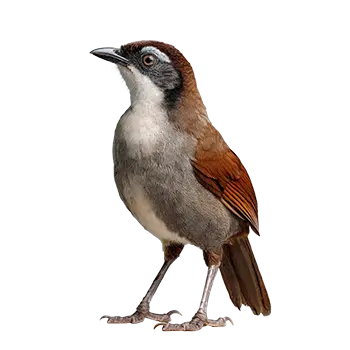

Origins & Natural Habitat

The laughing thrushes comprise a diverse assemblage of passerine birds historically grouped under the genus Garrulax, though modern molecular systematics have redistributed many species across several genera including Trochalopteron, Pterorhinus, Ianthocincla, and others within the family Leiothrichidae. The group's common name derives from their loud, complex vocalizations, which in many species resemble cascading human laughter or raucous group choruses that ring through montane forests. With well over a hundred recognized species and subspecies, the laughing thrushes represent one of the most species-rich radiations of Old World songbirds.

The center of diversity for laughing thrushes lies in the subtropical and tropical highlands of southern China, the eastern Himalayas, and mainland Southeast Asia. Species occupy a range of forest habitats, from dense subtropical broadleaf forests at elevations exceeding 2,500 meters to bamboo thickets, scrubby hillsides, and the undergrowth of lowland tropical woodland. Several species have adapted to edge habitats and secondary growth, which historically brought them into regular contact with human settlements and agricultural landscapes. A smaller number of species occur in the Indian subcontinent, and a few representatives are found as far west as the Middle East and as far south as the islands of Indonesia.

Laughing thrushes are predominantly ground-dwelling or low-canopy foragers, moving through leaf litter and dense undergrowth in noisy, cohesive flocks. Their social nature is one of the group's defining characteristics. Most species live in cooperative groups that forage together, mob predators communally, and in some cases engage in cooperative breeding where non-breeding group members assist with raising chicks. This gregarious behavior produces the boisterous vocal displays that first attracted human attention and made the birds conspicuous even in dense forest environments.

The ecological role of laughing thrushes within their native ecosystems is significant. As omnivores consuming insects, invertebrates, fruits, and seeds, they contribute to pest regulation and seed dispersal across the forest understory. Their flocking behavior creates disturbance patterns in leaf litter that benefit other ground-foraging species, and their communal alarm calls serve as an early warning system for mixed-species flocks. This ecological integration means that the decline of laughing thrush populations in parts of their range carries consequences that extend well beyond the species themselves.

Early History with Humans

The relationship between laughing thrushes and human societies in Asia stretches back many centuries, rooted in the birds' powerful and melodious songs. In China, the practice of keeping songbirds is documented as far back as the Tang Dynasty (618–907 CE), and laughing thrushes — particularly the Chinese Hwamei (Garrulax canorus) — were among the most prized species. The Hwamei's name, meaning "beautiful eyebrow," references the distinctive white eye-ring and supercilium that marks the species, and historical texts describe its song as one of the finest among all caged birds. By the Song Dynasty (960–1279 CE), bird-keeping had become a refined cultural practice intertwined with poetry, painting, and the contemplation of nature.

The tradition of songbird keeping extended well beyond China. In Vietnam, laughing thrushes held a prominent place in avicultural traditions that valued vocal competition among caged males. Communities in northern Vietnam and Laos developed specialized knowledge about training and conditioning birds for song contests, a practice that created a dedicated market for wild-caught individuals and shaped local economies in forested highland regions. Similar traditions took root in parts of Indonesia, where the Greater Necklaced Laughing Thrush and the White-crested Laughing Thrush were kept for their exuberant group vocalizations.

European naturalists encountered laughing thrushes during the colonial period, as expeditions into the interior forests of India, Burma, and Indochina returned specimens to museums and zoological collections. The first formal scientific descriptions of several laughing thrush species date to the late 18th and early 19th centuries, when ornithologists including John Latham, Coenraad Jacob Temminck, and Brian Houghton Hodgson catalogued species from collections gathered across South and Southeast Asia. These early descriptions often remarked on the birds' extraordinary vocal output and their sociable, confiding nature.

The colonial-era tea plantations and hill stations of India and Ceylon brought European residents into close contact with several laughing thrush species, including the White-crested Laughing Thrush (Garrulax leucolophus), which readily colonized garden edges and secondary forest near human habitation. British naturalists stationed in the hill country of Darjeeling, Assam, and the Nilgiris wrote extensively about the birds' behavior, and some species were shipped back to European aviaries during the 19th century. However, it was always in East and Southeast Asia where the deepest and most sustained human relationship with laughing thrushes flourished.

Cultural Symbolism & Folklore

In Chinese culture, the laughing thrush — especially the Hwamei — occupies a symbolic position that extends well beyond its role as a caged songbird. The bird's song has been associated with joy, vitality, and the renewal of spring for centuries. Classical Chinese poetry frequently references the Hwamei's call as an emblem of natural harmony, and the bird appears in landscape paintings of the Song and Ming dynasties alongside scholars, bamboo groves, and mountain streams. Owning a particularly fine singer was considered a mark of cultivated taste, and the practice of carrying caged Hwamei to teahouses and public parks for communal listening sessions became a deeply embedded social ritual that persists in modified form to this day.

In the folklore of several ethnic groups across southern China and northern Southeast Asia, laughing thrushes are credited with the power to dispel sadness or break spells of silence. Among the Miao (Hmong) people, stories describe the laughing thrush as a bird that taught humans to sing, its cascading call serving as the template for celebratory vocal music. In Dai and Zhuang traditions, the bird's laughter-like song is sometimes interpreted as a commentary on human folly — a forest observer whose amusement at human affairs is both gentle and knowing.

The White-crested Laughing Thrush, with its striking black-and-white plumage and boisterous group calls, has inspired distinct cultural associations in the Indian subcontinent. In parts of northeastern India, where the species is common in hill forests, its raucous dawn choruses are woven into local sayings about punctuality, gossip, and community spirit. The bird's habit of moving in noisy, tightly bonded groups has made it a folk metaphor for village solidarity in some Naga and Mizo communities.

Across their range, laughing thrushes have also acquired less flattering reputations in certain contexts. Their loud, persistent vocalizations and tendency to mob intruders have led some farming communities to associate them with disturbance and mischief. In parts of Java and Sumatra, the Greater Necklaced Laughing Thrush is sometimes regarded as an omen bird whose calls at certain times of day carry portentous meaning. This duality — beloved songster and disruptive trickster — gives the laughing thrush a cultural complexity that few other passerine groups can match.

Scientific Study & Classification

The taxonomic history of the laughing thrushes is one of the most convoluted in modern ornithology. The group was traditionally lumped into the large, catch-all genus Garrulax, which at its peak contained well over 50 species and served as a taxonomic repository for any robust, ground-dwelling Asian babbler with loud vocalizations. This arrangement was always understood to be provisional, and ornithologists from the mid-20th century onward noted that the morphological and vocal diversity within Garrulax was far too great to represent a single natural lineage.

The molecular revolution in systematics, beginning in the 1990s and accelerating through the 2000s and 2010s, fundamentally reorganized the laughing thrushes. DNA sequence data revealed that the traditional Garrulax was deeply polyphyletic, meaning its constituent species did not all share a single common ancestor to the exclusion of other genera. The resulting reclassification split the group across multiple genera — Trochalopteron for the brightly colored high-altitude species, Pterorhinus for a large clade of southeast Asian forms, Ianthocincla for the giant laughing thrushes, and several smaller genera for isolated lineages. The family-level placement also shifted, with the laughing thrushes and their allies moved from the old catch-all family Timaliidae ("Old World babblers") into the newly erected Leiothrichidae.

Beyond taxonomy, laughing thrushes have contributed to ecological and behavioral research in several important domains. Their cooperative breeding systems have been studied extensively in species such as the Grey-crowned Crocias and the White-crested Laughing Thrush, providing data on kin selection, helping behavior, and the evolution of sociality in birds. Bioacoustics researchers have analyzed the complex duets and choruses of laughing thrushes to understand vocal learning, coordination, and the role of song in group cohesion — topics with relevance to broader questions about the evolution of communication.

Conservation-focused research has also intensified as wild populations of several species have declined. Field studies in southern China, Vietnam, and the Indonesian archipelago have documented the impact of trapping for the cagebird trade on population viability, and captive breeding programs in zoos and breeding centers have generated data on reproductive biology, genetics, and reintroduction methodology. The laughing thrushes have thus become a case study in how taxonomy, ecology, and conservation intersect when a widely distributed group faces uneven but significant anthropogenic pressure.

The Breed Today

In contemporary aviculture, the laughing thrush occupies a distinctive niche. Unlike parrots or finches, which dominate the Western pet bird market, laughing thrushes are kept primarily by specialist breeders and experienced aviculturists who value their vocal abilities, social dynamics, and the challenge of maintaining species that require thoughtful husbandry. In East and Southeast Asia, the tradition of keeping Hwamei and other singing laughing thrushes remains vibrant, though it increasingly operates within a framework of legal regulation and conservation awareness that did not exist a generation ago.

Captive breeding of laughing thrushes has expanded significantly since the early 2000s, driven in part by import restrictions that have limited the availability of wild-caught birds. European aviculturists have been particularly active, establishing self-sustaining captive populations of species including the Red-tailed Laughing Thrush (Trochalopteron milnei), the Black-throated Laughing Thrush (Pterorhinus chinensis), and the Silver-eared Laughing Thrush (Trochalopteron melanostigma). Studbook programs coordinated through the European Association of Zoos and Aquaria track genetic diversity and breeding recommendations for several of the more endangered species.

The husbandry knowledge base for laughing thrushes has grown substantially. Modern keepers understand that these birds require spacious, planted aviaries that allow for natural foraging behavior, group social structures, and the expression of their full vocal repertoire. Dietary science has moved beyond simple insectivore mixes to encompass carefully formulated diets that include live insects, fruit, softbill pellets, and occasional protein supplements. The recognition that laughing thrushes are intelligent, social birds with complex behavioral needs has elevated the standard of care expected in both private and institutional settings.

Despite these advances, many laughing thrush species face an uncertain future in the wild. The combined pressures of habitat loss and the cagebird trade have placed several species on the IUCN Red List, and a handful — including the critically endangered Rufous-fronted Laughing Thrush (Pterorhinus rufifrons) and the Sumatran Laughing Thrush (Garrulax bicolor) — survive in perilously small wild populations. The breed's story today is therefore one of parallel trajectories: growing sophistication in captive management alongside continuing declines in the forests that produced these remarkable birds.

Notable Populations & Conservation Milestones

Several laughing thrush species have become flagship cases in Asian bird conservation, their stories illustrating both the severity of the cagebird trade's impact and the potential for dedicated intervention to reverse population declines. The Black-hooded Laughing Thrush (Garrulax milleti), endemic to the forests of central Vietnam, was feared extinct for much of the 20th century before being rediscovered in 1999 in the Kon Tum Plateau region. Its rediscovery galvanized conservation efforts in the Vietnamese highlands and drew international attention to the broader crisis facing songbirds across Southeast Asia.

The Edwards's Pheasant captive breeding program at several European zoos provided a model that was subsequently adapted for critically endangered laughing thrushes. The Rufous-fronted Laughing Thrush, restricted to a tiny range in northern Vietnam, became the subject of a coordinated breeding effort involving the Vietnam National University of Forestry, Chester Zoo in the United Kingdom, and several German zoological institutions. These programs aimed not only to establish insurance populations but to develop reintroduction protocols tailored to the specific ecological and social requirements of group-living passerines.

In Indonesia, the plight of the Sumatran Laughing Thrush and the Javan subspecies of the Black-throated Laughing Thrush brought the songbird trade crisis into sharp public focus. Indonesian conservation organizations, working alongside international partners, launched public awareness campaigns highlighting the ecological cost of unregulated trapping. The establishment of dedicated songbird breeding centers in Java, such as the Cikananga Conservation Breeding Centre, marked a turning point in the institutional capacity to manage captive laughing thrush populations within the range countries where the species naturally occur.

The Chinese Hwamei's trajectory offers a more complex story. While the species remains relatively abundant in parts of its range, localized population collapses driven by intensive trapping for the songbird competition circuit have raised alarms among Chinese ornithologists. In response, several Chinese provinces have implemented seasonal trapping bans and licensing requirements, and academic institutions have partnered with local bird-keeping associations to promote captive-bred birds as alternatives to wild-caught individuals. These efforts represent an evolving relationship between a centuries-old cultural practice and the modern imperative to sustain wild populations for future generations.

Always consult a qualified professional before making any health-related decisions. This content is provided for informational reference only and should not replace professional guidance specific to your animal.