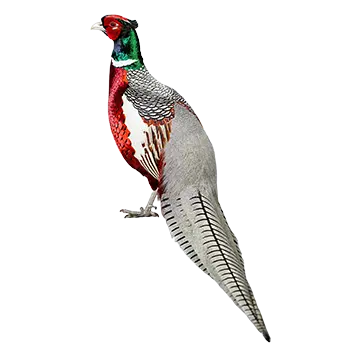

Origins & Natural Habitat

The Lady Amherst's Pheasant (Chrysolophus amherstiae) is native to the mountainous forests of southwestern China and the adjacent highlands of northeastern Myanmar. Its core range encompasses the provinces of Yunnan, Sichuan, Guizhou, and Guangxi, where it inhabits dense bamboo thickets, rhododendron undergrowth, and mixed broadleaf-conifer forests at elevations typically between 2,000 and 4,500 meters. The species favors steep terrain with heavy ground cover, a habitat preference that kept it largely hidden from Western naturalists for centuries despite its extraordinary plumage.

Within this rugged landscape the Lady Amherst's Pheasant occupies a specific ecological niche. It forages on the forest floor for seeds, grain, tender bamboo shoots, insects, and invertebrates, relying on its cryptic hen plumage and quiet habits to avoid predators. Males are more conspicuous, displaying their elongated white-and-black barred tails and iridescent blue-green capes primarily during the spring breeding season when territorial calls ring through the montane valleys. Outside the breeding period the birds tend to be secretive and solitary, retreating deeper into undergrowth at the first sign of disturbance.

The species is closely related to the Golden Pheasant (Chrysolophus pictorialis), which occupies a partially overlapping range in central China. The two species are the only members of the genus Chrysolophus, and where their territories converge they are capable of producing fertile hybrids. This genetic compatibility has been both a curiosity for ornithologists and a management concern for aviculturists, who must maintain separate breeding groups to preserve the integrity of each species' lineage.

Despite its remote habitat the Lady Amherst's Pheasant has not been immune to environmental pressures. Logging, agricultural expansion into highland areas, and the collection of bamboo and non-timber forest products have degraded portions of its range over the past century. Nevertheless, the species' ability to persist in steep, less accessible terrain has helped buffer it against the most severe habitat losses, and the International Union for Conservation of Nature currently classifies it as Least Concern, though with an acknowledgment that population numbers are declining.

Discovery & Western Introduction

The Lady Amherst's Pheasant entered Western scientific consciousness through the efforts of colonial-era naturalists and diplomats operating along the frontiers of the British Empire in Asia. The species was first described to European science by the English naturalist Benjamin Leadbeater in 1829, based on a specimen sent to London by Sarah Countess Amherst, wife of William Pitt Amherst, the Governor-General of India from 1823 to 1828. Sarah Amherst was an avid collector of natural history specimens and maintained a personal menagerie during her time in India. Her contribution of the first known skin of this pheasant to British collections earned her the lasting honor of the species' common name.

The formal taxonomic description was published shortly after the specimen arrived in England. Leadbeater placed the bird in the genus Chrysolophus alongside the already-known Golden Pheasant, recognizing the morphological similarities between the two species while noting the dramatic differences in plumage pattern. The specific epithet amherstiae commemorated Sarah Amherst directly. The specimen caused considerable excitement among ornithologists and collectors of the period, who regarded it as one of the most visually striking birds yet brought to Europe from the Far East.

Living birds followed the skins within a few decades. French and British explorers and missionaries operating in Yunnan and upper Myanmar during the mid-19th century secured live Lady Amherst's Pheasants for export, and by the 1870s small numbers had reached the aviaries of private collectors and zoological gardens in London, Paris, and Amsterdam. The Zoological Society of London received its first living specimens in 1869, and the birds bred successfully in captivity not long after, confirming that the species could be maintained and propagated far from its native range.

The timing of the Lady Amherst's Pheasant's arrival in Europe coincided with a broader Victorian fascination with exotic wildlife and ornamental birds. Wealthy estate owners competed to stock their grounds with rare pheasant species, and the Lady Amherst's — with its striking contrast of white, green, blue, and red — quickly became one of the most coveted prizes in that arena. The bird's journey from the cloud forests of China to the manicured parks of England encapsulates a distinctive chapter in the history of global natural history collecting.

Cultural Symbolism & Folklore

In its native China the Lady Amherst's Pheasant has held cultural significance for centuries, long before Western naturalists assigned it a binomial name. Chinese art and decorative traditions have drawn upon the ornamental pheasants of the Chrysolophus genus as symbols of beauty, nobility, and good fortune. Pheasant imagery appears on silk textiles, porcelain, lacquerware, and embroidered court robes dating to the Ming and Qing dynasties, and while the Golden Pheasant received the majority of artistic attention, the Lady Amherst's Pheasant was also represented in regional painting traditions from Yunnan and Sichuan, where the living birds were part of the local landscape.

Pheasants in general occupy a prominent place in Chinese cosmology. The mythological fenghuang, often translated as phoenix, incorporates features drawn from multiple real bird species including pheasants, peacocks, and cranes. While no single species maps directly onto the fenghuang, the iridescent plumage and elongated tails of Chrysolophus pheasants are among the visual antecedents that likely contributed to the mythological composite. Within folk belief systems in southwestern China, encountering a brilliantly colored pheasant in the forest could be interpreted as an auspicious sign, associated with prosperity or the approval of local nature spirits.

In Tibetan and Burmese communities along the edges of the species' range, pheasant feathers have found use in ceremonial dress and ritual decoration. The long tail plumes of male Lady Amherst's Pheasants, with their bold black-and-white barring, are visually distinctive and have been incorporated into headdresses and festival costumes in certain highland traditions. The use of these feathers connects the bird to living cultural practices that predate and exist independently of Western ornithological interest.

Once the species reached Europe its symbolic associations shifted. Victorian and Edwardian culture framed the Lady Amherst's Pheasant primarily as a luxury object and a testament to imperial reach, a living ornament whose presence on an English estate demonstrated the owner's wealth, taste, and connections to the far corners of the empire. This aestheticized view persisted well into the 20th century and continues in softened form today, where the bird's visual drama remains its most immediate cultural currency, inspiring textile designers, illustrators, and decorative artists who draw on its plumage patterns without necessarily engaging with its deeper ecological or cultural context.

Taxonomic & Scientific Milestones

The taxonomic history of the Lady Amherst's Pheasant reflects broader trends in ornithological classification over the past two centuries. Following Leadbeater's original 1829 description, the species was firmly placed within the genus Chrysolophus, a classification that has remained stable. The genus name derives from the Greek chryso (gold) and lophos (crest), referencing the Golden Pheasant described earlier. While the Lady Amherst's Pheasant lacks the golden coloring of its congener, the two species share structural features — including the elaborate nuchal cape, the long graduated tail, and the compact body plan — that clearly mark them as close relatives.

Molecular phylogenetic studies conducted in the late 20th and early 21st centuries confirmed the close relationship between C. amherstiae and C. pictorialis and placed the Chrysolophus genus within the broader pheasant family Phasianidae, specifically allied with the ruffed pheasants and long-tailed pheasants of eastern Asia. These genetic analyses also clarified the extent of hybridization between the two Chrysolophus species, demonstrating that fertile hybrids occur both in the wild — in narrow contact zones in central China — and frequently in captive collections where the two species are housed together without adequate separation.

Field research on the Lady Amherst's Pheasant in its native range has been comparatively limited, owing to the remoteness and difficulty of the terrain it inhabits. Chinese ornithologists have conducted population surveys in Yunnan and Sichuan since the 1980s, producing baseline data on distribution, habitat preferences, and breeding behavior. These studies revealed that the species' range is more fragmented than earlier estimates suggested, with populations concentrated in isolated mountain blocks separated by agricultural valleys that the birds rarely cross.

One of the more unusual chapters in the scientific history of C. amherstiae concerns the feral population that established itself in Bedfordshire, England, during the early 20th century. Birds escaped or were released from private estates and bred in the woodlands around Whipsnade and the surrounding area. This population attracted considerable attention from British ornithologists and was monitored for decades, providing rare data on the species' behavior and ecology outside its native environment. The feral population eventually declined and is now considered functionally extinct in Britain, a trajectory that offered its own lessons about the ecological requirements and limitations of the species.

Avicultural Heritage

The Lady Amherst's Pheasant has been one of the cornerstone species in ornamental pheasant keeping since the late 19th century. Its willingness to breed in captivity, its relative hardiness in temperate climates, and its visually spectacular male plumage combined to make it a favorite among aviculturists ranging from aristocratic estate owners to dedicated amateur breeders. By the early 1900s the species was well established in collections across Britain, continental Europe, and North America, and breeding stock was sufficiently abundant that the bird was no longer dependent on imports from the wild for its captive population.

The development of the Lady Amherst's Pheasant in aviculture paralleled the growth of organized pheasant breeding as a serious pursuit. Societies such as the World Pheasant Association, founded in 1975, formalized standards for the keeping and breeding of pheasant species and promoted the exchange of knowledge and genetic material among breeders. Lady Amherst's Pheasants featured prominently in these networks, and dedicated breeders worked to maintain genetically diverse captive lines free from hybridization with Golden Pheasants — a persistent challenge given the ease with which the two species interbreed.

Husbandry practices for the species evolved considerably over the 20th century. Early keepers housed Lady Amherst's Pheasants in relatively spartan enclosures, but modern aviculture emphasizes spacious planted aviaries with natural ground cover, elevated perches, and environmental enrichment that allows the birds to express natural foraging and display behaviors. Diet has similarly advanced from simple grain mixes to carefully balanced rations incorporating game bird pellets, fresh greens, live insects, and seasonal fruits, reflecting a deeper understanding of the species' nutritional requirements.

The Lady Amherst's Pheasant also played a role in the broader conservation conversation within aviculture. As awareness grew that some pheasant species were declining in the wild, breeders increasingly framed their work not just as a hobby but as a form of ex situ conservation, maintaining viable captive populations that could theoretically contribute to future reintroduction efforts. While no formal reintroduction program has been launched for C. amherstiae, the species' strong captive population represents a genetic reservoir that conservation biologists regard as a meaningful asset should wild numbers decline further.

The Species Today

Today the Lady Amherst's Pheasant occupies a distinctive position in the avian world: widespread and well established in captivity, yet increasingly scarce in portions of its native range. Wild populations in China and Myanmar continue to face pressure from habitat degradation, and while the species is not considered globally threatened, localized declines have been documented in areas where logging and agricultural encroachment have reduced the montane forest cover on which the birds depend. Chinese conservation authorities have included the species in broader biodiversity protection initiatives aimed at preserving the highland ecosystems of Yunnan and Sichuan.

In aviculture the Lady Amherst's Pheasant remains one of the most commonly kept ornamental pheasant species worldwide. It is bred by hobbyists, zoological institutions, and game bird farms across North America, Europe, Australia, and parts of Asia. The species' affordability and relative ease of care compared to more demanding pheasant genera have ensured its continued popularity, and it serves as an entry point for many newcomers to pheasant keeping. Avicultural societies continue to promote best practices for maintaining pure bloodlines and avoiding the Golden Pheasant hybridization that has diluted some captive stocks.

The feral population that once existed in England has become a cautionary footnote. At its peak in the mid-20th century the Bedfordshire colony numbered in the low hundreds and was a point of pride for British birders, representing one of the few self-sustaining populations of an exotic pheasant species in Europe. By the early 21st century, however, the population had collapsed, likely due to a combination of habitat changes, predation pressure, competition with native species, and genetic bottlenecking. Surveys conducted in the 2010s found no evidence of a breeding population, and the British Ornithologists' Union removed the species from the official British list.

Looking forward, the Lady Amherst's Pheasant's future will be shaped by the intersection of wild habitat conservation, captive breeding management, and the broader cultural value that humans place on ornamental biodiversity. The species' striking appearance continues to draw attention and advocacy, and its deep roots in both Asian cultural traditions and Western avicultural history ensure that it remains far more than a footnote in the annals of ornithology. Whether in a mist-shrouded bamboo thicket in Yunnan or a carefully planted aviary in rural England, the Lady Amherst's Pheasant endures as one of the most arresting birds on earth.

Always consult a qualified professional before making any health-related decisions. This content is provided for informational reference only and should not replace professional guidance specific to your animal.