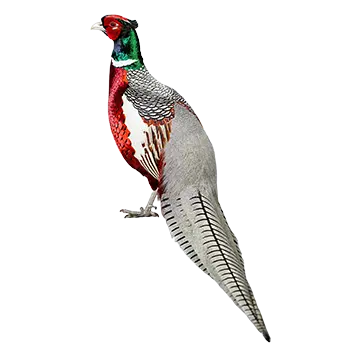

Film & Television

The Lady Amherst's Pheasant has been a recurring subject in wildlife documentary filmmaking since the genre's emergence in the mid-20th century. Its courtship display — in which the male fans his black-and-white barred cape into a shimmering disc, lowers his elongated tail, and circles the female in a precise lateral dance — ranks among the most cinematically arresting mating rituals in the avian world. Producers and cinematographers have consistently sought out this species when assembling segments on sexual selection, ornamental plumage, or the biodiversity of Asian montane forests.

BBC Natural History Unit productions have featured the Lady Amherst's Pheasant across multiple decades of programming. The species appeared in segments exploring the evolutionary pressures behind elaborate male ornamentation, with slow-motion footage capturing the iridescent green, blue, and white plumage in detail that the naked eye can barely register in the field. These sequences introduced millions of viewers to a bird that most would never encounter outside a zoological collection, cementing its status as one of the visual icons of pheasant diversity.

Beyond dedicated wildlife programming the Lady Amherst's Pheasant has made appearances in period dramas and costume films set on British country estates, where its presence in the background of garden or parkland scenes serves as a visual shorthand for aristocratic opulence. The bird's association with grand private aviaries and ornamental grounds makes it a natural prop for productions aiming to convey wealth and refined taste in a Victorian or Edwardian setting. While these appearances are typically brief, they reinforce the species' cultural identity as a bird linked to beauty and privilege.

Independent and nature-focused filmmakers in China have also turned their cameras on C. amherstiae, documenting the species in its wild habitat in Yunnan and Sichuan. These productions, often made for regional broadcast or conservation-oriented film festivals, provide a counterpoint to the Western framing of the bird as an ornamental curiosity, instead presenting it within its native ecological context. Chinese wildlife cinema has grown significantly in scope and production quality in recent years, and the Lady Amherst's Pheasant is among the flagship species that benefit from this increased attention.

Ornithological Illustration & Fine Art

No discussion of the Lady Amherst's Pheasant in visual culture can proceed without addressing the work of John Gould, the Victorian ornithologist and artist whose monumental illustrated folio Birds of Asia (published in parts between 1850 and 1883) included what remains the most iconic printed depiction of the species. Gould's hand-colored lithograph presented the male in full lateral display, its cape fanned and tail trailing, set against a lightly sketched backdrop of rocky terrain and vegetation. The plate established a visual standard for depicting the species that influenced ornithological illustration for more than a century.

Gould was not working alone. His wife Elizabeth Gould and later the artist William Matthew Hart produced many of the finished lithographs from Gould's preliminary sketches, and the Lady Amherst's Pheasant plate reflects this collaborative process. The precision of the feather detail, the accuracy of the proportions, and the theatrical staging of the bird in mid-display demonstrate the synthesis of scientific observation and artistic skill that characterized the best Victorian natural history illustration. Original prints from the Birds of Asia folio remain highly sought by collectors, with plates featuring the Chrysolophus pheasants commanding particularly strong prices at auction.

Beyond Gould's foundational work the Lady Amherst's Pheasant has been a subject for bird artists across a range of media and traditions. Chinese brush-and-ink painting traditions have incorporated ornamental pheasants for centuries, and contemporary Chinese artists continue to render C. amherstiae in styles that blend classical technique with modern sensibility. In the West, the species appears in the portfolios of prominent 20th- and 21st-century wildlife artists who specialize in game birds, often depicted in naturalistic forest settings that evoke its montane habitat.

The decorative arts have also drawn heavily on the Lady Amherst's Pheasant's visual vocabulary. Its plumage patterns — particularly the geometric black-and-white barring of the cape and the long graduated tail — have been abstracted into motifs for porcelain, wallpaper, textile prints, and stained glass. These design applications treat the bird less as a zoological subject and more as a source of pattern and color, translating its natural ornamentation into human decorative contexts that range from Arts and Crafts movement ceramics to contemporary luxury goods.

Literature & Published Works

The Lady Amherst's Pheasant occupies a distinctive niche in ornithological and natural history literature. The species features prominently in the major monographs on Phasianidae that have been published since the mid-19th century, beginning with Daniel Giraud Elliot's A Monograph of the Phasianidae, or Family of the Pheasants (1870–1872), which included detailed descriptions and plates of both Chrysolophus species. William Beebe's influential A Monograph of the Pheasants (1918–1922) expanded the written record considerably, providing field observations from expeditions to the species' native range alongside accounts of its behavior in captivity.

In more popular natural history writing the Lady Amherst's Pheasant appears frequently in books about game birds, ornamental fowl, and aviculture. Jean Delacour's The Pheasants of the World (first edition 1951, revised 1977) became a standard reference that introduced the species to generations of bird enthusiasts and breeders. Delacour's text combined taxonomic rigor with practical husbandry advice and personal anecdotes from decades of keeping pheasants at his estate at Clères in Normandy, and his treatment of the Lady Amherst's Pheasant reflects both scientific authority and genuine affection for the species.

The bird has also found its way into literary fiction and poetry, though less frequently than more culturally embedded species like the peacock or the nightingale. English nature writers of the 20th century occasionally referenced the Lady Amherst's Pheasant in pastoral descriptions of country estates, where its exotic presence amid native flora served as a metaphor for the collision of imperial ambition and domestic tranquility. The bird's name itself — evoking a specific woman, a title, and a colonial context — carries narrative weight that writers have sometimes exploited to explore themes of appropriation, beauty, and the cataloguing impulse that drove Victorian natural history.

Modern field guides and regional bird handbooks covering China and Southeast Asia treat the Lady Amherst's Pheasant as a desirable but challenging species to observe in the wild, and guide authors frequently note the contrast between the bird's visual prominence in captivity and its secretive, almost ghostly habits in its native montane forests. This tension between spectacle and elusiveness runs through much of the published literature on the species and contributes to the mystique that continues to surround it.

Photography & Social Media

The Lady Amherst's Pheasant is one of the most frequently photographed ornamental pheasant species in the world, and its image circulates widely across both professional photography platforms and social media channels. The male's courtship display, with its fanned cape and trailing tail presented against the dark forest floor, offers photographers a subject of extraordinary visual drama, and images of displaying males routinely feature in bird photography competitions, gallery exhibitions, and published collections. The species' relative accessibility in zoological gardens and private collections means that photographers do not need to mount expensive expeditions to remote Chinese highlands in order to capture high-quality images.

Professional wildlife photographers who specialize in game birds and galliformes have produced extensive portfolios featuring the Lady Amherst's Pheasant. These bodies of work range from controlled studio-style portraits that isolate the bird's plumage details against neutral backgrounds to environmental compositions that place the bird within naturalistic aviary settings designed to evoke its wild habitat. The species' coloration presents specific technical challenges — the brilliant white of the cape can blow out highlights, while the deep iridescent greens and blues require careful exposure management — that make it a respected test of a photographer's skill.

On social media platforms the Lady Amherst's Pheasant enjoys consistent visibility within birding, aviculture, and animal photography communities. Instagram accounts dedicated to ornamental poultry and exotic birds regularly feature the species, and individual posts of displaying males routinely generate high engagement. YouTube hosts a substantial library of video content showing courtship displays, aviary tours, and breeding season behavior, contributed by both professional videographers and amateur keepers documenting their own birds. These platforms have expanded the species' cultural footprint well beyond the traditional audiences of aviculture and ornithology, introducing it to viewers who might never visit a pheasantry or open a field guide.

The democratization of high-quality camera technology has also enabled citizen science efforts. Birdwatchers in China who encounter the species in the wild contribute photographs to platforms such as eBird and iNaturalist, building a growing visual record of the bird in its native habitat that supplements formal survey data. These images, captured in the misty bamboo forests of Yunnan and Sichuan, provide a stark and compelling contrast to the polished aviary portraits that dominate Western photographic coverage of the species.

Video Games & Digital Media

The Lady Amherst's Pheasant has made appearances in video games and digital media primarily through titles that emphasize wildlife simulation, collection mechanics, or naturalistic open-world environments. Hunting simulation games, a genre with a dedicated following, have included various pheasant species among their quarry rosters, and the Lady Amherst's Pheasant's distinctive appearance makes it a visually rewarding in-game target that stands out from more commonly modeled upland birds. These games typically render the species with attention to its characteristic plumage patterns, and players may encounter it as a rare or regionally restricted species within the game's ecosystem.

Beyond hunting simulators the Lady Amherst's Pheasant appears in wildlife management and zoo-building games where players construct and curate collections of exotic animals. Titles in this genre allow players to house, breed, and display ornamental birds, and the Lady Amherst's Pheasant often occupies a mid-tier rarity slot — recognizable enough to be included but exotic enough to function as a collectible milestone. The bird's dramatic sexual dimorphism also gives game designers an opportunity to model visible differences between male and female specimens, adding biological authenticity to the gameplay.

Digital encyclopedias and educational apps focused on wildlife identification have incorporated the Lady Amherst's Pheasant into their databases, often featuring interactive range maps, audio recordings of the male's breeding call, and rotatable 3D models or high-resolution image galleries. These tools serve both casual learners and serious birdwatchers preparing for trips to southwestern China, and they represent a growing segment of digital media that blurs the line between entertainment and education.

The species has also surfaced in mobile games and casual digital products that use striking animal imagery as a design element. Match-three puzzles, tile games, and virtual pet applications have drawn on the Lady Amherst's Pheasant's plumage as raw material for character design or decorative assets, abstracting the bird's visual identity into stylized forms that retain enough of its distinctive patterning to remain recognizable. While these appearances are typically minor, they contribute to the species' ambient presence in digital culture and introduce its image to audiences far removed from traditional birding or avicultural circles.

Fashion, Advertising & Commercial Branding

The Lady Amherst's Pheasant has a long and well-documented relationship with the fashion industry, rooted in the use of its feathers as millinery and costume embellishments. During the late 19th and early 20th centuries, the ornamental feather trade drove enormous demand for exotic plumage, and the Lady Amherst's Pheasant's long black-and-white barred tail feathers and iridescent cape hackles were prized materials for hat decoration, theatrical costume, and haute couture accessories. The feathers were valued not only for their beauty but for their durability and distinctive patterning, which could not be easily replicated with feathers from more common species.

Although the mass plumage trade declined sharply after the passage of bird protection legislation in the early 20th century — including the United States' Lacey Act and Britain's Plumage Bill — the Lady Amherst's Pheasant's feathers never fully disappeared from fashion. Captive-bred feathers remain available through specialty suppliers and are used by milliners, costume designers, fly-tying artisans, and makers of ceremonial and festival accessories. High-fashion designers have periodically returned to ornamental pheasant feathers for runway pieces and editorial styling, treating them as a heritage material that connects contemporary design to the craft traditions of an earlier era.

In commercial branding and advertising the Lady Amherst's Pheasant's image has been employed as a signifier of elegance, rarity, and refined taste. Luxury hospitality brands, premium spirits, and artisanal goods producers have drawn on the species' visual identity for packaging, logo design, and promotional imagery. The bird's association with aristocratic estates and the collector's sensibility lends it a connotation of exclusivity that translates effectively into marketing contexts where brands wish to project heritage and sophistication without resorting to more overused animal symbols.

Textile and wallpaper designers have also mined the species' plumage for pattern inspiration. The geometric regularity of the cape's barring, the sweeping curves of the tail, and the contrast between metallic greens and pure whites provide a rich visual palette that translates well into repeating surface designs. These patterns appear in both luxury and mass-market home furnishing lines, extending the Lady Amherst's Pheasant's visual influence into domestic interiors where the living bird itself may never be seen. The species thus occupies an unusual dual role in commercial culture: it is both a literal product (through feather sales and live bird trade) and an aesthetic resource whose image circulates independently of the animal itself.

Always consult a qualified professional before making any health-related decisions. This content is provided for informational reference only and should not replace professional guidance specific to your animal.