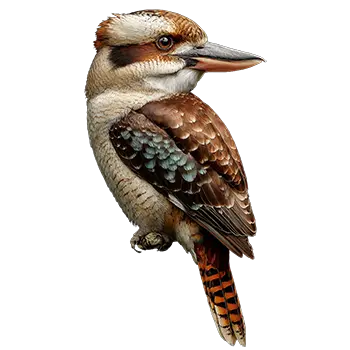

Origins & Evolutionary History

The kookaburra belongs to the family Alcedinidae, the tree kingfishers, a lineage whose evolutionary roots stretch back tens of millions of years to the ancient supercontinent of Gondwana. Fossil evidence and molecular phylogenetics place the divergence of the Dacelo genus, which contains all four recognized kookaburra species, within a broader radiation of Australasian kingfishers that began as Australia separated from Antarctica and drifted northward during the Eocene. Unlike most kingfishers, which are closely associated with aquatic habitats, the kookaburra lineage adapted to terrestrial hunting in open woodland and forest edges, a shift that would prove central to the bird's ecological success across the Australian continent.

The Laughing Kookaburra (Dacelo novaeguineae) is the largest and most widely recognized member of the genus. Its native range historically encompassed the eucalypt forests and open woodlands of eastern Australia, from Cape York in Queensland south through New South Wales and Victoria into South Australia. A second prominent species, the Blue-winged Kookaburra (Dacelo leachii), occupies the tropical and subtropical zones of northern Australia and extends into southern New Guinea. Two additional species, the Rufous-bellied Kookaburra (Dacelo gaudichaud) and the Spangled Kookaburra (Dacelo tyro), inhabit the lowland forests of New Guinea and nearby islands, though they are far less known outside ornithological circles.

The kookaburra's terrestrial hunting strategy represents a significant ecological departure from its aquatic kingfisher relatives. Rather than diving into water for fish, kookaburras hunt from elevated perches, swooping down to seize insects, lizards, snakes, small rodents, and occasionally small birds from the ground or low vegetation. This ambush predation style is supported by the bird's powerful bill, which functions as a versatile tool for crushing prey and dispatching venomous snakes by striking them against hard surfaces. The adaptation to dry-country hunting allowed kookaburras to colonize habitats that would be inhospitable to water-dependent kingfishers.

Australia's geological isolation over millions of years created the conditions for the kookaburra's diversification and ecological specialization. As the continent's climate shifted from the wet, forested conditions of the Miocene toward the drier, more open landscapes of the Pliocene and Pleistocene, kookaburras thrived in the expanding woodlands and savannas. Their territorial social structure, cooperative breeding behavior, and loud vocalizations all appear to be adaptations that emerged during this long period of co-evolution with the Australian landscape.

Indigenous Australian Significance

For Aboriginal and Torres Strait Islander peoples, the kookaburra has held deep cultural significance for tens of thousands of years. In many Indigenous Australian traditions, the kookaburra's dawn call is woven into creation narratives and serves as a marker of the transition between night and day. Among several language groups of southeastern Australia, the kookaburra's laugh is said to have been given to the bird by ancestral spirits as a signal to the sky people to light the great fire of the sun each morning. This association with the daily renewal of light positions the kookaburra as a cosmologically important figure rather than merely a familiar animal.

The bird appears in Dreaming stories across multiple regions and language groups, though the specific narratives vary considerably. In some traditions, the kookaburra is a trickster figure whose laughter carries moral lessons about pride, foolishness, or the consequences of breaking social rules. In others, it is a messenger or guardian whose call warns of danger or marks the boundaries of sacred country. The diversity of these stories reflects the broad geographic range of the Laughing Kookaburra and the many distinct cultural traditions that developed in parallel across the Australian continent.

Indigenous ecological knowledge about the kookaburra extends well beyond mythology. Aboriginal peoples have long understood the bird's role as a predator of snakes, insects, and other small animals, and its presence near campsites was often welcomed as a practical benefit. The kookaburra's territorial calls provided useful information about the structure of the local environment, since the birds' territories are relatively stable and their vocalizations mark boundaries that other species also recognize. This kind of deep observational knowledge, built over millennia, reflects a relationship with the kookaburra that is simultaneously spiritual, ecological, and practical.

It is important to acknowledge that the richness of Indigenous Australian relationships with the kookaburra cannot be fully captured in a general reference article. These traditions are living cultural systems, not historical artifacts, and many are held by specific communities with protocols governing their sharing. What can be said with certainty is that the kookaburra's place in Aboriginal and Torres Strait Islander cultures predates European contact by an almost incomprehensible span of time, making it one of the longest continuous cultural relationships between a human society and a specific bird species anywhere in the world.

European Encounter & Colonial Era

European awareness of the kookaburra began with the earliest colonial expeditions to the Australian continent. The Laughing Kookaburra was among the first Australian birds formally described by European naturalists, receiving its scientific name Dacelo novaeguineae from the German naturalist Hermann in 1783 — a name that contains a geographic error, since the Laughing Kookaburra is not native to New Guinea. The species epithet reflects the confusion that characterized early European attempts to classify the fauna of a continent whose wildlife was unlike anything previously encountered by Western science.

For the British colonists who arrived with the First Fleet in 1788 and in the waves of settlement that followed, the kookaburra's raucous dawn chorus was one of the most immediately striking features of the Australian soundscape. Early colonial accounts frequently describe the bird's call with a mixture of wonder and unease, comparing it to mocking human laughter echoing through unfamiliar bushland. The bird was given a variety of colloquial names by settlers, including "laughing jackass," "bushman's clock," and "breakfast bird," all of which reflect the dawn timing and carrying power of its territorial call.

As European settlement expanded, the kookaburra proved remarkably adaptable to the altered landscapes that followed. Unlike many native species that declined as forests were cleared for agriculture and pastoralism, the Laughing Kookaburra benefited from the creation of open, parklike landscapes with scattered trees — conditions that closely resembled its preferred woodland-edge habitat. The bird's willingness to hunt introduced prey species, including house mice, European starlings, and various invertebrates associated with agriculture, further cemented its place in the modified Australian landscape.

During the late 19th and early 20th centuries, Laughing Kookaburras were deliberately introduced to parts of Australia where they were not historically found, including Western Australia, Tasmania, and Kangaroo Island. These introductions were driven by a combination of nostalgia among settlers from the eastern states, a desire for natural pest control, and the general colonial-era enthusiasm for rearranging wildlife. While the introductions were largely successful in establishing breeding populations, they also created ecological problems, particularly in Tasmania and Western Australia, where kookaburras competed with and preyed upon native species that had not evolved alongside a large terrestrial kingfisher.

Taxonomy & Scientific Study

The taxonomic classification of kookaburras has undergone several revisions since Hermann's original 1783 description. The genus name Dacelo is itself an anagram of Alcedo, the Latin word for kingfisher, coined to reflect the kookaburra's kinship with the broader kingfisher family while acknowledging its distinctly un-kingfisher-like habits. Modern molecular phylogenetics has confirmed the placement of Dacelo within the Halcyonidae, or tree kingfishers, and has clarified the relationships among the four recognized species. The Laughing Kookaburra and Blue-winged Kookaburra are sister species, as are the Rufous-bellied and Spangled Kookaburras, with the two pairs having diverged from a common ancestor several million years ago.

Scientific interest in kookaburra behavior accelerated in the mid-20th century, particularly through studies of their cooperative breeding system. Kookaburras are among a relatively small number of bird species in which offspring from previous breeding seasons remain with the family group to help raise subsequent broods. This helper-at-the-nest behavior, first systematically studied in the Laughing Kookaburra by Australian ornithologists in the 1970s and 1980s, contributed significantly to the development of cooperative breeding theory in evolutionary biology. Research demonstrated that helpers increase the survival rate of nestlings and that the decision to help or disperse is influenced by territory quality, environmental conditions, and the availability of breeding vacancies.

The kookaburra's famous laugh has also been a subject of scientific investigation. Acoustic analysis has revealed that the call is a complex, structured vocalization used primarily for territorial defense and group cohesion. Family groups engage in coordinated chorus calling, typically at dawn and dusk, with the combined volume serving to advertise territorial boundaries to neighboring groups. Studies have shown that individual kookaburras can be identified by their call signatures and that the structure of the chorus conveys information about group size, which deters potential intruders without the need for physical confrontation.

More recent research has explored the kookaburra's sensory ecology, predatory efficiency, and physiological adaptations to the variable Australian climate. Studies on thermoregulation have documented the bird's strategies for coping with extreme heat, including behavioral adjustments such as seeking shade, reducing activity during peak temperatures, and panting. Other work has investigated the biomechanics of the kookaburra's strike, which involves a rapid downward swoop and a forceful impact that can kill prey instantly. These studies have deepened the scientific understanding of a bird that, despite its familiarity, continues to reveal new dimensions of biological complexity.

National Symbol & Identity

The kookaburra's emergence as a symbol of Australian national identity is a relatively modern phenomenon, though it builds on centuries of cultural familiarity. By the early 20th century, the Laughing Kookaburra had become one of the most recognizable and widely depicted Australian animals, featured on postcards, stamps, and decorative objects aimed at both domestic and international audiences. Its cheerful, irreverent-sounding call resonated with a national self-image that valued humor, resilience, and a certain larrikin spirit, and the bird became an informal emblem of Australianness long before it received any official designation.

The kookaburra received its most prominent moment on the world stage as one of the three mascots of the 2000 Sydney Olympic Games. Named Olly, the kookaburra mascot stood alongside a platypus and an echidna as representatives of the Australian landscape and spirit. The choice reflected the bird's status as an animal that virtually every Australian could identify and that carried positive, welcoming associations for an international audience. The mascot's popularity further cemented the kookaburra's place in the national iconography and introduced the bird to millions of people worldwide who might never have encountered it otherwise.

The bird has also appeared on Australian currency, most notably on a long-running series of silver bullion coins produced by the Perth Mint. The Australian Kookaburra silver coin, first issued in 1990, features a new kookaburra design each year and has become one of the most collected bullion series in the world. The coin's international popularity has made the kookaburra an unlikely ambassador for Australian numismatics, connecting the bird to global precious-metals markets in a way that its colonial-era admirers could never have anticipated.

Beyond official and commercial uses, the kookaburra functions as an everyday cultural touchstone in Australian life. Its call is one of the most commonly used sound effects in Australian broadcasting, its image appears on everything from tea towels to craft beer labels, and its name has been adopted by sports teams, businesses, and community organizations across the country. This saturation-level presence reflects a genuine popular affection for the bird that transcends regional, demographic, and political boundaries, making the kookaburra one of the few Australian animals whose cultural significance rivals that of the kangaroo or koala.

The Kookaburra Today

The Laughing Kookaburra remains one of the most abundant and visible native birds in eastern Australia, a status that is by no means guaranteed for Australian wildlife in an era of unprecedented ecological change. The species' adaptability to suburban and agricultural landscapes has buffered it against some of the habitat loss that has devastated other woodland birds, and its populations are currently assessed as stable across most of its natural range. However, this apparent resilience should not obscure the pressures that kookaburras face, including the loss of large nesting hollows due to the removal of mature trees, predation by introduced species such as foxes and feral cats, and the broader impacts of climate change on the invertebrate and reptile communities that form the base of the kookaburra's diet.

In the areas where kookaburras were introduced during the 19th and early 20th centuries, particularly Tasmania and parts of Western Australia, the species' status is more ecologically complicated. Tasmanian conservation authorities have expressed concern about the kookaburra's impact on native birds and invertebrates in that state, where it is considered an invasive species despite being native to the Australian mainland. This dual status — beloved icon in one jurisdiction, ecological threat in another — encapsulates the complexities of wildlife management in a country where state boundaries do not align with ecological ones.

The kookaburra's relationship with suburban Australians continues to evolve. In many neighborhoods, kookaburras are bold enough to take food from outdoor dining areas and barbecues, a behavior that endears them to some residents and frustrates others. Wildlife authorities encourage people to avoid feeding kookaburras processed human food, which can cause nutritional deficiencies and dependency, and instead to appreciate the birds' natural hunting behavior. Community education programs and urban wildlife initiatives have helped foster coexistence, though tensions between wildlife conservation and suburban development remain an ongoing challenge.

Looking forward, the kookaburra's future in a warming Australia is a subject of active research and concern. Climate projections suggest that rising temperatures and changing rainfall patterns may alter the distribution and abundance of the prey species on which kookaburras depend, potentially shifting the bird's range or reducing its reproductive success in marginal habitats. At the same time, the kookaburra's behavioral flexibility, its ability to exploit a wide range of prey, habitats, and conditions, suggests that it is better positioned than many Australian birds to weather the changes ahead. The kookaburra's history is one of adaptation, and its continued presence in the Australian landscape will depend on whether that adaptability can keep pace with the scale and speed of 21st-century environmental change.

Always consult a qualified professional before making any health-related decisions. This content is provided for informational reference only and should not replace professional guidance specific to your animal.