
Origins & Breed Development

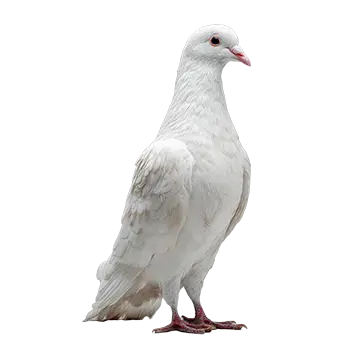
The King Pigeon is a breed of domestic pigeon (Columba livia domestica) that was developed in the United States during the late 19th and early 20th centuries. Breeders sought to create a large-bodied, broad-breasted pigeon ideally suited for commercial squab production, and they achieved this by crossing several established European utility breeds including the Duchess, the Homer, and the Runt. The result was a bird of exceptional size and meatiness that quickly gained favor among squab farmers across the country.

The breed's formal recognition came in stages. Early breeders worked largely through regional poultry and pigeon associations, refining the King's conformation toward a compact, heavily muscled body with a relatively short neck and wide stance. By the 1920s and 1930s, the King Pigeon had established itself as the dominant commercial squab breed in North America. Squab production was a meaningful segment of the American poultry industry at the time, supplying upscale restaurants and urban markets with a delicacy that had long been associated with European fine dining.

Two distinct lines emerged as the breed matured. The Utility King was optimized for rapid growth, high feed conversion, and prolific breeding, traits essential to commercial viability. The Show King, by contrast, was bred for conformation aesthetics, with emphasis on a broad, rounded breast, clean head profile, and overall symmetry. While both lines share a common ancestry, decades of selective pressure have produced notable divergences in body type, temperament, and flight capability between the two strains.

The King Pigeon's development coincided with a broader period of innovation in American animal husbandry, during which scientific breeding principles were increasingly applied to poultry and livestock. The breed stands as a testament to that era's ambition to engineer animals for specific commercial purposes, an ambition whose consequences for the birds themselves would become a subject of growing concern in the decades that followed.

Historical Role in Squab Production

Squab, the culinary term for a young pigeon harvested before it fledges, has been a valued food source across many cultures for centuries. In ancient Egypt, Rome, and medieval Europe, pigeon keeping for meat was a widespread practice, and purpose-built dovecotes were architectural features of estates and monasteries. The King Pigeon inherited this deep culinary tradition and carried it into the industrial age, becoming the primary breed raised for squab in the United States for much of the 20th century.

At the height of American squab production, large-scale King Pigeon operations could be found across the Eastern Seaboard and in California. Breeding pairs were housed in lofts and produced multiple clutches per year, with squabs reaching market weight of approximately one pound at roughly four weeks of age. The King's docile temperament and willingness to breed prolifically in confined settings made it exceptionally well suited to this intensive production model. Industry literature from the period often touted the breed's feed efficiency and the premium prices that squab commanded compared to chicken or turkey.

The industry experienced a gradual decline beginning in the mid-20th century as consumer tastes shifted and the economics of poultry production favored faster-growing chicken breeds raised at far greater scale. Squab transitioned from a relatively common menu item to a specialty product found primarily in high-end restaurants, ethnic food markets, and farm-to-table establishments. This contraction left large numbers of King Pigeons without a commercial purpose, a development that would have profound implications for the breed's future identity.

Despite its reduced commercial footprint, squab production using King Pigeons persists on a smaller scale in several regions. Some heritage poultry enthusiasts and small-scale farmers continue to raise Kings for squab, emphasizing the product's culinary distinction and the breed's deep roots in American agricultural history. These operations exist alongside a growing movement that views the King Pigeon through an entirely different lens, not as livestock but as a companion animal deserving of care and protection.

Cultural Symbolism & the Domestic Pigeon Tradition

Pigeons as a family occupy a distinctive place in human cultural history that stretches back at least five thousand years. The domestic pigeon is among the oldest domesticated birds, with archaeological evidence of pigeon keeping found in Mesopotamian and Egyptian sites dating to the third millennium BCE. Throughout this long shared history, pigeons have served as messengers, religious symbols, food sources, and companions. The King Pigeon, though a relatively modern breed, inherits and embodies this rich tradition in its physical form and its relationship to the people who keep it.

In many cultures, white pigeons and doves carry powerful symbolic associations with peace, purity, and the divine. The white King Pigeon, which is the most common color variety, frequently finds itself cast in ceremonial roles that draw on these associations. Wedding releases and memorial ceremonies have historically used white pigeons as living symbols, though this practice has become a subject of ethical controversy as awareness has grown that domestically bred King Pigeons lack the homing instinct and flight stamina necessary to survive after release.

The broader pigeon fancy, the community of breeders who raise pigeons for exhibition, competition, and personal enjoyment, has deep cultural roots in Europe, the Middle East, and Asia. Within this tradition, the King Pigeon occupies a respected position as both a utility breed and a show bird. National and regional pigeon clubs hold exhibitions where Show Kings are judged against a written standard of perfection, and dedicated breeders invest years in refining their flocks. This exhibition culture represents a continuation of practices that date back centuries and connects modern King Pigeon enthusiasts to a lineage of pigeon keepers that spans continents and millennia.

The cultural significance of the King Pigeon has shifted markedly in recent decades. Where the breed was once valued primarily for its productivity, it is now increasingly appreciated for its gentle disposition and trusting nature. This transition from agricultural commodity to companion animal mirrors broader cultural changes in how Western societies relate to domesticated animals, and the King Pigeon has become something of a case study in that evolving relationship.

The Rise of King Pigeon Rescue

One of the most significant chapters in the King Pigeon's cultural history is the emergence of a dedicated rescue and adoption movement that began gaining momentum in the early 2000s. As commercial squab production continued to contract, surplus King Pigeons increasingly appeared at animal shelters, in parks, and on city streets where they were wholly unable to fend for themselves. Unlike feral pigeons, which are descendants of free-living domestics that have adapted to urban environments over many generations, King Pigeons are too large, too conspicuous, and too poor at flying to survive without human care.

Pigeon rescue organizations, most notably Palomacy Pigeon and Dove Adoptions in the San Francisco Bay Area, began systematically rescuing, rehabilitating, and rehoming King Pigeons. These organizations developed foster networks, adoption protocols, and educational campaigns that challenged prevailing attitudes toward pigeons as pests or nuisances. Their work revealed a bird that was docile, affectionate, and remarkably well suited to indoor companionship, qualities that had been overshadowed by the breed's utilitarian origins.

The rescue movement also drew attention to the ethical dimensions of ceremonial pigeon releases. Advocates documented the fate of King Pigeons released at weddings and events, many of which were found injured, starving, or dead within days of release. This advocacy led to increased public scrutiny of the release industry and prompted some event planners and venues to discontinue the practice. The issue became a rallying point that connected King Pigeon welfare to broader conversations about the responsible treatment of domesticated animals.

Today, King Pigeon rescue operates through a network of shelters, sanctuaries, and individual foster homes across North America and parts of Europe. The birds are adopted as indoor companions, often kept in large flight enclosures or given supervised outdoor time. Social media has played a significant role in popularizing King Pigeon adoption, with accounts dedicated to rescued pigeons attracting substantial followings and introducing the breed to audiences who might never have considered a pigeon as a pet.

Scientific & Behavioral Study

The domestic pigeon, including the King variety, holds a distinguished place in the history of biological science. Charles Darwin devoted extensive study to domestic pigeon breeds in the development of his theory of natural selection, using the dramatic morphological variation among pigeon breeds as evidence that selective breeding could produce profound physical changes within a single species. While Darwin worked primarily with breeds such as the Fantail, Pouter, and Tumbler, the principles he demonstrated apply directly to the King Pigeon's own development through deliberate human selection.

Behavioral research involving domestic pigeons has generated foundational knowledge in psychology and neuroscience. B.F. Skinner's operant conditioning experiments, which used pigeons as subjects extensively throughout the mid-20th century, established principles of learning theory that remain central to behavioral science. While laboratory research typically employed homing-type pigeons rather than Kings specifically, the King Pigeon's calm temperament and tolerance of handling have made it a useful subject in studies of avian cognition, social behavior, and stress physiology conducted at universities and research institutions.

More recent scientific attention has focused on the welfare implications of breeding for extreme commercial traits. The King Pigeon's heavy body and reduced flight capability raise questions that parallel ongoing research into welfare compromises in broiler chickens and other production-bred poultry. Veterinary researchers have examined the orthopedic, respiratory, and reproductive challenges that King Pigeons may face as a consequence of their breeding history, contributing to a growing body of literature on the welfare costs of selective breeding in domestic birds.

The King Pigeon has also contributed to citizen science and observational research through the rescue community. Experienced rehabbers and foster caregivers have documented behavioral repertoires, social dynamics, and health patterns in rescued Kings, providing practical knowledge that complements formal academic study. This grassroots data collection reflects a collaborative relationship between scientific institutions and the volunteer networks that interact with King Pigeons daily.

The King Pigeon Today

The King Pigeon occupies a unique and evolving position in the landscape of domestic birds today. It is simultaneously a heritage agricultural breed, an active exhibition bird, and a growing presence in the companion animal world. This multifaceted identity sets the King apart from most other pigeon breeds and creates a community of keepers whose motivations and perspectives are remarkably diverse.

In the show world, the King Pigeon continues to attract dedicated breeders who work toward the breed standard maintained by organizations such as the National Pigeon Association in the United States. Show Kings are evaluated on criteria including body type, carriage, head shape, eye color, and feather quality. Competition at national and regional shows remains active, and the breed regularly appears among the winners at major exhibitions. For these breeders, the King represents a living art form shaped by generations of careful selection.

The companion pigeon movement represents the most rapidly growing segment of King Pigeon keeping. Adoption organizations report steady increases in applications from individuals and families seeking pigeons as indoor pets. King Pigeons are valued in this context for their quiet cooing, their willingness to perch on laps and shoulders, and their relatively low-maintenance care requirements compared to parrots and other hookbills. The breed's gentle nature makes it particularly suitable for households with children or other pets, and many adopters describe a bond with their pigeons that rivals the companionship offered by more traditional pets.

Looking forward, the King Pigeon's trajectory appears to be one of continued diversification. The breed's agricultural heritage is preserved by a dedicated core of squab producers and heritage poultry advocates. Its show tradition endures through the pigeon fancy. And its role as a companion animal continues to expand, driven by rescue organizations, social media visibility, and a growing cultural willingness to reconsider which animals deserve care, attention, and a place in the home. The King Pigeon's story is one of reinvention, a breed shaped by human purposes that is now finding new meaning in an era of changing values.

Always consult a qualified professional before making any health-related decisions. This content is provided for informational reference only and should not replace professional guidance specific to your animal.