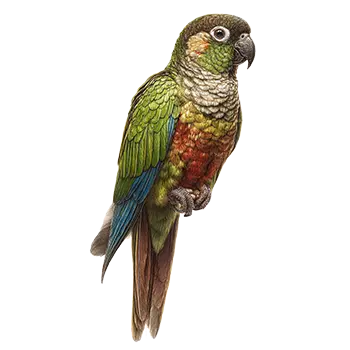

The Green-Cheeked Conure (Pyrrhura molinae) is a small parrot native to the forested regions of central and southern South America. Its range extends across a broad arc from western Brazil through Bolivia, northwestern Argentina, and into western Paraguay, where it inhabits subtropical and tropical moist forests, deciduous woodland edges, and transitional zones between dense forest and more open scrubland. The species occupies elevations from near sea level to approximately 3,000 meters in the eastern foothills of the Andes, demonstrating a notable adaptability to varying altitudes and forest types.
Within this range, the Green-Cheeked Conure favors the canopy and mid-story of forest habitat, where it forages for seeds, fruits, flowers, and occasionally insects. The bird is almost always encountered in flocks, typically numbering between 10 and 20 individuals, though larger aggregations have been observed at favored feeding sites and communal roosts. This gregarious nature is central to the species' ecology and behavior, shaping its vocalizations, social bonds, and roosting habits in ways that would later translate directly into its behavior in captive settings.
Six subspecies of Pyrrhura molinae are generally recognized by taxonomists, each exhibiting subtle differences in plumage coloration, particularly on the breast, tail, and flight feathers. These subspecies correspond roughly to geographic populations separated by river systems, mountain ranges, and habitat discontinuities across the species' range. The nominate subspecies, P. m. molinae, is found in eastern Bolivia and adjacent Brazil, while other forms such as P. m. australis in Argentina and P. m. restricta in limited regions of Bolivia represent localized populations that have diverged over time.
The forest ecosystems that support wild Green-Cheeked Conure populations have faced increasing pressure from agricultural expansion, logging, and land conversion throughout the 20th and 21st centuries. While the species is not currently considered globally threatened, regional declines have been documented in areas where habitat fragmentation has reduced the availability of mature trees suitable for nesting cavities. This ongoing ecological context provides the backdrop against which the Green-Cheeked Conure's transition from wild bird to global companion species has unfolded.