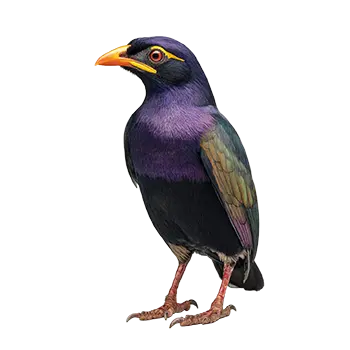

The Greater Hill Mynah has occupied a distinctive place in the literary traditions of South and Southeast Asia for centuries. In classical Sanskrit and Pali literature, the mynah's vocal abilities served as a recurring motif in poetry, drama, and philosophical discourse. Indian poets employed the bird as a symbol of eloquence, devotion, and the ambiguity of imitation, exploring whether a voice that perfectly copies another possesses its own form of meaning. The mynah appears in courtly poetry traditions across multiple Indian language literatures, including Tamil, Telugu, and Hindi, where it is frequently cast as a messenger or confidant whose speech bridges the gap between lovers, rulers, or the human and divine realms.
In Western literature, the mynah bird entered the popular imagination primarily through colonial-era travel writing and natural history accounts. British and Dutch naturalists stationed in India and Southeast Asia during the 18th and 19th centuries wrote extensively about the species, often devoting detailed passages to specific birds they had observed or kept. These accounts, published in journals and books that circulated widely among educated European audiences, established the hill mynah as the paradigmatic talking bird in the Western imagination, a position that parrots would later come to dominate but never entirely displace.
The 20th century brought the Greater Hill Mynah into the realm of modern fiction and philosophical literature. Aldous Huxley featured mynah birds in his novel Island, published in 1962, where they serve as a recurring symbolic device. The birds in Huxley's utopian society are trained to repeat phrases such as "Attention" and "Here and now, boys," functioning as living reminders of mindfulness and present-moment awareness. This literary use of the mynah drew directly on the species' real-world vocal abilities and introduced it to a global readership that might otherwise have known little about the bird.
Beyond Huxley, the mynah has appeared in short fiction, poetry, and essays by writers across multiple traditions. The bird's mimicry raises questions about authenticity, identity, and the nature of communication that have proven irresistible to literary minds. Whether deployed as a comic device, a philosophical provocation, or a symbol of the natural world's strangeness, the Greater Hill Mynah's presence in literature reflects a sustained human fascination with the implications of a non-human voice that sounds perfectly human.