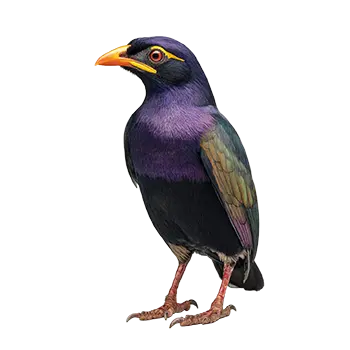

Origins & Natural Habitat

The Greater Hill Mynah (Gracula religiosa) is native to the hill forests of South and Southeast Asia, inhabiting a broad geographic range that stretches from the Western Ghats and Sri Lanka through Nepal, northeastern India, Bangladesh, Myanmar, Thailand, the Malay Peninsula, and into the Indonesian archipelago and the Philippines. Within this range, several subspecies have been recognized, differing primarily in body size and the configuration of the fleshy yellow wattles that adorn the sides and nape of the head. The species occupies a distinct ecological niche in the middle and upper stories of humid tropical and subtropical forests, typically at elevations between 300 and 2,000 meters.

In its native habitat, the Greater Hill Mynah is a frugivorous bird with a strong preference for figs, berries, and other soft fruits, supplemented by nectar, flower buds, and occasional insects. It forages in small, noisy flocks that move through the canopy in search of fruiting trees, and its loud, clear calls are among the most recognizable sounds of the Asian hill forests. These vocalizations, which include a remarkable range of whistles, warbles, and ringing notes, are produced by a highly developed syrinx and serve territorial, social, and pair-bonding functions.

The species nests in natural tree cavities, often in tall, dead or dying trees along forest edges and riverbanks. Breeding pairs defend their nest sites vigorously and typically produce two to three eggs per clutch. The dependence on large, mature trees for nesting has made the Greater Hill Mynah particularly sensitive to deforestation and selective logging, which have reduced the availability of suitable cavities across much of its range. This ecological vulnerability would eventually intersect with human demand for the species in ways that shaped both its cultural history and its conservation trajectory.

Paleornithological and genetic evidence places the Sturnidae family, to which the hill mynahs belong, as originating in Asia, with diversification occurring across the region over millions of years. The genus Gracula appears to have diverged from related starling lineages relatively recently in evolutionary terms, developing the distinctive wattle structures and vocal capabilities that would later make it so attractive to human admirers. By the time human civilizations arose across the species' range, the Greater Hill Mynah was already a conspicuous and acoustically dominant presence in the forests of southern Asia.

Early History with Humans

The Greater Hill Mynah's relationship with human societies extends back thousands of years across South and Southeast Asia. In ancient India, the bird was known in Sanskrit literature as the "shariKa" or a related term, and its remarkable ability to reproduce the human voice was noted by scholars and poets well before the common era. Hindu and Buddhist texts contain references to the mynah's vocal gifts, often associating the bird with divine communication or spiritual messengers. In the Jataka tales, stories of the Buddha's previous lives, talking birds including mynahs appear as characters whose speech carries moral instruction.

The practice of keeping Greater Hill Mynahs as caged companions is documented in Indian, Thai, and Malay court records stretching back many centuries. Indian royalty and wealthy merchants prized the birds for their ability to reproduce phrases, songs, and even the tonal inflections of their keepers' voices with a clarity that surpassed parrots. Unlike most parrots, whose speech retains a distinctly avian quality, the hill mynah's mimicry replicates the pitch, resonance, and timbre of the human voice so faithfully that listeners often cannot distinguish the bird's reproduction from the original speaker. This extraordinary fidelity made the mynah a status symbol in courts from the Chola dynasty of southern India to the palaces of Ayutthaya in Siam.

European explorers and colonial naturalists first encountered the Greater Hill Mynah during the 16th and 17th centuries, and their accounts consistently emphasized the bird's vocal abilities as something qualitatively different from any European cage bird. Portuguese, Dutch, and British traders operating in the Indian Ocean region quickly recognized the species' commercial value, and by the 18th century, hill mynahs were being transported westward as luxury curiosities. The birds became fashionable in the drawing rooms of colonial administrators and European collectors, where their mimicry astonished guests accustomed to the more mechanical repetitions of Common Mynahs and parakeets.

The colonial period also brought the first systematic efforts to document the species scientifically. Linnaeus described Gracula religiosa in 1758, and the specific epithet "religiosa" reflects early European observations of the bird's association with Hindu temples and religious life in India. Subsequent naturalists, including Jerdon and Blyth in British India, provided detailed field accounts of the species' behavior, distribution, and subspecific variation that remain valuable references today. This period established the Greater Hill Mynah as a species of both scientific and commercial interest, setting the stage for the global pet trade that would follow.

Cultural Symbolism & Folklore

Throughout South and Southeast Asia, the Greater Hill Mynah carries rich symbolic associations that reflect its unique vocal gifts. In Hindu tradition, the bird has been linked to Saraswati, the goddess of knowledge, music, and speech, and its ability to reproduce human language has been interpreted as a manifestation of divine eloquence. In parts of southern India and Sri Lanka, hearing a hill mynah call near a home was historically considered an auspicious sign, and the bird's presence in temple precincts was welcomed as a natural embellishment of sacred space.

In Thai culture, the Greater Hill Mynah holds a particularly prominent position. Known locally as "nok khiao," the species has been a favored pet of the Thai royal household for centuries, and competitions in mynah mimicry and song have a long tradition in Thai society. Skilled birds that can reproduce complex phrases or musical passages with exceptional clarity command significant prestige and monetary value. The cultural infrastructure surrounding mynah keeping in Thailand, including specialized diet formulations, training methods, and competitive events, is more elaborate than in any other country within the species' range.

In Malay and Indonesian folklore, the hill mynah sometimes appears as a forest spirit or a voice of the jungle that can lure unwary travelers deeper into the wilderness. This trickster archetype reflects the uncanny quality of the bird's mimicry when encountered in a dense forest setting, where its faithful reproduction of human sounds can genuinely confuse and disorient listeners. In some traditions, the mynah's voice is thought to carry messages from deceased ancestors or forest deities, lending the bird a liminal quality that positions it between the human and spirit worlds.

Beyond Asia, the Greater Hill Mynah has acquired symbolic resonance in Western culture primarily through its association with the concept of perfect imitation. Writers, philosophers, and cognitive scientists have invoked the species in discussions about the nature of language, the distinction between mimicry and understanding, and the boundaries of animal cognition. The mynah's voice raises a question that has fascinated human listeners for millennia: when a bird reproduces your words with such fidelity that the copy is indistinguishable from the original, what exactly is happening in the mind of the mimic?

Scientific Study & Recognition

The Greater Hill Mynah has been a subject of scientific interest since Linnaeus first classified it within the Linnaean system in 1758. Early taxonomic work focused on delineating the various subspecies distributed across the species' vast Asian range, with ornithologists recognizing differences in body size, wattle configuration, and plumage sheen among populations from the Western Ghats, the Himalayas, mainland Southeast Asia, and the Indonesian islands. The resulting subspecific taxonomy remains somewhat contested, with some authorities recognizing as many as a dozen subspecies while others consolidate several of these into broader groupings.

The species gained particular scientific attention in the mid-20th century when researchers began systematically studying its vocal mimicry. Bioacoustic analyses confirmed what casual listeners had long observed: the Greater Hill Mynah reproduces human speech with a fidelity unmatched by any parrot species. Spectrographic studies demonstrated that the bird's reproductions preserve not only the phonemic structure of words but also the fundamental frequency, harmonic content, and prosodic contours of the original speaker's voice. This level of acoustic precision is made possible by an exceptionally muscular and flexible syrinx, combined with a vocal tract that can be dynamically reshaped to produce a wide range of resonance patterns.

Research into the cognitive dimensions of hill mynah vocalization has produced more complex and sometimes contentious results. While the species is clearly an extraordinary mimic, the question of whether its reproductions involve any semantic comprehension remains open. Studies conducted in controlled laboratory settings have shown that hill mynahs can learn to associate specific vocalizations with contexts, such as producing a greeting when a keeper enters the room, but whether this represents conditioned association or something closer to referential communication is still debated. The species has not been subjected to the kind of intensive, decades-long cognitive research program that was applied to the African Grey Parrot through the Alex studies.

Conservation science has also turned its attention to the Greater Hill Mynah in recent decades. Population surveys conducted across the species' range have documented significant declines in several regions, driven by a combination of habitat loss and capture for the pet trade. The species was listed under Appendix II of CITES in the 1990s, and several range states have enacted domestic protections. Field studies tracking population trends, breeding success, and the impact of trade have provided data that inform both national management plans and international policy discussions about the sustainable use of wild bird populations.

The Species Today

Today the Greater Hill Mynah occupies a somewhat paradoxical position in global aviculture. It remains one of the most admired and sought-after cage birds in the world, prized for vocal abilities that no other species can match, yet its availability in legitimate trade has become increasingly constrained as wild populations have declined and regulatory frameworks have tightened. In the United States and Europe, captive-bred Greater Hill Mynahs are available but far less common than they were during the peak decades of the exotic bird trade in the 1960s and 1970s. Prices for well-socialized, hand-raised birds are correspondingly high, and prospective keepers often face long waiting lists from reputable breeders.

In Southeast Asia, the Greater Hill Mynah continues to hold deep cultural importance, particularly in Thailand, where mynah keeping remains an active tradition with organized competitions and a dedicated community of enthusiasts. Thai breeders have developed sophisticated husbandry protocols that emphasize diet, vocal training, and socialization from a young age, producing birds capable of remarkably clear and extensive mimicry. The Thai avicultural tradition represents one of the most developed bodies of practical knowledge about the species anywhere in the world, though much of it remains oral and has not been systematically documented in scientific literature.

Captive care for the Greater Hill Mynah has evolved considerably from the seed-and-fruit diets and small wire cages that characterized earlier decades. Modern best practices emphasize spacious flight enclosures, iron-supplemented softbill diets to prevent the hemochromatosis to which the species is prone, and extensive social interaction. The bird's intelligence and social nature mean that it requires significant daily engagement with its keeper to remain psychologically healthy; understimulated hill mynahs are prone to stereotypic behaviors, feather condition issues, and withdrawal.

Conservation efforts for wild populations of the Greater Hill Mynah have intensified in recent years. Several range countries have implemented stricter enforcement against poaching and illegal trade, and community-based conservation programs in India, Thailand, and Indonesia are working to protect nesting habitat and establish sustainable management frameworks. Captive breeding programs focused on conservation rather than the pet trade have also been launched at several zoological institutions. The species' long-term future in the wild will depend on the success of these efforts in balancing the cultural demand for hill mynahs with the ecological needs of declining wild populations.

Notable Individuals & Lasting Legacy

While the Greater Hill Mynah has not produced a single internationally famous individual on the scale of Alex the African Grey, numerous individual birds have achieved regional celebrity and contributed to public appreciation of the species. In Thailand, champion mynahs that excel in competitive mimicry events are widely known within the avicultural community and can be valued at extraordinary sums. These competition winners are celebrated in Thai media and serve as ambassadors for a centuries-old cultural tradition that connects modern enthusiasts with the royal courts of old Siam.

In Western aviculture, individual hill mynahs have occasionally gained media attention for the quality and humor of their mimicry. Birds that faithfully reproduce telephone rings, laughter, or the voices of family members have been featured in television segments and viral internet videos, introducing the species to audiences unfamiliar with its remarkable abilities. While such attention is often lighthearted, it has played a genuine role in raising awareness of the Greater Hill Mynah among potential keepers and supporters of avian conservation.

The species' legacy in zoological collections has also been noteworthy. Several prominent zoos, including institutions in Singapore, London, and San Diego, have maintained Greater Hill Mynahs in educational exhibits that highlight avian vocal learning and the broader biology of the starling family. These exhibits have introduced millions of visitors to the bird's extraordinary voice and have often served as launching points for discussions about tropical forest conservation, the ethics of the wildlife trade, and the cognitive lives of birds.

The Greater Hill Mynah's enduring appeal lies in a single, deceptively simple quality: the uncanny perfection of its voice. Unlike parrots, which speak in recognizably avian tones, the hill mynah produces sounds that are functionally identical to their human originals. This gift has made the species a cultural touchstone across civilizations, a scientific puzzle that continues to challenge researchers, and a companion animal that forms unusually deep communicative bonds with its keepers. Whether in the mist-shrouded forests of the Western Ghats or the living room of a devoted aviculturist, the Greater Hill Mynah's voice remains one of the most remarkable phenomena in the natural world.

Always consult a qualified professional before making any health-related decisions. This content is provided for informational reference only and should not replace professional guidance specific to your animal.